It was in Sweden, I think, that the unique nature of America first dawned on me.I was 21, a counselor in a Jewish overnight camp held in the town of Skara, about an hour and a half northeast of Gothenburg. By that point I had traveled widely, but there was something particularly clarifying about those weeks spent wandering the beautiful Västra Götaland countryside, campers in tow: the Swedes, I came to realize, were a tribe. Blonde and blue-eyed, quiet, polite and austerely clean, they looked and acted similar to one another because, well, they were.
By Dovid Margolin
I, a Jew, could not become a Swede any more than I could become a Martian. Only Swedes can be Swedes.Not so America. There is no homogenous American tribe and there never was. This I instinctively understood from my own hometown of Boston, where the descendants of the Mayflower were joined rather famously by the Irish. Are the Cabots and Lodges any more Bostonian, or American for that matter, than the Kennedys or Flynns?
Of course not; while the Irish, like every new group that arrived in the United States, faced their own set of challenges, the underlying ethos of the American republic—the truths held to be “self-evident” by the Founding Fathers, namely “that all men are created equal, that they are endowed by their Creator with certain unalienable Rights, that among these are Life, Liberty and the pursuit of Happiness”—has always, in the end, won the day.
Into this same great melting pot stepped the Jews, who, though involved in the American experiment from the start, began arriving en masse in the 1880s and ultimately thrived in ways unknown to history. Just as the Irish could become real Americans, along with the Italians, Greeks and Japanese, so could the Jews, each contributing in their own way to the broader culture.
That is the beauty of America: E Pluribus Unum—Out of many, one.

Indeed, the Rebbe, Rabbi Menachem M. Schneerson, of righteous memory, pointed to this unique American phenomenon when explaining the importance of erecting a Chanukah menorah in public spaces. The public menorah, he wrote in late 1981, had brought many “a sense of pride in their Yiddishkeit [Judaism], and the realization that there is no reason, really, in this free country, to hide one’s Jewishness, as if it were contrary or inimical to American life and culture.
On the contrary, it is fully in keeping with the American national slogan ‘E Pluribus Unum’ and the fact that American culture has been enriched by the thriving ethnic cultures which contributed very much, each in its own way, to American life, both materially and spiritually.”But historically many Jewish immigrants struggled with this idea, as did their children after them.
They thought that becoming an American required shedding their own identity and disappearing into the wider culture. Sensitive to the dangers of persecution, for obvious reasons, Jews often arrived in the United States intent on leaving their Judaism behind. Some abandoned it altogether, while others felt the need to at the very least soften its intensity and fervor, modernizing or reforming it to fit what they thought of as the American way. Jewish life in America, already missing the deep roots of history it had enjoyed in the Old World, suffered deeply as a result.
It was this spiritual malaise that the Rebbe’s father-in-law, the Sixth Rebbe—Rabbi Yosef Yitzchak Schneersohn, of righteous memory—sought to correct when he arrived in New York City from Nazi-occupied Europe on a windswept March morning in 1940. “America iz nit andersh,” he declared immediately upon disembarkation. “America is not different.”Rabbi Yosef Yitzchak would dedicate the last decade of his life on earth to changing “the whole panorama of Jewish life in the so-called New World,” the Rebbe explained in a 1983 letter to the film producer Jerry Weintraub.
What precisely did Rabbi Yosef Yitzchak mean by these words? “[That] the New World was neither ‘new’ nor any different from the ‘Old’ – insofar as [Judaism] is concerned; that there is no need, nor any real excuse, to make any concession in regard to any aspect of the Jewish way of life that our parents and forebears upheld so tenaciously for thousands of years back home in the ‘Old World.’”1
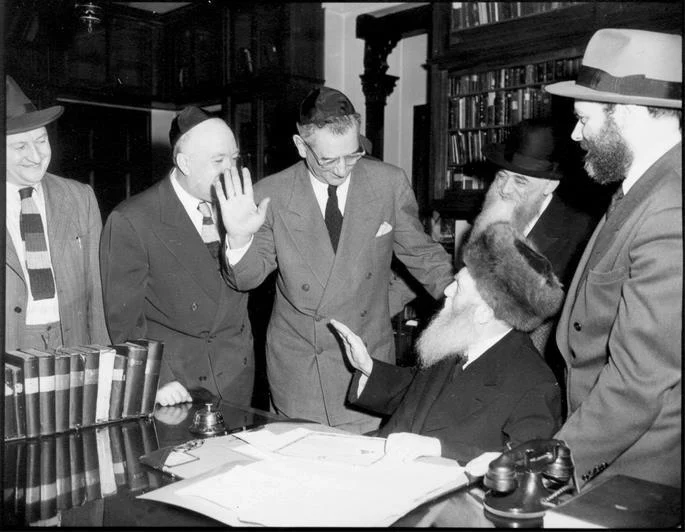
The Rebbe, Rabbi Menachem M. Schneerson, of righteous memory, (far right) looks on as his father-in-law the Sixth Rebbe, Rabbi Yosef Yitzchak Schneersohn, of righteous memory, becomes a citizen of the United States, March 17, 1949. “America iz nit andersh,” the Sixth Rebbe had declared upon his arrival in New York. “America is not different.” [Library of Agudas Chasidei Chabad]
Rabbi Yosef Yitzchak had faced Czarist oppression in his younger years, later surviving Communist imprisonment and torture. He had only barely escaped Hitler’s Europe. The Rebbe had similarly lived through pogroms as a child and knew first-hand the horrors of the Old World, suffering the death of his father in Soviet exile and the murder of his brother and grandmother at the hands of the Germans.All of which begs the question: Is America actually different, as the Rebbe appears to imply when extolling “this free country,” or is it in fact no different at all?
New Frontier
Perhaps the best place to start looking for an answer is a cold winter’s night in 1975. That evening the Rebbe delivered what might be called a landmark talk on America, exploring what drove the Pilgrims’ arrival here, the Founding Fathers who established the republic, America’s foundational ideals, her relationship with the Jewish people, kinship with the People of Israel, and its singular role in world history.
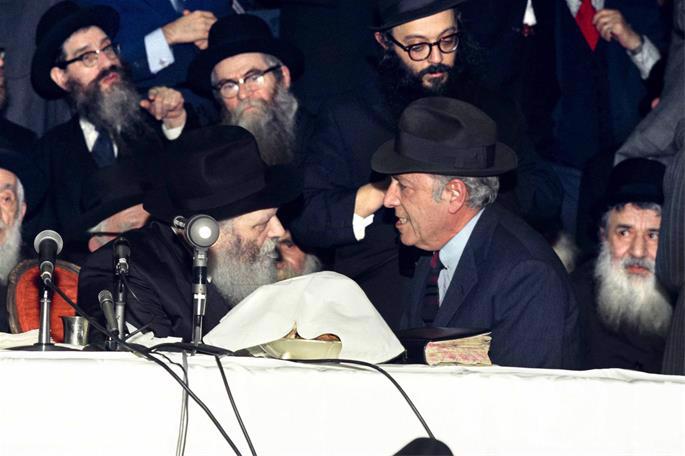
Jan. 22, 1975—10 Shevat 5735 on the Jewish calendar—marked the 25th anniversary of both the passing of his predecessor, the Sixth Rebbe, and the Rebbe’s assumption of leadership of the Chabad-Lubavitch movement. Thousands flocked to the Rebbe’s synagogue at 770 Eastern Parkway in Brooklyn to celebrate and commemorate the occasion together with him.
“The historic 10 Shevat farbrengen was commenced at 9 o’clock this evening…,” wrote the English businessman Zalmon Jaffe. “By 7:15 there were already about 1,000 people present; they wanted to reserve their seats or ‘standing’ spots and by the time the proceedings began, with the Rebbe’s entry, 6,000 were crushed together. Everyone was in good spirits and happy to be present to share in this momentous event.”
Seats had of course been saved for the dignitaries in the crowd, including the mayor of New York City, Abe Beame. Prominent representatives of American culture were there, too: “I particularly noticed Herman Wouk and Jan Peerce singing with all their hearts and souls, clapping with all their might, in time to the singing,” observed Jaffe, referring to the novelist and the Metropolitan opera tenor, respectively.
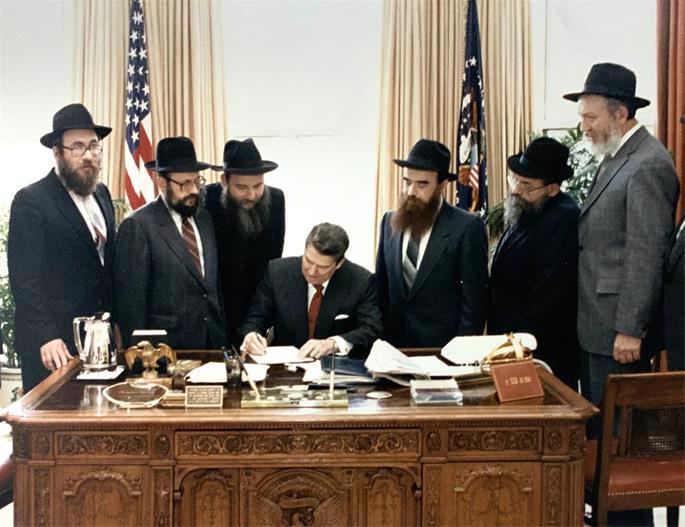
President Gerald Ford sent personal greetings, delivered by his representative to the festivities: “I want to join with those who applaud the dedication and wisdom that have characterized your leadership … ,” Ford wrote. “Your efforts on behalf of education and your countless humanitarian endeavors have greatly benefited and strengthened our society.”
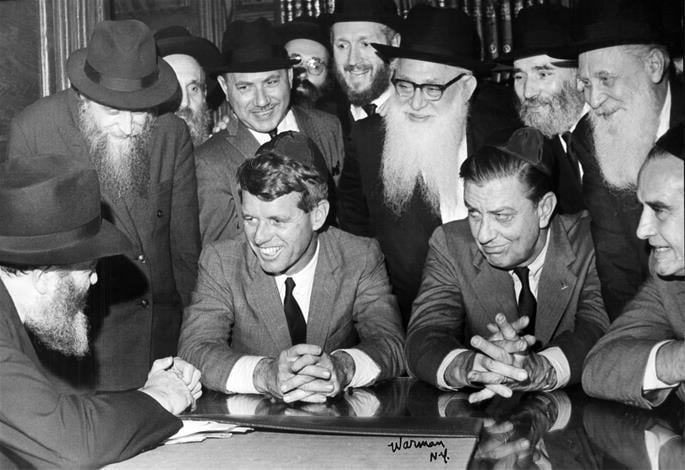
Already in the 1950s, the Rebbe was dispatching couples to serve communities as far away as Morocco and Italy. Jews from all walks of life—born Americans and European survivors, observant and not—regularly sought the advice of this young Rebbe in Brooklyn, who could talk and correspond with them in multiple languages, including English. At the same time, the Rebbe was engaging with the state of the broader society, addressing issues like urban disintegration and school prayer—the Rebbe was in fact one of the most outspoken religious leaders in the United States in favor of a school prayer amendment.2 Notable non-Jewish visitors to 770 during those early years included William Sloane Coffin Jr. and Robert F. Kennedy.3
>That the Rebbe believed America to be of vital importance to the future of Jewish life had long been clear: “Now that the great centers of Eastern Europe have been destroyed by Fascism and Communism, America has become the focus and fountainhead of Jewish survival … ,” he explained in a 1951 interview. “American Jewry must recognize this sacred, historical mission which Divine Providence has entrusted to it at this critical moment of our struggle for survival.”G‑d had directed Chabad’s relocation to the New World as well. With his father-in-law’s arrival in the U.S., the Rebbe wrote to New York Mayor John Lindsay, “the center of our Chabad-Lubavitch movement was … transplanted in this great metropolis, where it has enjoyed every opportunity to carry on its historic destiny.”4Over the years Chabad’s impact continued to grow. By the 25th anniversary of the Rebbe’s leadership, he was preparing to further broaden the scope of his work. The promise of America would play a vital role in the expansive project that lay ahead.5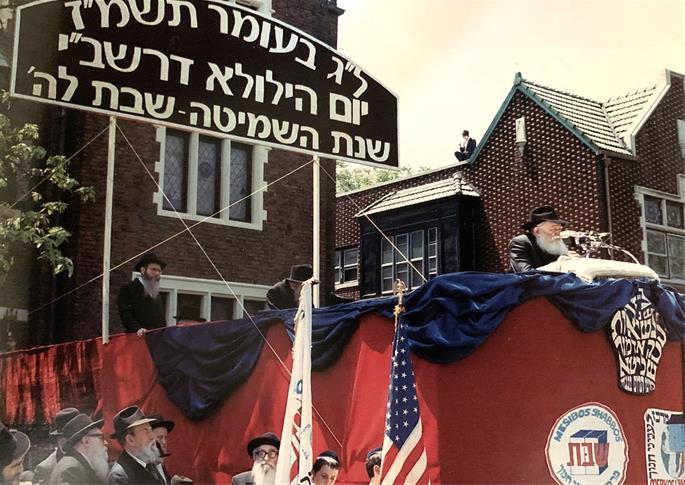
Foundation and Providence
The Rebbe began by quoting Jeremiah: “Seek the peace of the city … and pray to the L-rd on its behalf; as in its peace there will be peace for you.”7 The Talmud teaches by extension that it is important to speak in praise of the hospitality one enjoys.8 Here we’ll quote from the first section of the essay as it appeared in the Congressional Record, titled “In Appreciation:”
[It] is only right that we should gratefully recall on this solemn and festive occasion … the role which this country, the United States of America, and its great leaders, played in saving [the life of my saintly predecessor, my father-in-law of blessed memory], not once but twice, [from the Soviet Union and from Nazi Germany,] under the most crucial and dire circumstances … . Moreover, every courtesy and facility was extended to him and his family, and his entourage, to transfer the headquarters of the Chabad-Lubavitch movement to these shores. Here, in this blessed country of religious freedom, the movement has flourished with renewed vitality, with unprecedented national and global scope.
Truly, those great Americans were the emissaries of G‑d to save not only his life alone; for it meant also a new lease on the expansion of the movement he headed … .
The Rebbe opens the conversation with what is a defining and unifying feature of American civic culture: gratitude. Virtually all of us—or our parents or ancestors—came from somewhere, having left something, seeking a better life, both material and spiritual, in the United States. Whether escaping religious or ethnic persecution, government instability or dictatorship, hunger, war or Communist requisitioning, immigrants throughout history have come to America for an essential reason.
Recalling all this with sincere gratitude, we are confident that the said American tradition of active concern for religious freedom, and for those who are oppressed on racial or other grounds, will be zealously continued. Certainly those Americans who have been elected to public office, from the highest down, will surely consider it their privilege and duty to show what America and Americans stand for. To be sure, such action is not always universally popular; there may even be obstacles to overcome—but do not all deeds of virtue and duty require effort [?]
If, as the Chassidic masters taught, the fate of even an inanimate object is Divinely-ordained, then how much more so the fate of the most powerful country in history, one with an unparalleled capacity to influence the entire world. “This is not an accident, but Divine Providence,” the Rebbe explained, “and surely something that imposes a special responsibility and a special merit—both with regards to the country itself, and also with how it uses its influence in the world.”13
Of American Founders and American Youth
What is the source of America’s unique, world-historic strength—the one that allowed it to play such a crucial role providing safe haven to millions, including the Sixth Rebbe? What obligates it to use its influence for good throughout the world? The answer, in short, rests on that other American motto, the one found right on the money: “In G‑d We Trust.” In the Rebbe’s words:
American history tells us that this nation was founded on the inalienable rights of men. First and foremost among these rights is the right of religious freedom. As everybody knows, the Pilgrims came to America to be able to practice here their religion, free from persecution. The majority of the early settlers were religious refugees, who firmly believed in G‑d and in His word, the Bible …
The belief in G‑d which brought the early Americans to these shores was not an abstract belief in a Supreme Being Whose Presence is confined to the Seventh Heaven. It was a belief that permeated every aspect of their everyday life, particularly the education of their children. It was this uncompromising belief that prompted and guided the Founding Fathers to formulate the Bill of Rights.15
The Pilgrims felt themselves guided to these shores by the Hand of G‑d, and “saw in every matter Divine Providence, including even open miracles, as is well known in the history of the founding of this country.”16 This, to the Rebbe, is essential: America’s founding belief is rooted not only in the religious belief in the existence of G‑d, but an immanent G‑d, Creator and Conductor of the world (Borei olam uManhigo).

Indeed, in the Declaration of Independence, the Founding Fathers had appealed “to the Supreme Judge of the world for the rectitude of” their intentions, and placed “firm reliance on the protection of Divine Providence” for their actions. As president, George Washington had proclaimed a day of Thanksgiving to “the beneficent Author of all the good that was, that is, or that will be” for “the signal and manifold mercies, and the favorable interpositions of his Providence” during the war and in forming a government, as well as “for the civil and religious liberty with which we are blessed.”17 Abraham Lincoln had likewise echoed this when he encouraged Americans to set aside “a day of thanksgiving and praise to Almighty G‑d, the beneficent Creator and Ruler of the Universe.”18
For the Rebbe, this was not only history, but rather, it is instructive for “the way by which this nation must now conduct itself—conduct that is in accord with the spirit of this foundation, upon which the entire edifice of this country has been built.” The very placement of the Free Exercise Clause in the Constitution, given more weight even than freedom of speech, indicates how central the issue of religious freedom was to the Founders.19
But these ideas cannot be left in the past, nor taken for granted:
Times have changed, but the Truth never changes. Yet, through circumstances which need not be delved into here, the spirit and letter of the Constitution on religious freedom has come to mean to some—freedom from religion. We are witness to a sad phenomenon: Some well-meaning Americans, even some organizations, use the very same Bill of Rights in a way that is weakening and undermining the belief in G‑d in American life. It has prevented financial aid, Federal, State, and local, to any educational institutions where children are taught to believe in G‑d. Even the mere mention of a Supreme Being in a brief non-denominational prayer, to start the day off, has been proscribed.20
Such a state of affairs, the Rebbe continued, would have been inconceivable to the Founders, and there was no way such a reading of the Constitution could be in accordance with their intent. After all, those men and women who first found refuge on these shores had established “their daily life and the education of their children specifically in a manner permeated by the knowledge that there is an ‘Eternal G‑d’ (Kel olam), who is present here below and directs the world in every detail and at every moment.”

Of course, no one in this new republic was to be compelled to the faith of the other, and no law passed giving “priority” to any one particular religion. Nevertheless, “G‑d forbid to say that the government may spend money on all matters save for one thing alone”—teaching the younger generation that the world is not a “jungle,” but that there is “a Master to this place” (Baal Habayit lebirah zu) to whom every man, woman and child is ultimately accountable.21
In the history of the world, the American Revolution has distinguished itself from others by stating unequivocally that the rights of humankind stem not from government but from the Creator. This is not semantics. Speaking just 30 years after the Holocaust, the Rebbe recalled the destiny of a society where ethics were not founded upon the acknowledgement of a Supreme Being:
[Taking] a clue from the Divine “Constitution,” the Ten Commandments, we have already had occasion to point out that the fulfillment of the commandments “Thou shalt not murder,” “Thou shalt not steal,” etc., can be assured and can withstand any temptation only if they are preceded by the knowledge that “I am the L-rd, thy G‑d, Who brought thee out of the land of Egypt, from the house of bondage.” The Pilgrims knew this when they fled from their “Egypt,” and they wished to ensure for themselves and posterity the newly found freedom. We have also seen what happens to a society that has no fear of G‑d … .
Indeed, the Founders explicitly saw a reflection of the Biblical Exodus in the American experience. Washington, in his June 14, 1790, letter to the Hebrew Congregation of Savannah, Ga., wrote of the “providential agency” of “the same wonder-working Deity, who, long since delivering the Hebrews from their Egyptian oppressors [and] planted them in the promised land,” had lately “been conspicuous in establishing these United States as an Independent Nation … .”22
The Exodus and the freedom that follows, the Rebbe points out, is founded upon the first half of the verse: “I am the L-rd, thy G‑d.” Children raised without this awareness will not respect their parents or elders, and neither will they fear the police officer. Such a reality spells destruction for the society they inhabit and the one they will inherit.

The Rebbe lamented that though there was much talk in America about economic and energy crises—this was the mid-‘70s—not nearly enough attention was being paid to “the spiritual and moral crisis” engulfing America. “Juvenile delinquency and crime have become so rampant as to pose a serious threat to society,” he said. It was no accident then that Maimonides, the great doctor, scientist, and teacher, had stated in the opening of his opus that “the foundation of all foundations, and the pillar of all sciences, is to know that there is a Supreme Being, the Creator of all things that exist … .”23
Simply put, for a healthy society to function it is necessary for children to be raised with a recognition of an immanent G‑d, an “eye that sees and an ear that hears.”24 The Founders, the Rebbe observed, understood this, and would never have intended for the Constitution to be read in a way as “to wean the nation away from G‑d.” At the same time, they had built into their system of government a way of changing the Constitution, amendments. “Should not the Constitution be amended, or better still according to many be interpreted in a way to meet this national crisis?”25 Whatever the case may be, it was vital for American society to meet the moment. Civilization was relying on it.26
“There has not been a greater emergency than now,” the Rebbe stressed. “Time is of essence, particularly in matters of education. Children grow up every day. They should not be subjected to substitutes of Faith in G‑d, or to educational experimentations, sometimes more harmful than good.” The nation had elected a president and Congress to lead it not only out of its material crises, “but ‘also’ out of the spiritual and moral crisis, upon which ultimately depends the future of this great nation under G‑d, whose slogan is ‘In G‑d We Trust!’”27

As mentioned, the Rebbe had been very vocal in his support for non-denominational school prayer in the 1960s. And in the years following this talk, he would speak with great urgency in favor of a Moment of Silence in public schools and other educational settings, urging anyone who would listen to do something about it. Chassidim do not send their children to public school, but the Rebbe was not only concerned about Chassidim, or even only about Jews. He cared for every human being. And this campaign was about aiding American society at large by reminding it of its own promise.
America and ‘That’ Country
Having discussed America’s G‑d-given power and founding ideals, as well as their application to the domestic situation, the Rebbe returns to America’s responsibility on the world stage. The thread of Exodus and refuge had run through the entirety of the talk, beginning with the Sixth Rebbe’s finding refuge in the United States and continuing through the story of America’s founders escaping here from their Egypt. The Rebbe now extends the theme, pointing out that there were still enslaved people in the world, namely the men, women and children locked behind the Iron Curtain. They too needed America’s help. We turn again to the Congressional Record:
It has already been mentioned earlier that the United States played a decisive role in the liberation of my saintly predecessor … and in his emigration from behind the Iron Curtain. It was America in action—quietly, persuasively, firmly and effectively. It did so because it felt it was its duty to do a humanitarian act, and in doing so it demonstrated that this was American policy. It also proved that the voice of America, the voice of America’s conscience, is heeded around the world.
Just as America helped my saintly father-in-law to come out from behind the Iron Curtain, so it can today and tomorrow help many Jews to emigrate from there. We are certain that through quiet, but firm diplomacy, without publicity, a greater number of Jews are likely to be helped to emigrate from there.
The Rebbe does not stop at gaining the mere right to emigrate, either, emphasizing the importance also of doing “everything possible to alleviate the religious needs of those Jews who still have to, or choose to, remain there.” This stood in stark contrast to the many well-meaning groups who had begun to agitate for freedom for Soviet Jewry a few years earlier.
Freedom was important, full stop. But to the Rebbe, the Jewish communal position ought not be about waging a battle against Communism, but a battle for the Jews behind the Iron Curtain, whose needs were multifaceted. “They are entitled to the free exercise of their religion and to other basic human rights, rights which know of no geographical boundaries.”

Why was this America’s responsibility? Because G‑d Almighty had blessed it with providential power and placed it in the unique position to effect positive change in that and other parts of the world. America’s Founders, feeling themselves guided by the Creator in this endeavor, had birthed the “American tradition of active concern for religious freedom, and for those who are oppressed on racial or other grounds.” It was this that made the United States a refuge for so many for so long, and concern for the fate of persecuted Jews flowed directly from these same founding ideals.
Fascinatingly, at no point does the Rebbe mention the Soviet Union by name, though it was to her millions of Jews that he was clearly referring. In the original talk he speaks only of “that country,” a regular euphemism he applied to the USSR, and the Record refers only to the Iron Curtain.28 Because, again, for the Rebbe the purpose is not to score political points by denouncing the Soviet Union, but to alleviate the condition of its citizens, both material and spiritual. Cut off from their heritage for generations, Soviet Jews had suffered a particularly gruesome fate behind the Iron Curtain, an exile within an exile.
Would gratuitously poking the bear help the cause? To the Rebbe, the answer was a resounding no.29 He was not the only one.
“History has shown that the Soviet Union may yield under certain conditions to private pressure … but it is inconceivable on general grounds that such pressure should be effective when exerted publicly,” the political theoretician Hans Morgenthau wrote in his classic Politics Among Nations. “More particularly, in view of the nature of the Soviet Union’s government—which uses every sign of external pressure to justify repression at home—American agitation for human rights has no chance of being effective.”30
Which is why methods and tactics were so important to the Rebbe who, above all, believed in gaining tangible results.
America and the Holy Land
The Middle East was another part of the world where the Jews faced real danger, in this case an overwhelmingly larger Arab world hell-bent on their destruction. The Arab League at the time had 20 member states with a population of roughly 150 million people across 5.2 million square miles of land; Israel’s population stood at 3.4 million and its size 34,000 square miles—70 percent of that land in the Sinai peninsula, which Israel’s leaders would abandon to the Egyptians a few years later in exchange for a piece of paper.31

If America’s influence could be felt everywhere, the Rebbe continued, it was particularly so in the Holy Land, where its moral, economic and military aid—“including and especially arms in the plain sense”—had saved countless lives. (In the crowd stood Joseph Ciechanover, an Israeli diplomat who enjoyed a close relationship with the Rebbe and served at the time as chief of Israel’s defense procurement mission in the United States.)32
“As mentioned earlier, the founders of the American nation were imbued with belief in G‑d and with the spirit of the holy Bible,” the Rebbe explained. “It is, therefore, understandable that there should be a special affinity between the American people and the People of the Book, the Jewish people.” While the United States supplied Israel because it was in its interests to have a strong and democratic Israel in the Middle East—indeed, it was vital for the world order—it was America’s “own experience as a nation under G‑d” that served as the foundation of its commitment to the People of Israel. He continued:
[As] a nation born, reared and nourished with a deep sense of reverence for the Bible and for the inalienable rights of all men, [America] recognizes the inalienable right of the Jewish people to its homeland, the land which is acknowledged by all nations of the world as the Holy Land. This right has its roots in the everlasting covenant between G‑d and our Father Abraham, as is repeatedly reaffirmed in the Holy Scriptures … . 33
In light of the above, there is no need to convince the American government and people of this commitment vis-a-vis the Jewish people in general, and the Land of Israel in particular.34
The Jewish nation is the People of the Book, not of the sword. That book is the Torah, the very same that deeds the Land of Israel to the Jewish people being gifted by G‑d, in the words of Maimonides, “in order to bring about peace in the world.”35 And it was precisely by allowing Israel to procure more arms that peace could be ensured. As the Rebbe explained: “The purpose of arms is not to wait until war breaks out, G‑d forbid, and then utilize them in order to ‘deliver your enemies before you,’ but rather [have them in abundance] and cast dread upon the other side, to the point that they do not attack in the first place.”36
America had long ago adopted a policy of overwhelming military superiority to deter its enemies.37 Israel was in the same position in the Middle East, all the more important considering there was no longer such a thing as a regional war; “When war erupts, G‑d forbid, it is liable to drag the entire world along with it,” the Rebbe observed.38
Israel had until then been forced to defend itself militarily, he continued, but there was reason to hope it would not always be so. In the meantime, however, there were still many who desired the opposite of peace, and so plentiful advanced arms were required. True, this was in America’s geopolitical interests. But even more importantly for her, it was true to her founding spirit.
“We hope and pray for the day when the world will be free from the fear of war, and the vast resources that now go into wasteful military arsenals will be applied in peaceful and productive channels for the material and spiritual wellbeing of all humankind,” the Rebbe said.
It would be then, with the arrival of Moshiach, that the world would finally experience the prophecy of Isaiah: “And they shall beat their swords into plowshares, and their spears into pruning-hooks; nation shall not lift up sword against nation, neither shall they learn war any more.”39
The Promise of America
The seat of Rabbi Yosef Yitzchak’s leadership, the Rebbe once observed, had always been in cities—and no place embodied the idea of the city more than bustling New York.40 “Your Honor,” he wrote to Mayor Lindsay in 1972, “has the privileged distinction of representing the greatest City in the world … .”41
On this night, towards the conclusion of this talk, the Rebbe explicitly thanked New York and her leaders, a number of whom were in the audience, explaining that his father-in-law’s settling there 35 years earlier was no accident. With this great metropolis as his hub, Rabbi Yosef Yitzchak was able to establish and grow his activities on an unprecedented scale. The Rebbe would build upon this foundation, expanding Chabad’s activities to every corner of the United States and, indeed, the world.
Chabad’s program, the Rebbe indicated, was multifold: to reach out to every Jew and share with him or her the eternal wisdom of Judaism, and spread the Seven Laws of Noah among all humanity.42
This last piece was not an innovation of the Rebbe’s per se. Maimonides ruled centuries ago that the Jews had been enjoined to disseminate this universal code of ethics with all of mankind at Sinai. But for much of history persecution had made that impossible, the Rebbe becoming the first to revive this ancient calling. America—with its providential roots and ethos, where Jews had been blessed among all men with true religious freedom, and which since 1776 has heralded as its most foundational idea that it was the Creator who endowed man with “certain unalienable rights”—was the place from which this would be rectified.

America was not a bystander in this endeavor but a partner. This is reflected in the Rebbe’s frequent call that America not only distribute dollars as aid, but export to every corner of the globe the motto printed on those bills, “In G‑d We Trust,” thereby fulfilling its Divine mission. In this talk and many others, the Rebbe tasks every one who will hear his message with this program of great civilizational change.
And so the circle is closed. Just as the Jews need America in order to live freely as Jews, so too does America need the Jews in return. The Rebbe had spoken about the sad phenomenon of belief in G‑d being weakened and undermined in American life. Who better than the Jewish people, bearers of the covenant of Sinai, to remind America of its own Biblical bedrock? This is what serves as the source of the bounteous blessings it enjoys, as well as the responsibility it shoulders on the world stage.
So, Is It Different?
By now you’ll have picked up that, to the Rebbe, America is indeed different—very different.
So what did the Sixth Rebbe mean by his declaration “America is not different”? That America was no different insofar as Judaism was concerned. Just as the Jewish people had faithfully kept the Torah in the Old World, they could do so in America. In fact, it was easier.
Let’s return to the letter written to Jerry Weintraub: “Indeed,” the Rebbe continued, “in many respects it is vastly easier to follow the Torah way in this Land of Opportunity — opportunity not only in terms of material prosperity, but also and more importantly in the realm of the spirit.”43 What made it easier to live Jewishly in the United States was not just the lack of persecution, but the pioneering spirit embedded in the nation’s DNA. There is a reason why so many Chabad innovations, from the giant menorah to the mitzvah tank to the Sukkah on wheels, were born right here in the United States.
Not only do people in America “enjoy freedom and democracy,” the Rebbe explained in a 1969 letter, but “the whole country was built up by individuals who were not afraid to act on their own initiative and had the courage to blaze new trails.” Naturally, in such a place “it is not difficult to be independent in one’s convictions.”44 A Jew, he wrote another time, has the possibility “to observe everything here in freedom, and where the only obstacle is an inferiority complex … .”45
The Sixth Rebbe, and the Rebbe after him, set out to remedy this fundamental misunderstanding of the animating spirit of the United States. If anyone could appreciate the tenacity that the Jews had displayed over millennia to uphold their faith, it was Americans, with their rugged frontier mentality. And if anyone could understand “the Jew who lives according to his convictions and principles, based on the Ten Commandments and the whole Torah,” it was likewise Americans, children of a nation “imbued with belief in G‑d and the spirit of the holy Bible.”46
“All possess alike liberty of conscience and immunities of citizenship,” Washington wrote in his famous 1790 letter to the Hebrew Congregation in Newport, Rhode Island. “It is now no more that toleration is spoken of as if it were the indulgence of one class of people that another enjoyed the exercise of their inherent natural rights, for, happily, the Government of the United States, which gives to bigotry no sanction, to persecution no assistance, requires only that they who live under its protection should demean themselves as good citizens in giving it on all occasions their effectual support.” 47
America is not about tolerance, but about allowing each person the inherent right to actualize their potential and fulfill the unique mission for which G‑d has placed them on Earth. It is about doing it proudly, at home and in the street, as an individual, a community and, ultimately, as a nation—undaunted and unafraid.
This is how we can all access the blessings of America. And in this there is more than a kernel of truth to the phrase “America is different.”48 What we do with these blessings is up to us.
Dovid Margolin is a senior editor at Chabad.org, writing on social policy, Jewish life and Jewish history, with a particular interest in Russian Jewry. His work has appeared in The Wall Street Journal, Commentary, Mosaic and Tablet.
Letter to Jerry Weintraub, 9 Adar 5743 (Feb. 22, 1983), via Rebbe Responsa. Weintraub volunteered his time and professional expertise as the producer and chair Chabad of California’s annual telethon from 1980 until shortly before his passing in 2015.
See for example Congressional Record, vol. 117, pt. 29 (October 29, 1971), p. 38398-9, and spoken remarks of Cong. John E. Hunt of New Jersey in the debate that followed, Congressional Record, vol. 117, pt. 30 (November 8, 1971), p. 39910. See also the Rebbe’s article on government aid to parochial schools in the Catholic lay journal Commonweal, Sept. 28, 1962.
William Sloane Coffin Jr. (1924-2006) was an influential American theologian and antiwar activist who served as chaplain of Yale University, among other positions. Robert F. Kennedy (1925-1968), brother of President John F. Kennedy, was attorney general of the United States and U.S. Senator from New York until his assassination by a Palestinian terrorist in 1968.
Letter to John Lindsay, 17 Teves 5731 (Jan. 14, 1971), via Rebbe Responsa.
The Rebbe hinted to this shift at the outset of the farbrengen, when he spoke about the expansion of spheres of influence and leadership in every individual’s own life: At the age of bar or bat mitzvah a person becomes a “sovereign” over themselves, before growing into a position of leadership over their family, recognizing at this point that the needs of his or her family comes before their own personal ones. The same thing applies to communal work, the Rebbe continued: A person begins as the leader of a group or a faction, “but as soon as you are elected and appointed as leader or president over a larger entity, which incorporates within itself many subgroups, you must confront an even greater challenge. Then you are given the capability to overcome that challenge, not to fight for any one group against the interests of the majority of the other groups. On the contrary, you will explain to yourself and those around you that when the individual is at odds with the collective, the law is in favor of the collective.” The Rebbe also describes the growth of the Sixth Rebbe’s work, beginning on a smaller scale, then becoming the leader of Chabad, and then during a distressing period of history in the Soviet Union becoming responsible for all Jews in the country. While a Chabad Rebbe’s primary role is to teach Chassidut, circumstances had demanded he devote much of his time to the basics of Jewish life: opening cheders for the teaching of Alef-Bet and in general teaching the “Alef-Bet” of Judaism. See Torat Menachem Hitva’aduyot 5735, vol. 2 (vol. 79) (Brooklyn: Lahak, 2022), pp. 119-27. Translation here by Philip Wexler and Eli Rubin, “‘The Lower Half of the Globe’: Kabbalah and Social Analysis in the Lubavitcher Rebbe’s Vision for Judaism’s American Era.” Kabbalah in America, 2020.
Though the content is the same in both versions, they are structured differently. The Rebbe taught in Yiddish through the lens and idioms of the Torah, quoting liberally from original Torah sources etc. The essay in the Record, which was rendered into English by the Rebbe’s secretary, Dr. Nissan Mindel, and likely edited by the Rebbe, was crafted for a broader audience.
In a 1991 letter to President George H.W. Bush, the Rebbe quotes John Adams in a similar vein: “By Divine Providence your kind letter was dated on the morrow of the anniversary of the Nation’s birthday. It is well to remember that the founders of this Nation considered Independence Day as ‘a day of deliverance, by solemn acts of devotion to G‑d Al-mighty.’” The Rebbe Writes to George Bush About July 4th, Aug. 13, 1991. The quote comes from John Adams’ July 3, 1776 letter to Abigail Adams.
Congressional Record.
Torat Menachem Hitva’aduyot 5735, vol. 2 (vol. 79), p. 128.
Torat Menachem Hitva’aduyot 5735, vol. 2 (vol. 79), p. 128.
Torat Menachem Hitva’aduyot 5735, vol. 2 (vol. 79), p. 129.
Torat Menachem Hitva’aduyot 5735, vol. 2 (vol. 79), p. 129
Congressional Record.
Torat Menachem Hitva’aduyot 5735, vol. 2 (vol. 79), p. 129.
Thanksgiving Proclamation of 1789.
Thanksgiving Proclamation of 1864.
Though the menorah has been allowed on public land using mostly free-speech arguments, Justice Antonin Scalia noted in 1995 that the First Amendment was structured in a way that “private religious expression receives preferential treatment under the Free Exercise Clause.” Capitol Square Review & Advisory Bd. v. Pinette, 515 U.S. 753, 766–770 (1995) (Scalia, J., plurality opinion). The Rebbe explicitly highlights religious rights as “first and foremost among” the rights enumerated in the Constitution. See also Nathan Lewin, “Religion and the Court: 1995 A Symposium,” First Things, December 1995.
Congressional Record.
Torat Menachem Hitva’aduyot 5735, vol. 2 (vol. 79), p. 130
For the entirety see “George Washington to the Savannah, Ga., Hebrew Congregation, 14 June 1790,” Founders Online, National Archives. [Original source: The Papers of George Washington, Presidential Series, vol. 5, 16 January 1790 – 30 June 1790, ed. Dorothy Twohig, Mark A. Mastromarino, and Jack D. Warren. Charlottesville: University Press of Virginia, 1996, pp. 448–450.] The letter was reprinted in newspapers around the country, including the Gazette of the United States, New York, NY, June 19, 1790, DA_002326. Special Collections at The George Washington Presidential Library at Mount Vernon.
Maimonides, Yesodei HaTorah 1:1.
Avot 2:1. Watch the Rebbe speaking about Moment of Silence here.
Congressional Record.
Torat Menachem Hitva’aduyot 5735, vol. 2 (vol. 79), p. 132.
Congressional Record. The Rebbe frequently pointed out that children grow up quickly and no time can be spared. As he told Frank Lautenberg in a 1972 meeting regarding Jewish education: “Time is too valuable. As I said earlier, the building is on fire; this is no normal era. To express it clearly: this is an era of computers, and in an era of computers you must have your results within one second from now.” Lautenberg, later a U.S. Senator from New Jersey, was then president of the United Jewish Appeal.
See for example the Rebbe’s edits on a 1966 Lubavitch News Service (LNS) release about his forthcoming farbrengen commemorating 12-13 Tammuz, the anniversary of the release of Rabbi Yosef Yitzchak from Soviet imprisonment in 1927. The original headline was “Rabbi’s Release From Soviet Prison To Be Commemorated;” the Rebbe removed the word “Soviet.” In the body of the text the Rebbe likewise removed the word “Soviet” that had preceded “authorities.” At the same time, he added that it was the Yevsektzia—the Jewish sections of the Communist Party—who had instigated the arrest, causing the sentence to read: “At a time when vicious attempts were being made by the Yevsektzia to eradicate Judaism in Russia … .” The Yevsektzia had indeed fomented the Sixth Rebbe’s arrest, but by 1966 no longer existed; Russia was not a specific reference to the regime in power at the time. In edits on a 1973 LNS release celebrating the same anniversary, the Rebbe leaves in “Soviet Russia” but later replaces the word “Soviets” with “regime,” “Soviet” agents with “secret” agents, and “Soviet” pressures with just “pressures,” among other edits. See New-Friedman teshura, 22 Sivan 5786 (2026).
For example, the Rebbe was not happy when a group of Soviet Jewish dissidents chose a name for their illegal organization and publication that dated back to a Czarist-era Zionist political organization, seeing it as gratuitous. During a 1977 conversation recorded by Peter Kalms, the Rebbe told him the group was waving “a red tallis in front of a bull. If they have the possibility to change it, they should. It is not their purpose to criticize the Kremlin but to preserve Yiddishkeit… [It] is not even a Russian word. The Soviet official will look every time and see the continuation of Zionist work in 1919, which they consider even more dangerous … .” Peter Kalms, Guidance From the Rebbe (1961-1993), (Jerusalem, 2001), p. 74.
Politics Among Nations: The Struggle for Power and Peace, Sixth Edition, (McGraw-Hill, 1985), p. 276. Hans J. Morgenthau (1904-1980), the father of international relations as an academic study, first met the Rebbe in the early 1970s, forming a close relationship. “What a great man the Rebbe,” Morgenthau once told Rabbi Yehuda Krinsky, one of the Rebbe’s secretaries. “A leader—a brilliant thinker—a mover of people—a pragmatic man who has accomplished so much throughout the world for our people. And I can tell you most assuredly that he has a keen insight into world affairs.” Krinsky repeated this in the eulogy he gave for Morgenthau in 1980; among the other eulogists was Sec. of State Henry Kissinger, a student of Morgenthau’s. Morgenthau was buried in full accord with traditional Jewish law and custom by the Lubavitch Burial Society at Chabad’s section of the Old Montefiore Cemetery in Queens. New-Friedman teshura, 22 Sivan, 5786 (2026), p. 52.
“A piece of paper” is in fact how Egyptian President Anwar Sadat referred to it: “Poor Menachem [Begin], he has his problems … After all, I got back 90 percent of the Sinai and the Alma oil fields and what has Menachem got? A piece of paper.” See Jane Rosen, ‘Inching Ahead With Linowitz on Mideast Talks,’ New York Times, Oct. 19. 1980.
At the farbrengen Ciechanover approached the dais and spoke with the Rebbe for a few minutes. “You need to buy a lot of arms, so say a lot of l’chaim!” the Rebbe told him during the exchange, which is on camera and can be viewed here. “If only they’d give them to me!” Ciechanover responded. “They will supply them, but the arms must be used properly. In other words, there should be no need to actually use them.” For more on Ciechanover and the Rebbe see Dovid Margolin, “The Rebbe’s Diplomat: Joseph Ciechanover’s Hidden Role in Israeli History” on Chabad.org.
The Rebbe quotes by way of example the following three passages: “For all the land that you see I will give to you and to your seed to eternity,” (Genesis 13:15); “On that day, the Lord formed a covenant with Abram, saying, “To your seed I have given this land,” (Genesis 15:18); “I will give you and your seed after you the land of your sojournings, the entire land of Canaan for an everlasting possession,” (Genesis 17:8).
Congressional Record.
Maimonides, Hilchos Megillah v’Chanukah 2:14.
Torat Menachem Hitva’aduyot 5735, vol. 2 (vol. 79), p. 134.
Rooted, perhaps, in Washington’s dictum that “to be prepared for war is one of the most effectual means of preserving peace.” “George Washington to the United States Senate and House of Representatives, 8 January 1790,” Founders Online, National Archives. [Original source: The Papers of George Washington, Presidential Series, vol. 4, 8 September 1789 – 15 January 1790, ed. Dorothy Twohig. Charlottesville: University Press of Virginia, 1993, pp. 543–549.]
Torat Menachem Hitva’aduyot 5735, vol. 2 (vol. 79), p. 134.
Congressional Record. Isaiah 2:4.
“For better (or worse … ),” see Torat Menachem Hitva’aduyot 5712, vol. 2 (vol. 5), p. 173.
The Rebbe wrote this letter to Lindsay after the mayor informed him of his forthcoming trip to Israel, where he would also be visiting the Chassidic village of Kfar Chabad. The letter continues: “ … which is unique in being host to the largest Jewish population. Our brethren in the Holy Land will therefore eagerly welcome the First Citizen of this great Metropolis, since they are naturally keenly interested, perhaps with a touch of anxiety, in the fortunes of the Jewish community and its institutions in our City, and will look forward to your reassuring message.” Letter to John Lindsay, 10 Kislev, 5733 (Nov. 16, 1972,) via Rebbe Responsa.
Torat Menachem Hitva’aduyot 5735, vol. 2 (vol. 79), pp. 136-7.
Letter to Jerry Weintraub, 9 Adar 5743 (Feb. 22, 1983).
Letter to Fishel Brown, erev Purim 5729 (March 3, 1969), via Rebbe Responsa.
Letter to Yitzchak Meir (Irving) Bunim, 17 Sivan, 5724 (May 28, 1964), Yeshiva University Archives, Irving Bunim Family Papers (Box 1, Folder 9), via Rebbe Responsa.
Letter to Fishel Brown; Congressional Review.
“George Washington to the Hebrew Congregation in Newport, Rhode Island, 18 August 1790,” Founders Online, National Archives. [Original source: The Papers of George Washington, Presidential Series, vol. 6, 1 July 1790 – 30 November 1790, ed. Mark A. Mastromarino. Charlottesville: University Press of Virginia, 1996, pp. 284–286.]
Torat Menachem Hitva’aduyot 5730, vol. 1 (vol. 58), p. 162.