Αθήνα 26 Φεβρουαρίου 2024.
Το 1900, περισσότερες από 20.000 τράπεζες λειτουργούσαν στις Ηνωμένες Πολιτείες (σε σύγκριση με λιγότερες από 8.000 σήμερα). Όταν οι άνθρωποι κατέθεταν χρήματα στην τράπεζα, δεν αποθήκευαν απλώς τα μετρητά σε θησαυροφυλάκιο. Η τράπεζα έκανε τα κέρδη της δανείζοντας τα περισσότερα από αυτά τα κεφάλαια σε επιχειρήσεις και ιδιώτες και χρεώνοντας τόκους για αυτά τα δάνεια.
By Pendulum
Οι τραπεζικοί κανονισμοί απαιτούσαν από τις περισσότερες τράπεζες να διατηρούν ένα ορισμένο ποσοστό των καταθέσεών τους, που ονομάζονται re-serves, σε έτοιμα μετρητά ή εύκολα διαθέσιμα.
Οι τράπεζες των μικρών πόλεων κατέθεταν συχνά μερικά από τα αποθεματικά στις μεγαλύτερες τράπεζες για να κερδίσουν τόκους εκεί, αλλά μπορούσαν γρήγορα να ανακαλέσουν τα αποθεματικά τους όπως χρειαζόταν. Οι τράπεζες των πόλεων με τη σειρά τους συνήθως κατέθεταν μέρος των απαιτούμενων αποθεματικών στις μεγαλύτερες τράπεζες της πόλης. Μεγάλο ποσοστό των αποθεματικών που διέρρευσαν σε αυτήν την αλυσίδα τραπεζών κατέληξε στα χρηματοπιστωτικά ιδρύματα της Wall Street της Νέας Υόρκης, στις μεγαλύτερες τράπεζες και σε ομόλογα.
Με αυτόν τον τρόπο, η Wall Street χρηματοδότησε μεγάλο μέρος των αναπτυσσόμενων βιομηχανιών της Αμερικής.
Όταν τα πράγματα κύλησαν ομαλά, τα χρήματα από τα αποθεματικά των τραπεζών διέρρευσαν από την αλυσίδα των τραπεζών στη Wall Street και στη συνέχεια κατέβηκαν στην αλυσίδα με τη μορφή κερδοφόρων τόκων. Τα πράγματα δεν πήγαιναν πάντα ομαλά.
Τραπεζικοί πανικοί
Ένα πρόβλημα ήταν η συχνή έλλειψη χρημάτων σε κυκλοφορία. Για να καλύψουν την αύξηση της ζήτησης για δάνεια, οι τοπικές τράπεζες έπρεπε μερικές φορές να ανακαλούν τα αποθεματικά που είχαν καταθέσει στις τράπεζες των πόλεων. Με τη σειρά τους, αυτές οι τράπεζες έπρεπε συχνά να ανακαλούν τα αποθεματικά τους από την αλυσίδα των τραπεζών. Οι Ηνωμένες Πολιτείες δεν είχαν κεντρική τράπεζα.
Το 1836, ο Πρόεδρος An-Drew Jackson είχε αρνηθεί να εκ νέου την Τράπεζα των Ηνωμένων Πολιτειών. Έτσι, καμία εθνική κεντρική τράπεζα δεν διαχειρίστηκε την προσφορά χρήματος ή λειτούργησε ως «δανειστής έσχατης ανάγκης» για να διατηρήσει τις τράπεζες σε λειτουργία όταν προσωρινά δεν είχαν μετρητά. Επανειλημμένοι τραπεζικοί πανικοί ξέσπασαν μετά τον 19ο αιώνα. Τέτοια γεγονότα συνέβησαν ξαφνικά όταν οι καταθέτες, ενεργώντας με πραγματικούς ή φανταστικούς φόβους, έτρεξαν στις τράπεζές τους για να ζητήσουν πίσω τις καταθέσεις μετρητών τους.
Οι άνθρωποι πανικοβάλονταν εύκολα γιατί, αν η τράπεζά τους αποτύγχανε, θα έχαναν όλα τα χρήματα που είχαν καταθέσει. Σε αντίθεση με σήμερα, κανένα πρόγραμμα κρατικής ασφάλισης δεν εγγυάτο τις τραπεζικές καταθέσεις.
Ένας πανικός θα μπορούσε να ξεκινήσει ανάμεσα στις μικρές αγροτικές τράπεζες και να εξαπλωθεί στην αλυσίδα των τραπεζών. Θα μπορούσε επίσης να υποχωρήσει στην αλυσίδα μετά την αποτυχία των τραπεζών στη Wall Street. Οι χρηματοπιστωτικές αγορές θα μπορούσαν επίσης να προκαλέσουν πανικό στις τράπεζες. Εάν οι τράπεζες κερδοσκοπούσαν απερίσκεπτα τα αποθέματά τους στην ξηρά, όταν η αξία της γης έπεφτε, ακολουούσε πανικός. Εάν η χρηματιστηριακή αγορά καταρρεύσει, θα μπορούσε να προκληθεί τραπεζικός πανικός. Κατά τη διάρκεια του 1800, τουλάχιστον πέντε μεγάλοι τραπεζικοί πανικοί ξέσπασαν ακολουθούμενοι από οικονομική ύφεση ποικίλης διάρκειας και σοβαρότητας. Χωρίς μια κεντρική τράπεζα για να σώσει το τραπεζικό σύστημα κατά τη διάρκεια του πανικού, οι ίδιοι οι τραπεζίτες έπρεπε να προσπαθήσουν να σταματήσουν την οικονομική κατάρρευση.
J.P. Morgan funded the building of the Titanic, and cancelled his long-awaited journey just hours before its proposed departure.
3 of the wealthiest men on earth, whom were against the creation of the Federal Reserve Bank happened to be invited aboard for its maiden voyage. pic.twitter.com/2v2To0PudX
— illuminatibot (@iluminatibot) February 25, 2024
Κανένας τραπεζίτης δεν ήταν καλύτερος από τον J.P. Morgan.
Γεννημένος το 1837, ο John Pierpont Morgan ήταν γιος ενός επιτυχημένου χρηματοδότη τραπεζών. Ο Pierpont, όπως προτιμούσε να τον αποκαλούν, εκπαιδεύτηκε σε ιδιωτικά σχολεία της Νέας Αγγλίας και σπούδασε ιστορία της τέχνης σε ένα γερμανικό πανεπιστήμιο. Αφού πέθανε η πρώτη του γυναίκα, ο Morgan παντρεύτηκε τη Frances Tracy το 1865. Απέκτησαν τέσσερα παιδιά. Σε ηλικία 24 ετών, ο Morgan μπήκε στα χρηματοοικονομικά της Νέας Υόρκης ως πράκτορας της Wall Streetagent για την τραπεζική εταιρεία του πατέρα του. Το 1871, ο πατέρας του Morgan κανόνισε ο γιος του να δημιουργήσει μια εταιρική σχέση με έναν μεγαλύτερο τραπεζίτη.
Οι Drex-ell, Morgan and Co. αναδείχθηκαν σύντομα η κύρια πηγή δανείων προς τη κυβέρνηση των Η.Π.Α. κυβέρνηση.Τις επόμενες δεκαετίες, ο Morgan έγινε η κυρίαρχη φιγούρα στην Wall Library of Congres.
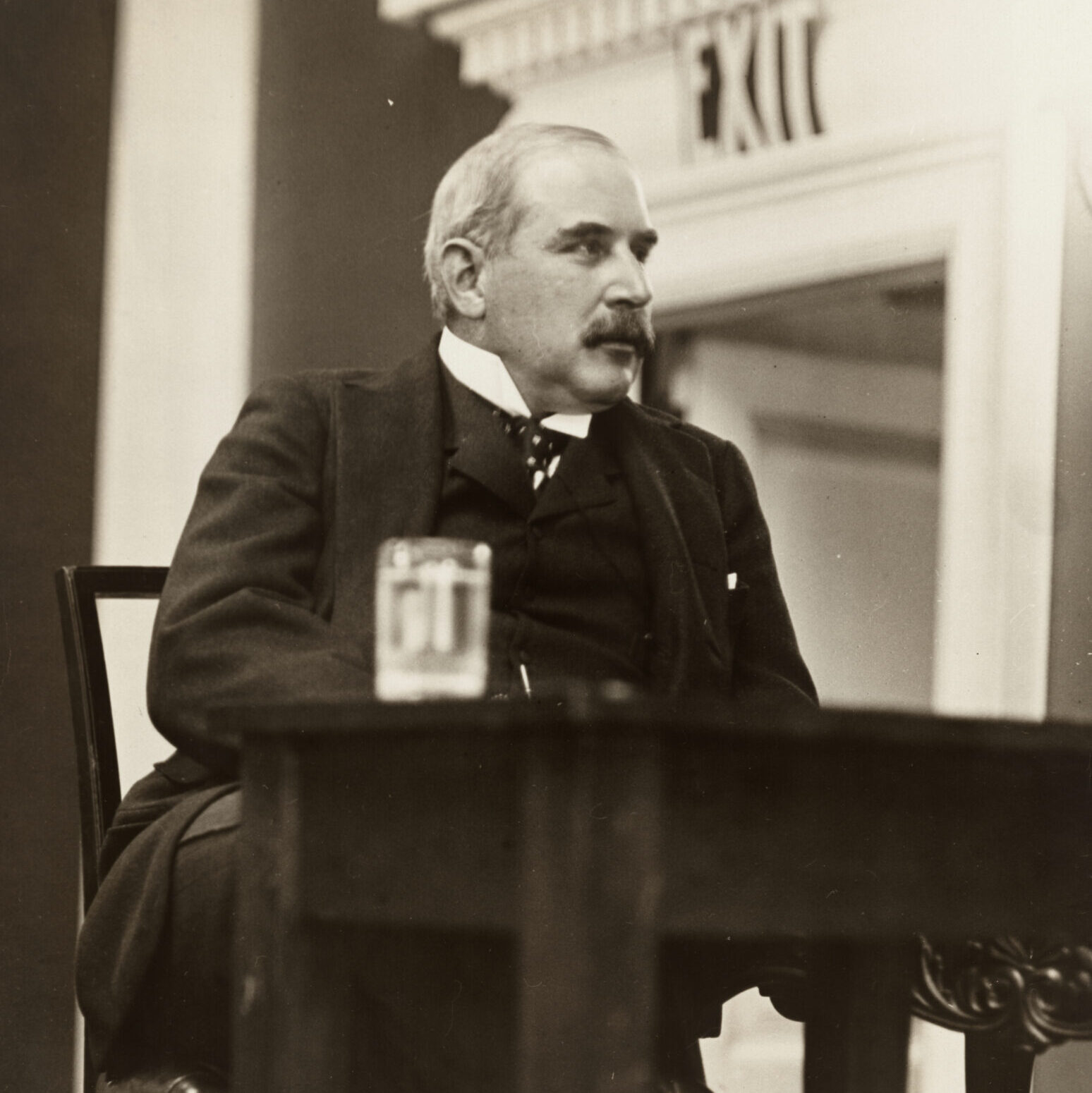


Ήταν πάνω από έξι πόδια ψηλός με μια παραμορφωμένη μοβ μύτη που προκλήθηκε από μια πάθηση του δέρματος. Μισούσε τις φωτογραφίες που τραβήχτηκαν με τη μύτη του στο προφίλ, και κάποτε επιτέθηκε σε φωτογράφους με το μπαστούνι του. Ο Morgan πίστευε ότι ο αμερικανικός καπιταλισμός θα έπρεπε να βρίσκεται υπό τον έλεγχο τραπεζιτών σαν αυτόν.
Οι Wall Streetpeers του τον έβλεπαν ως τον φυσικό τους ηγέτη, ο οποίος ήταν γνωστός ως έντιμος και δίκαιος. Ο Morgan θεώρησε τον άγριο καπιταλισμό στα τέλη του 19ου αιώνα ως σπάταλο και καταστροφικό. Μισούσε τον «καταστροφικό ανταγωνισμό», όπως οι πόλεμοι επιτοκίων που οδήγησαν πολλούς σιδηροδρόμους σε χρεοκοπία.
Ο Morgan πίστευε ότι ο καλύτερος τρόπος για τη δημιουργία επιχειρηματικής σταθερότητας ήταν οι ανταγωνιστές να ρυθμίζουν τον εαυτό τους με ιδιωτικές συμφωνίες που βασίζονται στην εμπιστοσύνη. Στη δεκαετία του 1880, ο Morgan άρχισε να οργανώνει συγχωνεύσεις ανταγωνιστικών σιδηροδρόμων.
Το 1893, ένα κραχ στο χρηματιστήριο προκάλεσε τραπεζικό πανικό και τη χειρότερη ύφεση στην ιστορία των ΗΠΑ μέχρι εκείνη την εποχή. Κατά τη διάρκεια αυτής της ύφεσης, η προσφορά χρήματος συρρικνώθηκε καθώς οι άνθρωποι και οι επιχειρήσεις συσσώρευσαν μετρητά. Το σπάνιο χρήμα προκάλεσε υψηλά επιτόκια δανεισμού, τα οποία οδήγησαν σε πτώση των δαπανών και μαζική ανεργία. Ο κανόνας του χρυσού επιδείνωσε την κρίση. Το Υπουργείο Οικονομικών των ΗΠΑ μπορούσε να τυπώσει μόνο χαρτονομίσματα που υποστηρίζονταν από τα αποθέματά του σε χρυσό.
Η νομισματική κρίση επιδεινώθηκε όταν τα ευρωπαϊκά έθνη ζήτησαν πληρωμή σε χρυσό για να διευθετήσουν τις εμπορικές ανισορροπίες. Αυτό απείλησε να συρρικνώσει περαιτέρω την προσφορά χρήματος.
Τον Φεβρουάριο του 1895, ο Μorgan και άλλοι τραπεζίτες συναντήθηκαν με τον Πρόεδρο Grover Cleveland. Ο Morgan πρότεινε σχέδιο για την οικονομική του εταιρεία να συντονίσει την αγορά χρυσού στις ΗΠΑ από παγκόσμιες πηγές με αντάλλαγμα κρατικά ομόλογα χρυσού πληρωτέα σε 30 χρόνια.
Ο Cleveland ενέκρινε το σχέδιο του Morgan. To σχέδιο λειτούργησε και η προσφορά χρήματος των ΗΠΑ σταθεροποιήθηκε. Ο Morgan και οι άλλοι τραπεζίτες που πραγματοποίησαν το σχέδιο είχαν επίσης καλό κέρδος. Στην πραγματικότητα, ο Morgan έδρασε στη θέση μιας κεντρικής τράπεζας που δεν είχαν οι ΗΠΑ. Η Wall Street του έδωσε το παρατσούκλι «Δίας», από τον κύριο Ρωμαίο θεό. Όταν πέθανε ο τραπεζικός συνεργάτης του, ο Morgan μετονόμασε την εταιρεία J.P. Morgan & Co. Η τράπεζα Morgan χρηματοδότησε τη συγχώνευση πολλών σιδηροδρομικών γραμμών σε έξι τεράστια συστήματα. Αντάλλαξε τη χρηματοδότησή του για την πλειοψηφία των μετοχών στους συγχωνευμένους σιδηροδρόμους και μια θέση στα διοικητικά συμβούλια τους. Η Wall Street αποκάλεσε αυτή τη διαδικασία «morganization». Η Morgan συγχώνευσε επίσης ανταγωνιστικές βιομηχανικές εταιρείες σε γιγαντιαίες εταιρείες.
Το 1901, συγχώνευσε εταιρείες χάλυβα που κατείχε με άλλες εταιρείες Carnegie Steelplusnine για να σχηματίσουν την U.S. Steel. Αυτή έγινε η πρώτη εταιρεία δισεκατομμυρίων δολαρίων στον κόσμο, η οποία ήλεγχε περίπου τη μισή αμερικανική επιχείρηση χάλυβα. Ο Morgan δώρισε εκατομμύρια δολάρια σε μουσεία, την όπερα, τα νοσοκομεία, τα σχολεία και την Επισκοπική Εκκλησία του. Το πάθος του ήταν να συλλέγει έργα τέχνης, χειρόγραφα και άλλα σπάνια αντικείμενα. Για να συγκρατήσει την τεράστια συλλογή του, έχτισε τη βιβλιοθήκη Morgan δίπλα στο σπίτι του.
Ο πανικός του 1907
Το 1901, ο αντιπρόεδρος Theodore Roosevelt έγινε πρόεδρος μετά τη δολοφονία του Προέδρου William McKinley. Ο Roosevelt έδειξε γρήγορα ότι συμπάσχει με τους μεταρρυθμιστές, που ονομάζονταν προοδευτικοί, που απαιτούσαν σθεναρή επιβολή των αντιμονοπωλιακών νόμων. Αλλά το σχέδιο κατέρρευσε και η αξία των αποθεμάτων της εταιρείας έπεσε. Ήταν τότε που ένα νέος είδος “τράπεζας” που ελέγχονταν ελάχιστα έκανε την εμφάνισή του. Οι εταιρείες καταπιστεύματος έκαναν κανονικές τραπεζικές συναλλαγές, αλλά επίσης έδιναν επικίνδυνα δάνεια και κερδοσκοπούσαν στο χρηματιστήριο.
Αναλαμβάνοντας κινδύνους, αποκόμισαν μεγαλύτερα κέρδη και μπορούσαν να προσφέρουν υψηλότερα επιτόκια στους καταθέτες από ό,τι οι πιο κοινές εμπορικές τράπεζες. Επίσης, οι εταιρείες καταπιστεύματος δεν έπρεπε να διατηρούν τόσο αποθεματικό όσο οι εμπορικές τράπεζες. Στις αρχές Οκτωβρίου, οι καταθέτες της Knicker bocker έμαθαν ότι ο πρόεδρος της τράπεζάς τους είχε επενδύσει σε μετοχές United Copper. Αυτό προκάλεσε την καταστροφή της εταιρείας καταπιστεύματος από καταθέτες που φοβήθηκαν ότι είχε χάσει χρήματα και ότι θα αποτύγχανε. Στην πραγματικότητα, η ίδια η Knickerbocker δεν είχε επενδύσει στο πρόγραμμα και ήταν σταθερή. Αλλά η Knickerbocker εξακολουθούσε να μένει χωρίς μετρητά για να εξοφλήσει τους πανικόβλητους καταθέτες της και έκλεισε. Ξεκίνησε ένας πανικός.
Οι καταθέτες σε άλλες τράπεζες εταιρειών εμπιστοσύνης της Νέας Υόρκης άρχισαν να αποσύρουν τα χρήματά τους. Η τραπεζική αλυσίδα Banksdown ανακαλούσαν τα αποθεματικά τους από τη WallStreet για να προφυλαχθούν από το διαρροή των καταθέσεών τους. Οι τραπεζίτες της Wall Street στράφηκαν στον 70χρονο J.P. Morgan, αυτόν που εμπιστεύονταν.
Όταν έλαβε χώρα μια νέα κίνηση στην τράπεζα Τhe Trust Co. of America, ο Morgan και δύο από τους φίλους του τραπεζίτες συγκέντρωσαν 3 εκατομμύρια δολάρια για να το σώσουν. Αλλά οι τραπεζικές εργασίες συνεχίστηκαν, ειδικά στις εταιρείες καταπιστεύματος.
Στη συνέχεια, ο δήμαρχος της Νέας Υόρκης ανέφερε στον Morgan ότι η οικονομικά πιεσμένη πόλη χρειαζόταν ένα δάνειο για να καλύψει τη μισθοδοσία της και να πληρώσει τους εργολάβους.
Φοβούμενοι ότι η οικονομική κατάρρευση της πόλης θα επιδεινώσει τον πανικό, ο Morgan και οι φίλοι του τραπεζίτες αγόρασαν 30 εκατομμύρια δολάρια σε ομόλογα της πόλης. Οι χρηματιστηριακές εταιρείες, που διαχειρίζονταν χρηματιστηριακές συναλλαγές, κινδύνευαν επίσης να αποτύχουν στις υποχρεώσεις τους. Η Morgan συγκέντρωσε μια «δεξαμενή χρημάτων» 25 εκατομμυρίων δολαρίων, σχηματίζοντας δάνεια χαμηλότερου επιτοκίου, αποφεύγοντας σχεδόν βέβαιο κραχ της αγοράς. Αλλά η μεγαλύτερη χρηματιστηριακή εταιρεία στη Wall Street, η Moore & Schley, είχε χρέος 25 εκατομμυρίων δολαρίων. Η χρεοκοπία αυτής της βασικής εταιρείας θα μπορούσε ακόμα να προκαλέσει το κραχ της χρηματιστηριακής αγοράς. Ο Morgan κάλεσε μια συνάντηση στη Βιβλιοθήκη Morgan. Συγκέντρωσε τους τραπεζίτες των εμπορικών εταιρειών και των εταιρειών εμπιστοσύνης της πόλης, τους έβαλε σε χωριστά δωμάτια, κλείδωσε την εξώπορτα και κράτησε το κλειδί στην τσέπη του μέχρι να μπορέσει να διαπραγματευτεί μια συμφωνία.
Η συνάντηση κράτησε μέχρι το βράδυ. Οι τραπεζίτες των εταιρειών καταπιστεύματος αντιστάθηκαν στη συγκέντρωση των αποθεματικών τους για να σταματήσουν τον πανικό, αλλά οι διαπραγματεύσεις συνεχίστηκαν. Στις 4:30 π.μ., ο Morgan τελικά τους παρενόχλησε να υπογράψουν μια συμφωνία. Ζητούσε από τους trust company bankers να διασώσουν τους αδερφούς τους τραπεζίτες που δυσκολευόντουσαν με τρεξίματα στις καταθέσεις τους. Από την πλευρά του, ο Morgan υποσχέθηκε να σώσει τη χρηματιστηριακή εταιρεία Moore & Schley. Στη συνέχεια, ο Morgan επινόησε ένα σχέδιο για τη μείωση του χρέους της Moore & Schley. Θα πουλούσε μια εταιρεία χάλυβα που ανήκε στην U.S. Steel, μια εταιρεία στην οποία μετέχει η Morganheld και ήταν μέλος του διοικητικού συμβουλίου της. Το μόνο πρόβλημα με αυτή τη συμφωνία ήταν ότι αγοράζοντας ανταγωνιστή, η U.S. Steel θα μονοπωλούσε ακόμη περισσότερο τη βιομηχανία χάλυβα.
Αυτό θα μπορούσε να προκαλέσει μια αντιμονοπωλιακή δίωξη από την κυβέρνηση Ρούσβελτ. Ο Μόργκαν έστειλε αμέσως έμπιστους συμβούλους στην Ουάσιγκτον για να πείσουν τον Πρόεδρο Roosevelt να εγκρίνει τη συμφωνία. Ο Roosevelt συμφώνησε ότι οι συνθήκες του πανικού της Wall Street δικαιολογούσαν την αγορά ενός ανταγωνιστή από την US Steel. Η σύναψη συμφωνίας του FalloutMorgan σταμάτησε τελικά τον πανικό της Wall Street. Ωστόσο, η πολυοικονομική ζημιά είχε ήδη εξαπλωθεί σε ολόκληρη τη χώρα.
Η προκύπτουσα ύφεση του 1907-08 ήταν σοβαρή, αλλά πιθανότατα θα ήταν μεγαλύτερη αν συνεχιζόταν ο πανικός στις τράπεζες. Η Wall Street επευφημούσε τον Morgan ως ήρωα. Αλλά οι προοδευτικοί επιτέθηκαν στον Morgan και στη Wall Street για όλα τα κέρδη που αποκόμισαν από τις συμφωνίες τους. Μερικοί μάλιστα τους κατηγόρησαν ότι προκάλεσαν τον πανικό για να μπορέσουν να βγάλουν χρήματα από αυτό, αλλά αυτό δεν αποδείχθηκε ποτέ. Αποδείχθηκε επίσης ότι η χαλυβουργική εταιρεία που αγόρασε η U.S. Steel είχε υποτιμηθεί. Αυτό έκανε την αγορά ακόμη πιο κερδοφόρα για την US Steel (και τoν Morgan). Οι προοδευτικοί επέκριναν τον πρόεδρο βαριά γιατί τον κουκούλωσε ο Morgan για να υπονομεύσει την εκστρατεία κατάρριψης της εμπιστοσύνης του. Επιπλέον, οι προοδευτικοί ισχυρίστηκαν ότι μια «χρηματοπιστία» τραπεζιτών της Wall Street, με επικεφαλής τον Morgan, συνωμότησαν να μονοπωλήσουν τη χρηματοοικονομική επένδυση του έθνους.
Τον Δεκέμβριο του 1912, ο Morgan κατέθεσε ενώπιον μιας ακρόασης της τραπεζικής επιτροπής του Κογκρέσου υπό την προεδρία του αντιπροσώπου Arsene Pujo. Σε ηλικία 75 ετών, ο Μorgan ήταν ημι-συνταξιούχος με τον γιο του, John Jr, στη διαδικασία ανάληψης της οικογενειακής τράπεζας. Όταν ο επικεφαλής σύμβουλος της επιτροπής ρώτησε τον Morgan εάν ασκούσε κάποια εξουσία στην οικονομία, εκείνος απάντησε: «Όχι το παραμικρό».
Αρνήθηκε ότι υπήρχαν χρήματα. Διαφώνησε επίσης ότι οι συγχωνεύσεις του σιδηροδρόμων και βιομηχανιών είχαν δημιουργήσει μια ανθυγιεινή συγκέντρωση οικονομικής δύναμης. Η επιτροπή Pujo, ωστόσο, κατέληξε στο συμπέρασμα ότι υπήρχε μια «κοινότητα συμφερόντων» στη Wall Street που συγκέντρωνε «τον έλεγχο των χρημάτων και της πίστης στα χέρια σχετικά λίγων ανδρών».
Η έκθεση της επιτροπής εντόπισε έξι Wall Streetbanks, συμπεριλαμβανομένης της Morgan’s, γεγονός που καθιστούσε σχεδόν αδύνατο για τις μεγάλες εταιρείες να πουλήσουν τα εταιρικά τους ομόλογα χωρίς τη συνεργασία του ομίλου. Οι έξι τράπεζες είχαν συμφωνήσει να μην ανταγωνίζονται η μία την άλλη για τη διαχείριση νέων εκδόσεων ομολόγων. Η έκθεση Pujo αποκάλυψε επίσης ότι η τράπεζα του Morgan κατείχε δύο ακόμη θέσεις ψήφου στα διοικητικά συμβούλια εταιρειών αξίας 25 δισεκατομμυρίων δολαρίων (μεταξύ 2 και 9 τρισεκατομμυρίων σε σημερινά δολάρια). Ο Morgan ταξίδεψε στην Ευρώπη στις αρχές του 1913. Πέθανε στον ύπνο του στη Ρώμη στις 31 Μαρτίου 1913.
Οι συνεργάτες του Morgan
Το κοινό απέδωσε δημοσίως τον θάνατό του στην πίεση των ακροάσεων του Pujo. Η περιουσία του Morgan αποτιμήθηκε σε περισσότερα από 100 εκατομμύρια δολάρια. Αυτός ο αριθμός ήταν πολύ μικρότερος από τις περιουσίες των βιομηχανικών βαρώνων όπως ο Carnegie και ο Rockefeller. Ο Carnegie σχολίασε: «Και για να σκεφτείς, δεν ήταν πλούσιος».
Ο μοναχογιός του Morgan, John Jr, κληρονόμησε τον έλεγχο της οικονομικής αυτοκρατορίας του πατέρα του.
Μετά τον Πανικό του 1907, υπήρξε ευρέως διαδεδομένη συμφωνία ότι η Κεντρική Τράπεζα ήταν απαραίτητη για τη διαχείριση της προσφοράς χρήματος και ως «δανειστής της τελευταίας ανάγκης».
Έντονη ήταν ωστόσο η διαφωνία, σχετικά με το ποιος θα έπρεπε να διοικεί αυτήν την τράπεζα. Οι περισσότεροι από τους τραπεζίτες της εποχής, συμπεριλαμβανομένης της Morgan, ήθελαν μια ιδιωτική κεντρική τράπεζα ελεγχόμενη εξ ολοκλήρου από τραπεζίτες. Οι προοδευτικοί ήθελαν την κεντρική τράπεζα υπό τον έλεγχο της ομοσπονδιακής κυβέρνησης. Αφού ο Δημοκρατικός Woodrow Wilson κέρδισε τις εκλογές ως πρόεδρος το 1912, τάχθηκε στο πλευρό των προοδευτικών.
Ο Wilson επέμεινε ότι η κεντρική τράπεζα είναι μια δημόσια υπηρεσία που διευθύνεται από κυβερνητικούς αξιωματούχους διορισμένους από τον πρόεδρο. Οι τραπεζίτες και οι Ρεπουμπλικάνοι αντιτάχθηκαν στο αίτημα του Wilson για ομοσπονδιακό έλεγχο της Κεντρικής τράπεζας. Υποστήριξαν ότι η τράπεζα θα ελεγχόταν από πολιτικούς που θα ακολουθούσε τις πολιτικές οποιουδήποτε κόμματος ήταν στην εξουσία. Κατήγγειλαν επίσης ότι ένα τέτοιο συμβούλιο θα σήμαινε σημαντική κρατική παρέμβαση στην ιδιωτική τραπεζική και στο δωρεάν σύστημα επιχειρήσεων.
Οι προοδευτικοί χρησιμοποίησαν τα ευρήματα των ακροάσεων του Pujo για να δικαιολογήσουν την ανάγκη για μια κεντρική τράπεζα που ελέγχεται από την κυβέρνηση για να αντιμετωπίσει την επικίνδυνη συγκέντρωση οικονομικής ισχύος της WallStreet. Για πολλά χρόνια, αγρότες και λαϊκιστές πολιτικοί είχαν παραπονεθεί ότι οι New York banks είχαν υπερβολικό έλεγχο στο κόστος δανεισμού.
Ήταν καιρός, υποστήριξαν οι προοδευτικοί, να σταματήσουν να βασίζονται στους τραπεζίτες της Wall Street, όπως ο J.P. Morgan, για να σταματήσουν οι ίδιοι οι τραπεζικοί πανικοί που αποφέρουν μεγάλα κέρδη στη διαδικασία. Με τους Δημοκρατικούς να ελέγχουν το Κογκρέσο, ο νόμος για την Federal Reserve ψηφίστηκε από ισχυρές πλειοψηφίες στη Βουλή και τη Γερουσία. Ο Πρόεδρος Wilson τον υπέγραψε ως νόμο στις 23 Δεκεμβρίου 1913.
Αυτά ήταν τα βασικά χαρακτηριστικά της πράξης:
• Ένα επταμελές Συμβούλιο Ομοσπονδιακών Αποθεμάτων, που διορίστηκε από τον Πρόεδρο με τη συγκατάθεση της Γερουσίας, επρόκειτο να συντονίσει την πολιτική προσφοράς χρήματος με 12 τράπεζες -αναφέρεται ως Federal Reserve Banks.
Κάθε μία από τις τράπεζες θα βρίσκεται σε διαφορετική περιοχή της χώρας.
• Η Federal Reserve Banks θα ήταν «δανειστές έσχατης ανάγκης» για τις τράπεζες των Η.Π.Α.
• Η Federal Reserve Banks μπορούσε να εκδώσει Federal Reserve Notes, χάρτινο νόμισμα με δυνατότητα επανεξόφλησης σε χρυσό, για να κάνει την προσφορά χρήματος πιο «ελαστική» ή επεκτάσιμη, εάν χρειάζεται.
12 περιφερειακές τράπεζες στους υπεύθυνους χάραξης πολιτικής του Ομοσπονδιακού Αποθεματικού Συστήματος στην Ουάσιγκτον
Ένα σημαντικό ελάττωμα στην προσπάθεια τραπεζικής μεταρρύθμισης του 1913 ήταν η έλλειψη ενός συστήματος ασφάλισης καταθέσεων από τις κυβερνητικές τράπεζες που θα προστατεύει τα χρήματα των ανθρώπων όταν οι τράπεζες πέφτουν.
Το Κογκρέσο ενέκρινε τελικά αυτή τη μεταρρύθμιση το 1933, δημιουργώντας την Federal Deposit Insurance Corporation. Σήμερα, η FDIC ασφαλίζει κάθε καταθέτη έως και τουλάχιστον 250.000 $ σε ασφαλισμένη τράπεζα.
Το 2000, η J.P. Morgan & Co. συγχωνεύθηκε με την Chase Manhattan Corp. για να σχηματίσουν την JPMorgan Chase Bank. Αυτή η τράπεζα συμμετείχε στη διάσωση των τραπεζών των ΗΠΑ το 2008. Δανείστηκε 25 δισεκατομμύρια δολάρια, τα οποία έκτοτε έχει αποπληρώσει στο Υπουργείο Οικονομικών των ΗΠΑ.
Tης Ίδρυσης της FED είχε προηγηθεί μία ενδιαφέρουσα λεπτομέρεια. Η βύθιση του Τιτανικού.

Το υπερωκεάνιο Τιτανικός βυθίστηκε το 1912, η Ομοσπονδιακή Τράπεζα της Αμερικής, η ξακουστή Federal Reserve Bank (FED), άνοιξε τις πύλες της το 1913. Δύο γεγονότα δηλαδή που δεν θα συνδέονταν κατά κανέναν τρόπο μεταξύ τους αν δεν λάχαινε στον Τιτανικό να πάρει στον υγρό του τάφο τρεις προβεβλημένους αμερικανούς επιβάτες με σοβαρή εμπλοκή στη δημιουργία της Κεντρικής Τράπεζας. Αρνητική εμπλοκή, καθώς όλοι τους δεν έβλεπαν με καλό μάτι τη δημιουργία ενός χρηματοπιστωτικού κολοσσού που θα μπορούσε πράγματι να δώσει υπόσταση στη Νέα Τάξη Πραγμάτων και τις σκοτεινές διεργασίες της οικονομικής ελίτ για την υποδούλωση της ανθρωπότητας. Οι τρεις εκατομμυριούχοι που έχασαν τη ζωή τους στο μοιραίο ναυάγιο του Τιτανικού ήταν οι Benjamin Guggenheim, Isador Strauss και John Astor, σφοδροί πολέμιοι της ίδρυσης της FED, η οποία άνοιξε τελικά σε πείσμα τους το 1913. Κάτι που δεν ήταν φυσικά καθόλου τυχαίο, σύμφωνα πάντα με το δημοφιλές σενάριο συνωμοσίας, καθώς όλες οι αντίθετες πλευρές στη δημιουργία της Κεντρικής Τράπεζας είχαν εξαφανιστεί μέχρι τότε από προσώπου γης.
Οι 3 ισχυροί επιβάτες ήταν ιδιαίτερα δραστήριοι και χρησιμοποιούσαν ήδη τις διασυνδέσεις τους στο Κογκρέσο για να μπλοκάρουν τη δημιουργία ενός κολοσσού που όμοιό του δεν είχε ξαναδεί ο σύγχρονος κόσμος. Αυτοί οι τρεις δεν ήταν άλλοι φυσικά από τους βαθύπλουτους Benjamin Guggenheim, Isa Strauss και John Astor, που περιλαμβάνονταν στη λίστα με τους πλουσιότερους ιδιώτες του τότε κόσμου. Την ίδια στιγμή, η ναυπήγηση του Τιτανικού είχε ήδη ξεκινήσει από το 1909 σε ένα ναυπηγείο του Μπέλφαστ της Ιρλανδίας, όταν εντελώς αναπάντεχα ο Τζ. Π. Μόργκαν αγόρασε τη ναυτιλιακή White Star Lines, που ήταν η πλοιοκτήτρια του Τιτανικού…

Οι τρεις ζάμπλουτοι της ιστορίας μας (ο John Jacob Astor ήταν μάλιστα αν όχι ο πλουσιότερος τότε άνθρωπος του κόσμου, σίγουρα στην πρώτη τριάδα) δελεάστηκαν να επιβιβαστούν στον Τιτανικό, καθώς μέχρι τότε η εξασφάλιση μιας VIP καμπίνας είχε γίνει το άγιο δισκοπότηρο της οικονομικής ελίτ. Ακόμα και ο Τζ. Π. Μόργκαν ήταν προγραμματισμένο να είναι στο μοιραίο ταξίδι, αλλά ακύρωσε τελικά (και βολικά) την τελευταία στιγμή.
Ο καπετάνιος του πλοίου Edward Smith ήταν στα σίγουρα ένας από τους πιο έμπειρους θαλασσόλυκους της εποχής, έχοντας ήδη 26 χρόνια πείρας στον Ατλαντικό και τις παγωμένες παγίδες του. Ο Smith δούλευε για τον Morgan.
Ο Smith, γνώστης της τεράστιας περιοχής των παγόβουνων του Βόρειου Ατλαντικού, ταξίδευε σε πλήρη ταχύτητα 22 κόμβων μια νύχτα χωρίς φεγγάρι παρά τους λευκούς παγωμένους όγκους που τον περικύκλωναν. Προφανώς εκτελούσε τις εντολές και μόνο ατύχημα δεν ήταν η πρόσκρουση στο παγόβουνο, καταλήγουν οι συνωμοσιολογικές αναλύσεις. Ένα από τα άλυτα μυστήρια του ναυαγίου παραμένουν οι φωτοβολίδες έκτακτης ανάγκης του πλοίου: όπως είναι γνωστό, μόνο οι κόκκινες ήταν και είναι το διεθνές σήμα κινδύνου, καθώς όλα τα υπόλοιπα χρώματα ήταν απλώς αναγνωριστικά (η πλοιοκτήτρια White Star Line είχε για παράδειγμα το λευκό).
Όταν λοιπόν βυθιζόταν το βαπόρι και το πλήρωμα άρχισε να εκτοξεύει τις φωτοβολίδες SOS, διαπίστωσε έντρομο ότι οι φωτοβολίδες δεν ήταν κόκκινες, αλλά λευκές. Διερχόμενα πλοία είδαν τις λευκές φωτοβολίδες και θεώρησαν φυσικότατα πως δεν ήταν σήμα εκτάκτου ανάγκης, αλλά ότι στο κατάστρωμα γινόταν πάρτι.
Ακόμα και οι σωσίβιες λέμβοι δεν ήταν επαρκείς ούτε και εντελώς γεμάτες όταν άφηναν το καράβι τη μοιραία εκείνη νύχτα της 14ης Απριλίου 1912. Η σύζυγος πάντως του John Jacob Astor γλίτωσε, όπως και πολλοί ακόμα άνθρωποι της μεγαλοαστικής και της μεσαίας τάξης, ακόμα και ιρλανδοί μετανάστες για τον Νέο Κόσμο. Όλα ήταν προσχεδιασμένα λοιπόν για το τρομακτικότερο ναυάγιο που γνώρισε ο 20ός αιώνας;
Έναν χρόνο και 8 μήνες αργότερα, τον Δεκέμβριο του 1913, το αμερικανικό Κογκρέσο υπερψήφιζε το νομοσχέδιο για τη δημιουργία της Ομοσπονδιακής Τράπεζας των ΗΠΑ, καθώς μέχρι τότε κάθε αντίσταση είχε καμφθεί.
Ο Α’ Παγκόσμιος Πόλεμος ξέσπασε σε λιγότερο από έναν χρόνο, υποδεικνύουν με νόημα οι υπέρμαχοι της άποψης ότι αμφότερα τα τραγικά περιστατικά ήταν δείγματα της πρωτόγνωρης πια δύναμης της Νέας Τάξης Πραγμάτων.
Η Κεντρική Τράπεζα χρηματοδότησε εξάλλου τόσο τις ΗΠΑ, όσο και τη Γερμανία και τη Ρωσία στον πόλεμο.
Άλλωστε πως θα μπορούσαν να γνωρίζουν οι εμπνευστές του ναυαγίου ότι οι 3 θα ήταν σίγουρα ανάμεσα στους νεκρούς και όχι τους διασωθέντες; Αυτό το ερώτημα επιδέχεται μίας απάντησης. Οι John Jacob Astor IV, Benjamin Guggenheim και Isador Strauss να ήταν νεκροί (δολοφονημένοι;) πριν την σύγκρουση με το παγόβουν την οποία μοιάζει να επεδίωκε ο καπετάνιος Edward Smith.

Ήταν αρχές Σεπτέμβρη όταν κυκλοφόρησε στη αγορά η πληροφορία ότι ο αμερικάνικος τραπεζικός κολοσσός της JP Morgan ενδιαφερόταν να αποκτήσει συμμετοχή στην ανερχόμενη ελληνική εταιρεία ψηφιακών συναλλαγών Viva Wallet.
Μάλιστα οι ίδιες πληροφορίες ανέφεραν πως η JP Morgan αποτιμούσε τη Viva Wallet πάνω από 1,5 δισ. ευρώ!
Την ίδια ώρα ο ιδρυτής και μεγαλύτερος μέτοχος της Viva Χάρης Καρώνης υποστήριζε σε όποιον τον ρωτούσε ότι δεν πουλάει, καθώς οι προοπτικές της εταιρείας του αξίζουν ακόμη μεγαλύτερης αποτίμησης.
Όλα έμοιαζαν σαν σενάρια επιστημονικής φαντασίας: Ο θείος Σαμ από την Αμερική να ανεμίζει τα δολάρια για μια ελληνική start up και ο επιχειρηματίας να έχει κλείσει τα αυτιά του και να μην ακούει τις «σειρήνες» από την άλλη άκρη του Ατλαντικού.
Και όμως έτσι ακριβώς έγινε. Το χρυσοφόρο deal έκλεισε πριν από τρεις ημέρες έχοντας λίγο -πολύ τα παραπάνω χαρακτηριστικά. Η JP Morgan απέκτησε το 49% της Viva Wallet από τρεις μετόχους μειοψηφίας (το Ηedosophia Fund 25%, το Family Office της Μαριάννας Λάτση 14% και την Deca του Δημήτρη Δασκαλόπουλου 10%). Eπίσης, οι ιδρυτικοί μέτοχοι της Viva Xάρης Καρώνης και Μάκης Αντύπας διατηρούν το πλειοψηφικό πακέτο του 51% και συνεχίζουν να «τρέχουν» την εταιρεία.
Επίσημη πληροφόρηση για την αποτίμηση της συναλλαγής δεν υπάρχει, αλλά όλα συγκλίνουν πως η JP Morgan αποτίμησε μετοχές και (τα λιγοστά) δάνεια στα 2 δισ. ευρώ! Aυτό σημαίνει πως τα τρία funds εισέπραξαν αθροιστικά περίπου 1 δισ. ευρώ, αποκομίζοντας τεράστιες υπεραξίες από την ημέρα που αποφάσισαν να χρηματοδοτήσουν την εταιρεία.
Είναι χαρακτηριστικό ότι η επένδυση της Μαριάννας Λάτση στη Viva Wallet δεν ξεπερνούσε τα 6 εκατ ευρώ και της Deca τα 15 εκατ. ευρώ. Αν επαληθευτούν οι παραπάνω αποτιμήσεις το family office της κυρίας Λάτση εισέπραξε για να αποχωρήσει από τη Viva περίπου 260 εκατ ευρώ και η Deca 190 εκατ ευρώ.
Όσο για τους ιδρυτικούς μετόχους, με την παραπάνω συναλλαγή πιστοποίησαν ότι οι μετοχές που κατέχουν αξίζουν περί το 1 δισ. ευρώ, κάτι που θα αξιοποιηθεί ως σημείο αναφοράς για τις μελλοντικές τους κινήσεις.

Θα πρέπει να σημειωθεί πως η JP Morgan υπέγραψε shareholders agreement με τον Χάρη Καρώνη, που κανείς δεν γνωρίζει τι περιλαμβάνει, αλλά ο λογικός συνειρμός που μπορεί να κάνει κάποιος είναι ότι ο τραπεζικός κολοσσός με κεφαλαιοποίηση 420 δισ. δολάρια δύσκολα θα αρκεστεί να παραμείνει με μειοψηφική συμμετοχή τη Viva Wallet. Ήδη σχεδιάζεται αύξηση κεφαλαίου στη Viva ύψους 200 εκατομμυρίων που θα καλυφθεί εξ΄ ολοκλήρου από την JP Morgan.
To φλερτ της JPMorgan με τη Viva ξεκίνησε από το Λονδίνο, όπου η ελληνική εταιρεία διατηρεί γραφεία. H απόκτηση της Viva Wallet εντάσσεται σε ένα ευρύτερο σχέδιο διείσδυσης των Αμερικανών στην αγορά εταιρειών που παρέχουν ψηφιακές υπηρεσίες (Fintech). Δεν είναι τυχαίο πως η JPMorgan εξαγόρασε πρόσφατα το 75% του τμήματος πληρωμών της γερμανικής αυτοκινητοβιομηχανίας Volkswagen, επεκτείνοντας την πλατφόρμα της για πρώτη φορά στον ευρύτερο τομέα της αυτοκινητοβιομηχανίας.
Ομως, χάρη στο μυαλό και τη διορατικότητα του Χάρη Καρώνη, η Viva Wallet έχει ξεπεράσει το στάδιο της ψηφιακής εταιρείας και έχει περάσει στο στάδιο της neobank. Ιδρύθηκε το 2000 ως εταιρεία πληρωμών και σήμερα, 22 χρόνια μετά, έχει παρoυσία σε 23 χώρες και κατέχει τρεις άδειες, μία τραπεζική -τον Αύγουστο του 2020 εξαγόρασε την Praxia Bank- και δύο άδειες ιδρύματος ηλεκτρονικού χρήματος στην Ελλάδα και την Αγγλία.
Σε καμία περίπτωση τα έσοδά της δεν δικαιολογούν την αποτίμηση των 2 δισ. ευρώ, αλλά οι προοπτικές της έπεισαν (!) τον επικεφαλής της JPMorgan Dimon να αποκτήσει το 49%. Περίπου το 90% των εσόδων της προέρχεται από το εξωτερικό και το 2021 είχε τριπλασιασμό εργασιών σε σχέση με το 2020.
Το μοντέλο ανάπτυξης της Viva Wallet προβλέπει ίδρυση τοπικού υποκατάστηματος σε κάθε χώρα και σύνδεση με το σύστημα πληρωμών της χώρας, εκκαθάριση συναλλαγών στο νόμισμα της κάθε χώρας, σύνδεση με το τοπικό σχήμα πληρωμών και την κάρτα που είναι πιο διαδεδομένη εκεί και παροχή τοπικού IBAN, για να κάνει ο πελάτης όλες τις συναλλαγές του με το τοπικό ΙΒΑΝ ή το τοπικό σχήμα πληρωμών.
Η αποδοχή καρτών δίνει μόνο ένα έσοδο, αλλά η Viva Wallet εξασφαλίζει επιπλέον τζίρο από τη χρήση του λογαριασμού ΙΒΑΝ από την έκδοση καρτών και από την έκδοση δανείων για κεφάλαια κίνησης. Στο εξωτερικό η Viva Wallet αναπτύσσεται με πελάτες αποκλειστικά επιχειρήσεις και μόνο στην Ελλάδα απευθύνεται και σε ιδιώτες καταναλωτές. Το μεγάλο πλεονέκτημα της Viva είναι η καινοτόμα υπηρεσία Tap on Phone, που μετατρέπει τα android κινητά σε τερματικά.
Η δήλωση του επικεφαλής της JP Morgan Paymnents Τάκη Γεωργακόπουλου για τη συναλλαγή δεν αφήνει περιθώρια παρερμηνειών: «Είμαστε πολύ ενθουσιασμένοι που κάνουμε μια στρατηγική επένδυση στη Viva Wallet για να υποστηρίξουμε το όραμά τους να αναπτυχθούν προσφέροντας καινοτομία στις πληρωμές, με στόχο τις ευρωπαϊκές μικρές και μεσαίες επιχειρήσεις (ΜμΕ). Το τοπίο στις πληρωμές είναι κατακερματισμένο στην Ευρώπη αλλά είναι μεγάλο σε όρους ευκαιρίας, με περισσότερους από 17 εκατομμύρια εμπόρους έτοιμους να εφαρμόσουν επεκτάσιμες λύσεις πληρωμών. Αυτός είναι ένας τομέας που θα επικεντρωθεί για πρόσθετη ανάπτυξη η JPMorgan Payments στο μέλλον».
Οταν αποφοίτησε από το 11ο Λύκειο στο Περιστέρι, ο 18χρονος τότε Χάρης Καρώνης ήξερε τι ήθελε να κάνει: να μη γίνει ποτέ υπάλληλος αλλά επιχειρηματίας και να ασχοληθεί με την τεχνολογία. Τα πέτυχε και τα δύο και μάλιστα χωρίς να τελειώσει τις σπουδές του στο ΤΕΙ ηλεκτρολόγων του Πειραιά. Το μυαλό του ξεπερνούσε τα στενά όρια της τριτοβάθμιας τεχνικής εκπαίδευσης.

Στην αρχή τον κέρδισε ο κόσμος του διαδικτύου, αλλά τα πρώτα του λεφτά τα έβγαλε με την εταιρεία Viva Sevices που παρείχε τηλεπικοινωνιακές υπηρεσίες.
Είχε ετήσια έσοδα άνω του 1 εκατ. ευρώ για αρκετά χρόνια, τα οποία ο νεαρός Καρώνης δεν τα έκανε βίλες και σκάφη αλλά τα επένδυσε και με κεφάλαια 20 εκατ. έστησε το 2000 τη Viva Wallet.
Αρχικά δημιουργούσε συστήματα software για τράπεζες, αλλά σύντομα επεκτάθηκε σε συμπληρωματικές υπηρεσίες, όπως ταξιδιωτικές πληρωμές και πληρωμές για θεάματα.
Mέχρι και το 2008 ανέπτυσσε συστήματα ηλεκτρονικών συναλλαγών. Τότε έκανε το colpo grosso. Eκμεταλλευόμενος την ευρωπαϊκή νομοθεσία διεκδίκησε και έλαβε άδεια ιδρύματος πληρωμών. Η δυνατή του ομάδα, με τον ίδιο να συντονίζει, προσφέρει διαρκώς καινοτόμες ιδέες και άφησε πίσω του τις συμβατικές τράπεζες. Δεν είναι υπερβολή να υποστηρίξει κάποιος ότι η Viva Wallet άλλαξε τον τρόπο με τον οποίο πληρώνουν και πληρώνονται οι επιχειρήσεις στην Ευρώπη μέσω της τεχνολογίας αιχμής.
Η συμφωνία προβλέπει και την ενεργοποίηση των stock options για περίπου 200 εργαζομένους της Viva Wallet, που θα λάβουν μια συνολική ανταμοιβή της τάξης των 50 εκατ. δολαρίων σε μετοχές και μετρητά.

Ο Michel de Nostredame αγαπά το ελληνικό ελαιόλαδο και τους καρπούς της ελιάς. Αμφότερα αποτελούν αναπόσπαστη συνταγή του ημερήσιου λιτού διαιτολογίου του ειδικά στη διάρκεια της πρωινής ανάγνωσης των επιλεγμένων ειδήσεων οι οποίες φθάνουν καθημερινά στο γραφείο καθώς ο γραμματέας του κτήματος που είναι επιφορτισμένος με αυτή την αποστολή συμπληρώνει τις σελίδες από τους Τόμους του Χρονολογίου πάντα γραπτώς και με επιμονή στη καλλιγραφία.
Μία από τις οικονομικές ειδήσεις εκείνης της μέρας την οποία επέλεξε ο γραμματέας να παραθέσει ήτο το δημοσίευμα των Financial Times για τις νομικές διαδικασίες κατά του Jamie Dimon από τον κάποτε ιδιοκτήτη της Viva Wallet η οποία πλέον θα μπορούσε να έχει ήδη εξατμισθεί ή να ονομάζεται 0- στο μετασύμπαν.
Στη πραγματικότητα ο Χάρης έχασε τη Viva στα πρώτα 10 λεπτά που κάθησε στο ίδιο τραπέζι με τον Jamie Dimon και τους συνεργάτες του.
Ο ενθουσιώδης και τολμητίας Χάρης γοητεύθηκε στην ιδέα ότι ένας ιστορικός τραπεζικός κολοσσός όπως η JP Morgan, η δόξα του οποίου αναδύεται ακόμη και από τα αμπάρια του Τιτανικού, ασχολήθηκε με τη Viva Wallet.
Έτσι στα πρώτα 10′ της συνάντησης ο Χάρης (Καρώνης) και ο Μάκης (Αντύπας) ξέρασαν το μυστικό της coca-cola. Δηλαδή το τρόπο που λειτουργεί το λογισμικό της Viva Wallet!
Έχοντας ήδη αυτό το μπλιμπλίκι στη κατοχή τους τα στελέχη της JP Morgan θα έπρεπε να επιστρατεύσουν τους καλούς τους τρόπους ώστε να ξεφορτωθούν τους ήδη αχρείαστους νέους συνεταίρους. Ήτο άλλωστε κάτι γνώριμο στους διαδρόμους της Wall Street.
Σε αυτό το σημείο οφείλουμε να σημειώσουμε ότι ο Jamie Dimon (το όνομα του οποίου είχε πέσει πρόσφατα στο τραπέζι ως υποψηφίου των Δημοκρατικών στη θέση του Joe Biden) είναι μία από τις ελάχιστες φωνές του κυρίου Michel de Nostredame όταν ο εκλεκτός Michel θέλει να προκαλέσει οικονομικό τρόμο. Ο Jamie διά μέσω του Jerome Powell της FED λαμβάνει τις σχετικές οδηγίες του Michel de Nostredame.
Όπως αντιλαμβάνεστε το γεγονός ότι ο ο Χάρης και ο Μάκης βρίκονται ακόμη εν ζωή (αλήθεια έχουν λάβει τα εμβόλια ευθανασίας COVID-19 για τις ανάγκες των ταξιδίων της συμφωνίας εν μέσω planδημίας;) διατηρώντας τη ψευδαίσθηση ότι τους ανήκει η Viva Wallet ή οι τραπεζικοί τους λογαριασμοί θα μπορούσε να αποτελεί ένα κωμειδύλλιο σε συνέχειες, τους αναγκαίους στίχους του οποίου θα γράφει ο Πάνος Βλάχος ενώ τα νέα για τις παραστάσεις του κωμειδυλλίου “Viva Wallet” θα μεταφέρει γαργαλιστικά στον σημερινό Έλληνα πρωθυπουργό LGTBQH(amas) KM, ο σύμβουλός του, ο οποίος τυγχάνει και φίλος των Børge Brende και Heiko Echter von der Leyen.
Πάμε τώρα να απολαύσουμε σχετικά πρόσφατα επεισόδια του κωμειδυλλίου>

Μήνυση κατά της JP Morgan (!) κατέθεσε ο Χάρης Καρώνης, ισχυριζόμενος ότι η αμερικάνικη τράπεζα προσπάθησε να μειώσει την αποτίμηση της Viva Wallet, σύμφωνα με τους FT.
Ο κ. Καρώνης, ο οποίος είναι ιδρυτής και συνιδιοκτήτης (!) της Viva Wallet έχει κινήσει (!) νομικές διαδικασίες (Κούγιας;) κατά της JP Morgan καθώς, όπως ισχυρίζεται, η τελευταία επιχείρησε να εμποδίσει την ανάπτυξη της εταιρείας του, στην οποία η αμερικάνικη τράπεζα διατηρεί μεγάλο ποσοστό μετοχών.
Σύμφωνα με νομικά έγγραφα που ήλθαν σε γνώση των FT, ο κ. Καρώνης θεωρεί ότι η JP Morgan βάζει εμπόδια στην είσοδο της Viva Wallet της στις αμερικανικές και νέες ευρωπαϊκές αγορές, σύμφωνα με νομικά έγγραφα που είδαν οι Financial Times.
Ο Καρώνης κατηγορεί επίσης την JPMorgan ότι εμπόδισε τη Viva επιτρέποντας στην επιχείρηση πληρωμών της ίδιας της τράπεζας να την ανταγωνιστεί σε ορισμένες ευρωπαϊκές αγορές-χα, χα, χα-το μυστικό της coca-cola.
Με βάση τη συμφωνία επένδυσης της JPMorgan στη Viva, η αμερικάνικη τράπεζα μπορεί να αναλάβει τον πλήρη έλεγχο του fintech εάν η αξία της Viva είναι κάτω από 5 δισ. ευρώ τον Ιούνιο του 2025. Να σημειωθεί ότι η αμερικάνικη τράπεζα κατέχει μερίδιο 48,5% στη Viva.
Όπως αναφέρει το δημοσίευμα των FT, η JPMorgan έχει προχωρήσει σε ανταγωγή εναντίον του Καρώνη και υποστηρίζει ότι ο τελευταίος επιχειρεί «περιορισμό ή παράκαμψη των συμβατικών και νόμιμων δικαιωμάτων της ως επενδυτή». Και οι δύο νομικές αξιώσεις κατατέθηκαν στο Ανώτατο Δικαστήριο του Λονδίνου (!) την Τετάρτη.
(Σε ποιον ανήκει το Λονδίνο;)
Από την ίδρυσή της το 2000, η Viva έχει σε έναν από τους μεγαλύτερους fintech στη νότια Ευρώπη, προσφέροντας υπηρεσίες πληρωμών σε 24 χώρες. Το 2020 απέκτησε τραπεζική άδεια μετά την εξαγορά της εταιρείας Praxia.
Σύμφωνα με τους FT, η δικαστική διαμάχη μεταξύ της JPMorgan και του Χάρη Καρώνη είναι η τελευταία διαμάχη που έχει ανοιχτή η τράπεζα-χα, χα, χα με ιδρυτή κάποιας από τις επιχειρήσεις που έχει επενδύσει.
Να σημειωθεί ότι Η JPMorgan επένδυσε 1 δισ. ευρώ στη Viva το 2021 για να εξασφαλίσει το 48,5% των μετοχών της ως μέρος μιας πολυδιαφημισμένης ώθησης στην ευρωπαϊκή αγορά πληρωμών.
Στη νομική αγωγή που κατατέθηκε στο Ανώτατο Δικαστήριο, η εταιρεία holding του Καρώνη, WRL, αμφισβήτησε τους όρους που δίνουν τη δυνατότητα να αποκτήσει η JP Morgan την Viva, γιατί όπως λέει δημιουργεί κίνητρα για την τράπεζα να περιορίσει την ανάπτυξή της, ώστε να την εξαγοράσει σε χαμηλότερη τιμή τον επόμενο χρόνο.
Στελέχη της JPMorgan πιστεύουν ότι ο Καρώνης αρνείται να αποδεχθεί ότι η αποτίμηση των εταιρειών fintech έχουν υποχωρήσει δραστικά τα τελευταία δύο χρόνια λόγω των υψηλότερων επιτοκίων.
Όταν η JPMorgan συμφώνησε να επενδύσει στη Viva, ο διευθύνων σύμβουλος Jamie Dimon – ο παππούς του οποίου μετανάστευσε στις ΗΠΑ από την Ελλάδα – ταξίδεψε στην Αθήνα για να συναντήσει τον Καρώνη καθώς και τον πρωθυπουργό LGTBQH(amas) KM.
Στην ημέρα επενδυτών της τράπεζας το 2022, ο Dimon επαίνεσε τον παγκόσμιο επικεφαλής πληρωμών της JPMorgan Τάκη Γεωργακόπουλο για την επίτευξη της συμφωνίας Viva.
Έκτοτε, οι σχέσεις μεταξύ της JPMorgan και του Καρώνη, ο οποίος εξακολουθεί να είναι διευθύνων σύμβουλος της Viva, έχουν επιδεινωθεί.
Προς τα τέλη του περασμένου έτους, δύο διευθυντές που διορίστηκαν από την JPMorgan στο διοικητικό συμβούλιο της Viva παραιτήθηκαν μετά από διαφωνίες για την ανεξαρτησία τους, ανέφεραν οι άνθρωποι που ενημερώθηκαν για την κατάσταση.
Οι δύο πλευρές έχουν επίσης διαφωνήσει σχετικά με τον τρόπο με τον οποίο αποτιμάται η Viva. Η JPMorgan προσέλαβει την Houlihan Lokey, η οποία πρόσφατα έδωσε στο fintech αποτίμηση 1 δισ. ευρώ. Ο εκτιμητής της Viva, η EY, την αποτίμησε στα 3 δισ. ευρώ.
Η JPMorgan και η WRL έχουν φτάσει σε αδιέξοδο σχετικά με τον τρόπο αποτίμησης της Viva και ζητούν από το Ανώτατο Δικαστήριο να επιλύσει τη διαφορά.
«Αυτή η αγωγή υποβλήθηκε αφού εξαντλήθηκαν όλες οι άλλες επιλογές», δήλωσε η JPMorgan σε μια δήλωση σχετικά με την αξίωσή της κατά της WRL.
«Παρά αυτή τη διαμάχη, πιστεύουμε στη Viva Wallet, στους ανθρώπους της, στη στρατηγική μας επένδυση στην εταιρεία και στην ευρύτερη επιχείρησή μας στην Ελλάδα».
Τι είχε προηγηθεί>
Oι ανατροπές διαδέχονται η μία την άλλη.
Με αυτή την εισαγωγή ας δούμε κάτι ενδιαφέρον.
To Koυρδιστό Πορτοκάλι έχοντας πρωταγωνιστικό ρόλο στις εξελίξεις (Leading in a disruptive world) επεσήμανε πολύ έγκαιρα ότι σε ένα κόσμο χωρίς σταθερά και με διαρκείς ανατροπές κανείς δεν μπορεί να θεωρείται με ασφάλεια “μεγάλος”.
Μάλιστα με αφορμή την εξαγορά της Viva Wallet από την JP Morgan είχαμε εντοπίσει κάποιες ενδιαφέρουσες “λεπτομέρειες” οι οποίες προφανώς και δεν πέρασαν απαρατήρητες από τον επικεφαλής της Viva Wallet Χάρη Καρώνη με αποτέλεσμα οι άνθρωποι να έχουν δεύτερες σκέψεις για τη περίφημη συμφωνία με την JP Morgan.
Για να δούμε τι έγραφε στις 11 Νοεμβρίου 2022 στο Capital.gr η Βάσω Αγγελέτου υπό τον τίτλο Μαύρα σύννεφα στο mega deal Viva – JP Morgan.
Με “ναυάγιο” απειλείται η πολύκροτη συμφωνία εκτιμώμενου ύψους 1 δισ. δολαρίων μεταξύ της Viva Wallet και της JP Morgan που είχε προκαλέσει κυριολεκτικά “φρενίτιδα” όταν ανακοινώθηκε στις αρχές του έτους.
Πηγές με γνώση των διαδικασιών αναφέρουν στο Capital.gr ότι το ιδρυτικό δίδυμο Χάρης Καρώνης – Μάκης Αντύπας που ελέγχει το 51,5% της Viva έχει αλλάξει στάση απέναντι στον τραπεζικό κολοσσό, προβάλλοντας πρόσθετες οικονομικές αξιώσεις για την ολοκλήρωση της συμφωνίας.
Επιδίωξη του πλειοψηφικού μετόχου είναι, σύμφωνα με τις ίδιες πληροφορίες, να επαναδιαπραγματευτεί το τίμημα της συναλλαγής, κρίνοντας ότι η αξία του “πρώτου μονόκερου” της χώρας έχει αυξηθεί τους μήνες που μεσολάβησαν.
Σύμφωνα με ασφαλείς πληροφορίες του Capital.gr, υπάρχει σε εξέλιξη μια συζήτηση για τα μελλοντικά δικαιώματα εξαγοράς που έχουν συμπεριληφθεί στο Shareholders Agreement κατ΄ επιθυμία της JP Morgan. Η εν λόγω συζήτηση διεξάγεται μεταξύ του πλειοψηφικού μετόχου και του αγοραστή και δεν περιλαμβάνει τους υπόλοιπους μετόχους.
Σύμφωνα με ασφαλείς πληροφορίες, πάντως, το κλίμα που έχει διαμορφωθεί εντός της neobank σε τίποτα δεν θυμίζει τους πανηγυρισμούς που είχαν διαδεχθεί τη δημοσιοποίηση της συμφωνίας μεταξύ των δύο εταιρειών. Θυμίζεται ότι το deal έλαβε τεράστιες διαστάσεις δημοσιότητας και επικροτήθηκε από αξιωματούχους της κυβέρνησης ως ένα από τα μεγαλύτερα επενδυτικά “success story” των τελευταίων ετών.
Πηγές με γνώση της κατάστασης κάνουν λόγο για “πολεμικό κλίμα” που έχει δημιουργηθεί στο εσωτερικό της Viva, με στόχο τον διευθύνοντα σύμβουλο Χάρη Καρώνη και τις νέες αξιώσεις που προβάλλει στον ενδιαφερόμενο αγοραστή.
Μεγάλη μερίδα του διοικητικού πυρήνα φαίνεται να κατηγορεί τον CEO ότι ρισκάρει να “τινάξει τη συμφωνία στον αέρα”. Θυμίζεται ότι η συμφωνία προβλέπει την επιβράβευση 200 στελεχών της Viva με stock options αξίας από 50.000 έως 4 εκατ. ευρώ – γεγονός που συνεπάγεται ότι μια ενδεχόμενη ματαίωσή της θα προκαλούσε μεγάλη απογοήτευση στα ωφελούμενα στελέχη.
Ανάλογα συναισθήματα θα βιώσουν, σε ένα τέτοιο ενδεχόμενο, και οι μειοψηφικοί μέτοχοι -το LATSCO family office με ποσοστό 13%, η DECA με 10% και το fund Hedosophia με 24%-, οι οποίοι έχουν προεξοφλήσει ένα cash out της επένδυσής τους έναντι δεκάδων εκατομμυρίων ευρώ, καταγράφοντας αποδόσεις που πολλοί επενδυτές θα ζήλευαν διεθνώς.
Πάντως, για την ολοκλήρωση του mega deal, το οποίο έχει λάβει εδώ και εβδομάδες το “πράσινο φως” της Τράπεζας της Ελλάδος και του SSM, υπάρχει προκαθορισμένη προθεσμία η οποία εκπνέει στα τέλη Νοεμβρίου. Αυτό σημαίνει ότι είναι ζήτημα λίγων εβδομάδων για να ενημερώσει η Viva Wallet την Τράπεζα της Ελλάδος σχετικά με την επιτυχή ή μη ολοκλήρωση της συμφωνίας εξαγοράς – ό,τι αυτό συνεπάγεται για τη φήμη της εταιρείας εντός και εκτός συνόρων.
Αυτά γράφει λοιπόν το Capital.

Ο Μάκης και ο Χάρης έχοντας ανάμεσά τους τον Jamie Dimon. Tώρα αναζητούν το πορτοφόλι τους (είναι πορτοφολάς ο Jamie;) με την αίσθηση ότι δεν τους ανήκει τίποτε και είναι δυστυχείς. Λάθος. Κατέχουν πλέον τη γνώση.
Πάμε να δούμε ένα ρεπορτάζ του Κουρδιστού Πορτοκαλιού όταν είχε ανακοινωθεί η περίφημη συμφωνία>
“Αν έχετε μια λαμπρή ιδέα, πάρτε με ένα τηλέφωνο. Ακόμη και μια ανταγωνιστική επενδυτική τράπεζα μπορεί να μας φέρει μια καλή ιδέα και θα πάρει την προμήθεια της”
Ο ίδιος είχε κάνει ξεκάθαρη εδώ και χρόνια την στρατηγική του: Ο μόνος τρόπος για να καταφέρει ο αμερικανικός τραπεζικός κολοσσός να αντιμετωπίσει τον αυξανόμενο ανταγωνισμό από τις fintech εταιρείες που γιγαντώνονται συνεχώς είναι οι επενδύσεις σε εταιρείες που αναπτύσσουν καινοτόμες τεχνολογίες ειδικά στο χώρο των ηλεκτρονικών πληρωμών και των επενδυτικών υπηρεσιών.
Εδώ λοιπόν θα μπορούσε να υπάρχει και μία άλλη ανάγνωση. Οι κάποτε Γολιάθ σπεύδουν να εξαγοράσουν τους απειλητικούς ψηφιακούς Δαυίδ πριν την διαφαινόμενη ήττα, η οποία θα μπορούσε να εξελιχθεί σε ήττα του “παλαιού κόσμου” από έναν “νέο” και “ανεξέλεγκτο” ψηφιακό κόσμο που έρχεται με φόρα και χωρίς τανκς να αμφισβητήσει τις δομές αιώνων της παγκόσμιας οικονομίας.
Ζούμε τον ερχομό του νέου και τις οδύνες του παλαιού;
Όλο και πιο συχνά οι κεντρικοί τραπεζίτες που βρίσκονται κάτω από τη σκέπη της Basel Committee-Bank for International Settlements επισημαίνουν την “ανάγκη να δείξουμε τη δέσμευσή μας στην παγκόσμια συνεργασία και στην ενίσχυση της ανθεκτικότητας των τραπεζών μας…”
Ο δε Πρόεδρος της Επιτροπής της Βασιλείας Pablo Hernández de Cos υπογράμμισε πρόσφατα τη σημασία να εφαρμοστεί με συνέπεια και χωρίς καθυστερήσεις Το πλαίσιο της Βασιλείας III που οριστικοποιήθηκε το 2017 και εγκρίθηκε από τους ηγέτες της G20. Σε κάθε του γραμμή της πρόσφατης ομιλίας του με θέμα την τραπεζική μεταρρύθμιση της ΕΕ μπορεί κανείς να διακρίνει το επίπεδο συναγερμού να κλιμακώνεται.
Implementing Basel III
Remarks by Pablo Hernández de Cos, Chair of the Basel Committee on Banking Supervision and Governor of the Bank of Spain, at the European Economic and Social Committee public hearing on “The EU banking reform package”, 8 February 2022.
Καλησπέρα και σας ευχαριστώ που με προσκαλέσατε να συμμετάσχω σε αυτή τη δημόσια ακρόαση σχετικά με τη δέσμη μέτρων για την τραπεζική μεταρρύθμιση της ΕΕ.
Θα εστιάσω τις παρατηρήσεις μου σήμερα στην εφαρμογή των εκκρεμών μεταρρυθμίσεων της Βασιλείας ΙΙΙ.
Θα κάνω πρώτα κάποιες σκέψεις με την ιδιότητά μου ως Chair of the Basel Committee και στη συνέχεια θα κάνω ορισμένες συγκεκριμένες παρατηρήσεις σχετικά με την κατάσταση στην Ευρώπη υπό την ιδιότητά μου ως Διοικητής της Τράπεζας της Ισπανίας.
Ως σύντομη επισκόπηση, η Basel Committee είναι ο κύριος παγκόσμιος ρυθμιστής προτύπων για την προληπτική ρύθμιση των τραπεζών και παρέχει ένα forum συνεργασίας σε θέματα τραπεζικής εποπτείας. Η εντολή της είναι να ενισχύσει τη ρύθμιση, την εποπτεία και τις πρακτικές των τραπεζών παγκοσμίως με σκοπό την ενίσχυση της παγκόσμιας χρηματοπιστωτικής σταθερότητας. Κατά τη συνέχιση των εργασιών της, η Επιτροπή βασίζεται σε αυστηρή εμπειρική ανάλυση, συμπεριλαμβανομένου ενός ολοκληρωμένου προγράμματος εργασίας αξιολόγησης. Μια τέτοια προσέγγιση βοηθά να διασφαλιστεί ότι η προσέγγιση της επιτροπής στηρίζεται όσο το δυνατόν περισσότερο σε αμερόληπτα στοιχεία.
Η χρηματοπιστωτική σταθερότητα είναι παγκόσμιο δημόσιο αγαθό. Οι διασυνοριακές διαρροές χρηματοπιστωτικών δυσχερειών μπορεί να οδηγήσουν σε ανεπαρκείς επενδύσεις στη χρηματοπιστωτική σταθερότητα από μεμονωμένες δικαιοδοσίες και περιφέρειες.
Δεδομένης της παγκόσμιας φύσης του χρηματοπιστωτικού συστήματος, η αγωνία σε μια δικαιοδοσία ή περιοχή μπορεί εύκολα να μεταδοθεί σε άλλα μέρη του πλανήτη.
Έχουμε δει πολλά παραδείγματα τέτοιων διασυνοριακών επιπτώσεων σε προηγούμενες χρηματοπιστωτικές κρίσεις. Επομένως, ένα ανοιχτό παγκόσμιο χρηματοπιστωτικό σύστημα απαιτεί ένα σύνολο παγκόσμιων ελάχιστων και συνεπών προτύπων προληπτικής εποπτείας. Στον διασυνδεδεμένο κόσμο μας, μια αποτυχία να το επιτύχουμε αυτό θα μπορούσε να οδηγήσει σε κατακερματισμό των ρυθμιστικών αρχών, ρυθμιστικό αρμπιτράζ, άνισους όρους ανταγωνισμού για τις διεθνώς ενεργές τράπεζες και αυξημένους κινδύνους για την παγκόσμια χρηματοπιστωτική σταθερότητα.
Από την ίδρυσή της το 1974, τα μέλη της Επιτροπής της Βασιλείας έχουν επιδείξει την ισχυρή τους δέσμευση για συνεργασία σε θέματα παγκόσμιας χρηματοπιστωτικής σταθερότητας, μεταξύ άλλων μέσω της ανάπτυξης ενός παγκόσμιου ρυθμιστικού πλαισίου για τράπεζες που δραστηριοποιούνται διεθνώς. Η τελευταία έκδοση αυτού του πλαισίου, γνωστή ως Βασιλεία ΙΙΙ, επιδιώκει να αντιμετωπίσει τις ελλείψεις στο τραπεζικό σύστημα που εκτέθηκαν από τη Μεγάλη Χρηματοπιστωτική Κρίση (GFC). Το πλαίσιο της Βασιλείας III οριστικοποιήθηκε το 2017 και εγκρίθηκε από τους ηγέτες της G20.
Ξεκινώντας από την άποψή μου ως Προέδρου της Επιτροπής, θα ήθελα να σταθώ σε τρία σημεία.
Πρώτον, νομίζω ότι είναι χρήσιμο να υπενθυμίσουμε το σκεπτικό αυτών των μεταρρυθμίσεων και γιατί παραμένουν τόσο σημαντικές σήμερα όσο ήταν όταν οριστικοποιήθηκαν το 2017.
Ενώ πολλά έχουν αλλάξει από το 2017, η πανδημία του Covid-19 και άλλες διαρθρωτικές τάσεις υπογράμμισαν ακόμη περισσότερο τη σημασία ενός ανθεκτικού τραπεζικού συστήματος. Οι μεταρρυθμίσεις της Βασιλείας ΙΙΙ έπαιξαν κεντρικό ρόλο στο να διασφαλιστεί ότι το τραπεζικό σύστημα παρέμεινε λειτουργικά και οικονομικά ανθεκτικό κατά τη διάρκεια της πανδημίας.
Σε αντίθεση με την εμπειρία του GFC, οι τράπεζες μπόρεσαν να συνεχίσουν να υποστηρίζουν την πραγματική οικονομία. Οι πελάτες των τραπεζών, είτε είναι καταθέτες, δανειολήπτες ή χρήστες άλλων τραπεζικών υπηρεσιών, έχουν ωφεληθεί πολύ από την ανθεκτικότητα του τραπεζικού συστήματος και θα συνεχίσουν να το κάνουν. Θα πρέπει επίσης να αναγνωρίσουμε ότι τα μέτρα δημόσιας στήριξης έχουν υποστηρίξει σε μεγάλο βαθμό τις τράπεζες από τις ζημίες μέχρι σήμερα. Επομένως, δεν πρέπει να εφησυχάζουμε για την ανάγκη εφαρμογής των εκκρεμών μεταρρυθμίσεων της Βασιλείας ΙΙΙ.
Ενώ το αρχικό σύνολο μεταρρυθμίσεων της Βασιλείας ΙΙΙ διόρθωσε έναν αριθμό σφαλμάτων στο ρυθμιστικό πλαίσιο πριν από την GFC, ο τρόπος με τον οποίο οι τράπεζες υπολόγιζαν τα σταθμισμένα περιουσιακά στοιχεία (RWA) – τον παρονομαστή των σταθμισμένων αναλογιών κεφαλαίου των τραπεζών – παρέμεινε σε μεγάλο βαθμό αμετάβλητος . Ωστόσο, ο GFC κατέδειξε οδυνηρά τον υπερβολικό βαθμό μεταβλητότητας στις κεφαλαιακές απαιτήσεις των τραπεζών που έχουν διαμορφωθεί ως μοντέλο. Για παράδειγμα, όταν ζητήθηκε από τις τράπεζες να διαμορφώσουν τις κεφαλαιακές απαιτήσεις πιστωτικού κινδύνου για το ίδιο υποθετικό χαρτοφυλάκιο, οι αναφερόμενοι δείκτες κεφαλαίου κυμαίνονταν έως και 400 μονάδες βάσης.
Παρόμοια ανησυχητικά επίπεδα μεταβλητότητας θα μπορούσαν επίσης να παρατηρηθούν σε άλλες κατηγορίες κινδύνων μοντελοποιημένων, συμπεριλαμβανομένου του πιστωτικού κινδύνου αγοράς και του πιστωτικού κινδύνου αντισυμβαλλομένου.
Και η GFC τόνισε τις ελλείψεις στο πλαίσιο λειτουργικού κινδύνου, όπου οι κεφαλαιακές απαιτήσεις των τραπεζών που διαμορφώθηκαν σε μοντέλα δεν ήταν επαρκώς εύρωστες για να καλύψουν ζημίες που προέρχονται από κακή συμπεριφορά και ανεπαρκή συστήματα και ελέγχους.
Αυτός ο υπερβολικός βαθμός μεταβλητότητας RWA απείλησε την αξιοπιστία των αναφερόμενων δεικτών κεφαλαίου των τραπεζών. Στην κορύφωση του GFC, οι επενδυτές έχασαν την πίστη τους στους δημοσιευμένους δείκτες των τραπεζών και έδωσαν μεγαλύτερη βαρύτητα σε άλλους δείκτες φερεγγυότητας των τραπεζών.
Οι εκκρεμείς μεταρρυθμίσεις της Βασιλείας ΙΙΙ επιδιώκουν να βοηθήσουν στην αποκατάσταση της αξιοπιστίας στον υπολογισμό του RWA των τραπεζών με τέσσερις τρόπους:
Πρώτον, θα ενισχύσουν την ευρωστία και την ευαισθησία κινδύνου των τυποποιημένων προσεγγίσεων για τον πιστωτικό κίνδυνο, τον κίνδυνο αγοράς και τον λειτουργικό κίνδυνο, γεγονός που θα διευκολύνει τη συγκρισιμότητα των δεικτών κεφαλαίου των τραπεζών.
Δεύτερον, θα περιορίσουν τη χρήση εσωτερικά μοντελοποιημένων προσεγγίσεων διασφαλίζοντας ότι οι μοντελοποιημένες παράμετροι υπόκεινται σε μεγαλύτερες διασφαλίσεις και ότι οι προηγμένες προσεγγίσεις μοντελοποίησης δεν χρησιμοποιούνται για χαρτοφυλάκια με περιορισμένα ιστορικά δεδομένα.
Τρίτον, οι μεταρρυθμίσεις της Βασιλείας ΙΙΙ θα εισαγάγουν ένα ισχυρό επίπεδο παραγωγής ευαίσθητο στον κίνδυνο. Το κατώτατο όριο παραγωγής παρέχει ένα backstop με βάση τον κίνδυνο που περιορίζει τον βαθμό στον οποίο οι τράπεζες μπορούν να μειώσουν τις κεφαλαιακές απαιτήσεις τους σε σχέση με τις τυποποιημένες προσεγγίσεις.
Αυτό βοηθά στη διατήρηση ίσων όρων ανταγωνισμού μεταξύ των τραπεζών που χρησιμοποιούν εσωτερικά μοντέλα και εκείνων των τυποποιημένων προσεγγίσεων. Υποστηρίζει επίσης την αξιοπιστία και τη συγκρισιμότητα των σταθμισμένων υπολογισμών των τραπεζών χάρη στις συνοδευτικές απαιτήσεις δημόσιας γνωστοποίησης, καθώς οι τράπεζες θα πρέπει να δημοσιεύουν το συνολικό RWA τους που αποτελεί τον παρονομαστή των σταθμισμένων κεφαλαιακών απαιτήσεών τους, συμπεριλαμβανομένης της προσαρμογής κατώτατου ορίου παραγωγής .
Και τέταρτον, οι μεταρρυθμίσεις θα συμπληρώσουν το σταθμισμένο ως προς τον κίνδυνο πλαίσιο με έναν οριστικό δείκτη μόχλευσης. Ο δείκτης μόχλευσης παρέχει προστασία έναντι μη βιώσιμων επιπέδων μόχλευσης και μετριάζει τον κίνδυνο παιχνιδιών και μοντέλων τόσο σε εσωτερικά μοντέλα όσο και σε τυποποιημένες προσεγγίσεις μέτρησης κινδύνου.

Η βαρύτητα των ρυθμιστικών σφαλμάτων που επιδιώκει να αντιμετωπίσει η Βασιλεία III παραμένει τόσο σημαντική σήμερα όσο και πριν από την πανδημία. Για παράδειγμα, μια πρόσφατη έκθεση της Ευρωπαϊκής Αρχής Τραπεζών σχετικά με τις κεφαλαιακές απαιτήσεις των τραπεζών που έχουν διαμορφωθεί με μοντέλα υποδεικνύει ένα «σημαντικό» επίπεδο διασποράς κεφαλαίων «που πρέπει να παρακολουθείται». Επομένως, είναι σημαντικό όλες οι δικαιοδοσίες της Επιτροπής της Βασιλείας να εφαρμόσουν τις μεταρρυθμίσεις της Βασιλείας ΙΙΙ με πλήρη και συνεπή τρόπο.
Το δεύτερο σημείο που θα ήθελα να θίξω είναι ο ισχυρισμός ότι οι μεταρρυθμίσεις της Βασιλείας ΙΙΙ δεν έχουν σχεδιαστεί επαρκώς για να αντικατοπτρίζουν τα ειδικά χαρακτηριστικά της δικαιοδοσίας ή της περιοχής και ότι η εφαρμογή τους θα εμποδίσει την οικονομική ανάπτυξη και την ικανότητα των τραπεζών να αντιμετωπίσουν τις διαρθρωτικές τάσεις και προκλήσεις. όπως η ψηφιοποίηση των οικονομικών ή οι οικονομικοί κίνδυνοι που σχετίζονται με το κλίμα. Τέτοιες δηλώσεις δεν αντικατοπτρίζουν επακριβώς την αυστηρή διαδικασία που ακολούθησε η επιτροπή και δεν εξυπηρετούν τα συμφέροντα μιας βιώσιμης και χωρίς αποκλεισμούς οικονομική ανάκαμψη.
Οι μεταρρυθμίσεις της Βασιλείας ΙΙΙ επωφελήθηκαν από μια εκτεταμένη διαδικασία διαβούλευσης με ένα ευρύ φάσμα ενδιαφερομένων. Η Επιτροπή εξέδωσε τουλάχιστον 10 έγγραφα διαβούλευσης ως μέρος αυτών των μεταρρυθμίσεων, με μια συνοδευτική περίοδο διαβούλευσης που διήρκεσε σχεδόν τρία χρόνια. Τα οριστικά πρότυπα έλαβαν υπόψη πολλά από τα σχόλια που ελήφθησαν από τα ενδιαφερόμενα μέρη και αντικατοπτρίζουν τις διαφορές στις απόψεις μεταξύ των μελών μας. Περιλαμβάνουν μια σειρά εθνικών διακριτικών ευχέρειας για την παροχή ενός βαθμού ευελιξίας. Αποτελούν συμβιβασμό από τη φύση τους.
Μια εκτίμηση στο πίσω μέρος του φακέλου υποδηλώνει ότι έγιναν περισσότερες από 35 βασικές προσαρμογές στις μεταρρυθμίσεις καθώς οριστικοποιήθηκαν σε σχέση με τις αρχικές προτάσεις. Δεδομένου ότι μιλάω σε ένα κυρίως ευρωπαϊκό κοινό σήμερα, θα πρέπει να σημειώσω ότι η πλειονότητα αυτών των προσαρμογών έγιναν για να αντικατοπτρίζουν τις απόψεις διαφορετικών ευρωπαϊκών ενδιαφερομένων.
Οι μεταρρυθμίσεις της Βασιλείας ΙΙΙ καθοδηγήθηκαν επίσης από αυστηρές ποσοτικές αναλύσεις. Αυτές οι μελέτες δείχνουν ξεκάθαρα ότι η Επιτροπή πέτυχε τον στόχο που έθεσε η Ομάδα Διοικητών και Επικεφαλής Εποπτείας, και στη συνέχεια επικυρώθηκε από τους ηγέτες της G20, να μην αυξήσει σημαντικά τις συνολικές κεφαλαιακές απαιτήσεις σε παγκόσμιο επίπεδο.
Υπό πολύ συντηρητικές παραδοχές, αυτές οι μεταρρυθμίσεις εκτιμάται ότι θα αυξήσουν τις κεφαλαιακές απαιτήσεις των τραπεζών Tier 1 μόνο κατά 2% εάν εφαρμοστούν άμεσα.
Φυσικά, ορισμένες τράπεζες «απομακρυσμένες» ενδέχεται να αντιμετωπίσουν υψηλότερες απαιτήσεις, για παράδειγμα ως αποτέλεσμα επιθετικών πρακτικών μοντελοποίησης. Αυτό είναι ένα επιδιωκόμενο αποτέλεσμα των προτύπων μας, τα οποία στοχεύουν ακριβώς στη μείωση της υπερβολικής μεταβλητότητας RWA. Ακόμη και σε αυτές τις περιπτώσεις, ο πραγματικός αντίκτυπος κεφαλαίου είναι πιθανό να είναι πολύ χαμηλότερος από ό,τι υποστηρίζουν ορισμένοι ενδιαφερόμενοι, κυρίως λόγω των αρκετά μακρών μεταβατικών ρυθμίσεων: από το 2023, τα τελικά στοιχεία αυτών των μεταρρυθμίσεων θα εφαρμοστούν έως το 2028, περίπου 20 χρόνια από το GFC.
Είναι επίσης ολοένα και πιο σαφές ότι οι εκκρεμείς μεταρρυθμίσεις της Βασιλείας ΙΙΙ θα συμπληρώσουν τις προηγούμενες μεταρρυθμίσεις έχοντας θετικό καθαρό αντίκτυπο στην οικονομία. Για παράδειγμα, μια πρόσφατη ανάλυση της ΕΚΤ υποδηλώνει ότι το κόστος του ΑΕΠ για την εφαρμογή αυτών των μεταρρυθμίσεων στην Ευρώπη είναι μέτριο και προσωρινό, ενώ τα οφέλη τους θα συμβάλουν μόνιμα στην ενίσχυση της ανθεκτικότητας της οικονομίας σε δυσμενείς κρίσεις.
Διαπιστώνει επίσης ότι πιθανές αποκλίσεις από τις μεταρρυθμίσεις της Βασιλείας ΙΙΙ που έχουν συμφωνηθεί παγκοσμίως –για παράδειγμα, όσον αφορά το κατώτατο όριο παραγωγής– θα μείωναν σημαντικά τα οφέλη για την πραγματική οικονομία. Η ιστορία έχει δείξει επανειλημμένα ότι οι υγιείς και ανθεκτικές τράπεζες είναι αυτές που μπορούν να δανείσουν καλύτερα την πραγματική οικονομία και να συμβάλουν στην ανάπτυξη και τις θέσεις εργασίας. Το να υποδηλώνει κανείς ότι η εφαρμογή της Βασιλείας III θα εμποδίσει κατά κάποιο τρόπο την ικανότητα των τραπεζών να επιτύχουν αυτούς τους στόχους και να προσαρμοστούν στις διαρθρωτικές τάσεις, συμπεριλαμβανομένης της ψηφιοποίησης των οικονομικών και της κλιματικής αλλαγής, δεν υποστηρίζεται από εμπειρικά στοιχεία.
Τρίτον, και αυτό θα είναι το τελευταίο μου σημείο ως Πρόεδρος της Επιτροπής της Βασιλείας, η πλήρης και συνεπής εφαρμογή της Βασιλείας ΙΙΙ είναι ένα ισχυρό σύμβολο της συνεχούς δέσμευσης των δικαιοδοσιών στην πολυμέρεια. Τα μέλη της Επιτροπής της Βασιλείας έχουν επανειλημμένα επαναλάβει την προσδοκία τους για αυτή τη δέσμευση όλα αυτά τα χρόνια. Είναι πλέον κρίσιμο όλες οι δικαιοδοσίες των μελών της Επιτροπής της Βασιλείας να μετατρέψουν αυτή τη δέσμευση σε συγκεκριμένη δράση εφαρμόζοντας τα πρότυπα πλήρως και με συνέπεια.
Θα κάνω τώρα μερικές παρατηρήσεις σχετικά με τις συγκεκριμένες προτάσεις που συζητούνται επί του παρόντος στην Ευρώπη υπό την ιδιότητά μου ως Διοικητής της Τράπεζας της Ισπανίας. Όπως ίσως γνωρίζετε, η Επιτροπή της Βασιλείας διαθέτει ένα ολοκληρωμένο πρόγραμμα –το Πρόγραμμα Αξιολόγησης Ρυθμιστικής Συνέπειας (RCAP) – για την αξιολόγηση της συνέπειας της εφαρμογής της Βασιλείας III από τα μέλη μας μετά την έγκρισή της στο εσωτερικό. Καθώς και όταν εφαρμοστεί η Βασιλεία ΙΙΙ στην Ευρώπη, η Επιτροπή θα έχει την ευκαιρία να διενεργήσει αξιολόγηση της συνοχής του RCAP από ομοτίμους. Μέχρι τότε, θα σχολιάσω την τρέχουσα κατάσταση ως Διοικητής μιας ευρωπαϊκής εθνικής κεντρικής τράπεζας.
Το σημείο εκκίνησης μου είναι να επαναλάβω τη σημασία για την πλήρη και συνεπή εφαρμογή όλων των πτυχών του πλαισίου της Βασιλείας ΙΙΙ, όπως ορίζεται σε κοινή επιστολή 24 κεντρικών τραπεζών και εποπτικών αρχών προς την Ευρωπαϊκή Επιτροπή τον περασμένο Σεπτέμβριο.
Θα ήθελα να επωφεληθώ αυτής της ευκαιρίας για να αναλογιστώ τι σημαίνει αυτό στην πράξη τώρα που η Ευρωπαϊκή Επιτροπή δημοσίευσε την πρότασή της.
Πρώτον, είναι κρίσιμο να εφαρμοστεί το πλήρες πακέτο της Βασιλείας ΙΙΙ στην Ευρώπη, καθώς τα στοιχεία του είναι συμπληρωματικά και είναι απαραίτητα για τη διασφάλιση της ανθεκτικότητας του ευρωπαϊκού τραπεζικού συστήματος. Από αυτή την άποψη, εκτιμώ ότι η πρόταση της Επιτροπής καλύπτει όλα τα στοιχεία που περιλαμβάνονται στη Βασιλεία III.
Δεύτερον, η διατήρηση της χρηματοπιστωτικής σταθερότητας απαιτεί έγκαιρη εφαρμογή των μεταρρυθμίσεων στην Ευρώπη. Η πρόταση της Ευρωπαϊκής Επιτροπής προβλέπει ήδη καθυστέρηση δύο ετών σε σύγκριση με το χρονοδιάγραμμα που έχει συμφωνηθεί παγκοσμίως. Ως εκ τούτου, θα προέτρεπα όλα τα ενδιαφερόμενα μέρη να επιταχύνουν τις εργασίες για την εφαρμογή της Βασιλείας III στην Ευρώπη, λαμβάνοντας δεόντως υπόψη την ανάγκη σεβασμού της ευρωπαϊκής νομοθετικής μας διαδικασίας. Οποιεσδήποτε περαιτέρω καθυστερήσεις θα μπορούσαν να έχουν ως αποτέλεσμα το ευρωπαϊκό τραπεζικό σύστημα να είναι ανεπαρκώς προετοιμασμένο για να αντιμετωπίσει μελλοντικούς κλυδωνισμούς και θα μπορούσε ακόμη και να έχει ανεπιθύμητες αρνητικές επιπτώσεις στη διαδικασία εφαρμογής σε άλλες δικαιοδοσίες.
Τέλος, η συνέπεια πρέπει να είναι βασικός πυλώνας της διαδικασίας εφαρμογής στην Ευρώπη. Όπως ανέφερα προηγουμένως, η Βασιλεία ΙΙΙ ενσωματώνει αρκετή ευελιξία μέσω της χρήσης εθνικών διακριτικών ευχέρειας. Για παράδειγμα, η Ευρωπαϊκή Επιτροπή προτείνει την άσκηση της διακριτικής ευχέρειας για τον αποκλεισμό των ιστορικών ζημιών των τραπεζών κατά τον υπολογισμό των απαιτήσεων κεφαλαίου λειτουργικού κινδύνου, μια επιλογή που έχει ήδη υιοθετηθεί από άλλες δικαιοδοσίες και συμμορφώνεται με τη Βασιλεία III.
Αντίθετα, η επιδίωξη προσεγγίσεων που υπερβαίνουν την ευελιξία που έχει ενσωματωθεί στη Βασιλεία III θα πρέπει να ελαχιστοποιηθεί. Υπάρχουν ήδη ορισμένες αποκλίσεις από τα αρχικά πρότυπα της Βασιλείας ΙΙΙ στη νομοθεσία μας και η πρόταση της Ευρωπαϊκής Επιτροπής περιλαμβάνει πρόσθετες, συμπεριλαμβανομένων αρκετών στο πλαίσιο πιστωτικού κινδύνου. Τέτοιες αποκλίσεις δεν θα ήταν προς το συμφέρον της Ευρώπης, καθώς θα μπορούσαν να υπονομεύσουν την αξιοπιστία και την ευρωστία του πλαισίου των τραπεζικών κεφαλαίων μας και θα μπορούσαν να αφήσουν υποκεφαλαιοποιημένα τα ειδικά ανοίγματα σε κίνδυνο. Ένα παράδειγμα σε αυτή τη συγκυρία ενός τέτοιου σεναρίου είναι η αποτίμηση εξασφαλίσεων, καθώς εντοπίζουμε ήδη συσσώρευση συστημικού κινδύνου σε αγορές ακινήτων σε διαφορετικές δικαιοδοσίες.
Ένας άλλος τομέας που με απασχολεί σχετίζεται με το κατώτατο όριο παραγωγής, το οποίο αποτελεί βασικό στοιχείο της Βασιλείας ΙΙΙ που βοηθά στη μείωση της υπερβολικής μεταβλητότητας στα σταθμισμένα στοιχεία ενεργητικού και στην αποκατάσταση της αξιοπιστίας των δεικτών κεφαλαίου των τραπεζών. Αν και χαιρετίζω το σχέδιο “single stack” στην πρόταση της Ευρωπαϊκής Επιτροπής, σημειώνω ότι η πρόταση εισάγει επίσης μια σειρά μεταβατικών προσαρμογών όσον αφορά τα ακίνητα κατοικιών, τις μη αξιολογημένες εταιρείες και τα ανοίγματα παραγώγων. Αυτές οι προσαρμογές θα πρέπει να αποφευχθούν, καθώς, κατά την άποψή μου, παρουσιάζουν απόκλιση από τη Βασιλεία ΙΙΙ, είναι αβάσιμες από λόγους προληπτικής εποπτείας ή χρηματοπιστωτικής σταθερότητας και θα μπορούσαν να προκαλέσουν μια “κούρσα προς τα κάτω”. Θα τονίσω ότι, ακόμη και όταν εξετάζονται επιχειρήματα που απαιτούν αυτές τις προσαρμογές για τη διευκόλυνση της εφαρμογής, οποιεσδήποτε τέτοιες αποκλίσεις θα πρέπει να είναι αυστηρά προσωρινές και δεν θα πρέπει να επεκταθούν περαιτέρω.
Συμπερασματικά, η Ευρώπη έχει μια μοναδική ευκαιρία να επιδείξει τη δέσμευσή της στην πολυμέρεια και στις αποφάσεις που έχουν συμφωνηθεί παγκοσμίως. Είναι προς το συλλογικό και παγκόσμιο συμφέρον μας να προχωρήσουμε προς την εφαρμογή της Βασιλείας ΙΙΙ και να διασφαλίσουμε ότι θα εστιάσουμε την προσοχή και τους πόρους μας σε ορισμένους από τους αναδυόμενους κινδύνους και τις διαρθρωτικές τάσεις που επηρεάζουν το τραπεζικό σύστημα, συμπεριλαμβανομένης της συνεχιζόμενης ψηφιοποίησης των οικονομικών και των χρηματοοικονομικών που σχετίζονται με το κλίμα. Πάνω από μια δεκαετία μετά τον GFC, οφείλουμε στους πολίτες της Ευρώπης να δείξουμε τη δέσμευσή μας στην παγκόσμια συνεργασία και στην ενίσχυση της ανθεκτικότητας των τραπεζών μας.
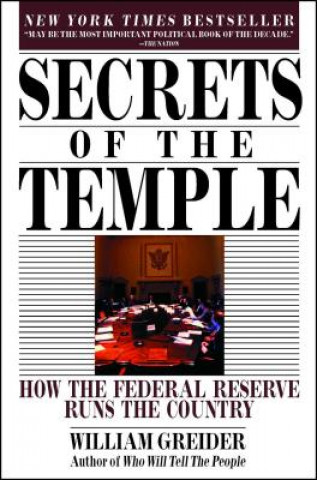
Το Κουρδιστό Πορτοκάλι κλείνοντας το σημερινό αφιέρωμα στον Χάρη και τον Μάκη οι οποίοι συνειδητοποιούν πλέον ότι δεν τους ανήκει τίποτε και είναι δυστυχισμένοι, τους καλεί να αγοράσουν από την Amazon από ένα αντίτυπο του βιβλίου του William Greider, Secrets of the Temple: How the Federal Reserve Runs the Country και να εντρυφήσουν στην ανάγνωσή του.
(Προς διευκόλυνσή τούς πρoσφέρουμε στο πιάτο την περίληψη)
Για παρηγορία μπορούμε να τους πούμε πως το γεγονός ότι πλησίασαν στο μονοπάτι που οδηγεί στο Ναό είναι σπουδαία εμπειρία γνώσης. Η γνώση είναι το απόκτημά μας σε αυτό το κόσμο.
Καλή τύχη!
PART ONE: SECRETS OF THE TEMPLE
Chapter 1: The Choice of Wall Street
In the summer of 1979, President Carter found himself stuck in the mud.
His popularity was dwindling by the day, and many in the nation viewed his
administration as a model of inconsistency and confusion. The next presidential
election was not far off, and a recent Gallup poll had shown that Democrats
preferred Ted Kennedy to Carter by a more than two-to-one margin (66 to 30
percent).
Carter and his inner circle decided it was time to turn his fortunes around.
For 10 days, he secluded himself at Camp David, and invited leaders from all
spheres of American life to tell him where he went wrong, and what he should
do about it. On Sunday, July 15, Carter famously delivered what would soon be
termed his “malaise speech” (Carter in fact never used the word). Carter told the
nation that they were suffering from a sort of spiritual crisis, that America was
losing its sense of unity and moral purpose. He criticized the nation as
materialist, saying “too many of us now tend to worship self-indulgence and
consumption. Human identity is no longer defined by what one does, but by
what one owns.”
Despite derisive coverage by the press, the speech resonated with the
American people. Carter’s popularity increased by 10 percent virtually
overnight. But Carter wasn’t finished yet. Determined to make a bold statement,
on the Tuesday after his speech Carter asked for the resignations of his entire
Cabinet. Carter would review each of them, and make the changes he found
necessary. Over the following few days, the heads began to roll. The Secretary of
the Treasury, W. Michael Blumenthal, would be replaced. So would the Secretary
of Health, Education, and Welfare, the Energy Secretary, the Transportation
Secretary, and the Attorney General.
Immediately, the actions Carter took to shore up public confidence began
to backfire in that other center of American power—Wall Street. After his speech
and the announcement of wholesale changes to his administration, the markets
turned downward. Short-term interest rates spiked. What worried Wall Street
were not abstract concepts like America’s moral center or sense of purpose, what
worried Wall Street was inflation. Throughout the Carter presidency and before,
inflation raged at unusually high levels—11% around the time of Carter’s speech.
High core inflation, only compounded by surging oil prices in the wake of the
1979 Iranian Revolution, meant that every dollar an American earned today
would only buy 89 cents worth of goods in a year. As a result, Americans were
borrowing money to buy goods today that they would pay off tomorrow.
The change that worried Wall Street the most, covered little by the press,
was the resignation of the chairman of the Federal Reserve, G. William Miller.
Miller was to replace Blumenthal as Treasury Secretary, but who would replace
SomeBookBlog
2
Miller? Markets began to get jittery fearing that the vice chairman, little known
Florida banker Frederick H. Schultz, might take over. Schultz was viewed by
many as a political crony, rewarded by Carter with the vice chairmanship for
raising campaign funds. Carter soon realized he had to calm the markets by
choosing a Fed chairman that Wall Street could trust to tamp down inflation.
Vice President Walter Mondale’s chief of staff, Richard Moe, was given
the task of vetting potential candidates. Moe sought the advice of many—leaders
in business, government officials, lawyers, labor leaders, and academic
economists. One name popped up over and over: Paul Volcker. Volcker was the
President of the New York Fed and an economist who had worked in
government and the private sector. In fact, his very first job was as a junior
employee at the New York Fed. What Moe heard from everyone was that
Volcker was eminently qualified, but what he heard from some disturbed him.
Volcker was described as rigidly conservative, independent, not a team player.
Moe urged Carter to look at other options. Carter did so, but when the president
of Bank of America Tom Clausen turned down the offer, Carter made his
decision. After Volcker’s nomination was announced, the stock and bond
markets shot up, as did the value of the dollar after a months long slide. Wall
Street had their man.
Chapter 2: In the Temple
Since its conception, the Federal Reserve Bank of the United States has
been cloaked in mystery, and subject to conspiracy theories. It was alleged that
the Fed was run by a select set of individuals—Zionists, Illuminati, Satanists—
who decided the fate of the nation and, indeed, the entire world through their
control of money. Though many such outlandish accusations came from the
fringes of society, even the average person had little understanding of how the
Fed worked, or what it did.
Who owned the Fed? In fact, the Fed occupied a unique position in the
American system, positioned in-between public and private management. At the
top of the Fed’s hierarchy were its seven governors, appointed by the President
and confirmed by the Senate for 14-year terms. These governors shared power
with the presidents of the twelve Reserve Banks, spread out all across the nation
from New York to San Francisco. These twelve presidents were elected by the
board of directors in their respective districts. The boards were made up of nine
directors, six of whom were elected by member banks of the Federal Reserve
System—private commercial banks. These private banks held stock shares in the
Federal Reserve Banks.
Monetary policy was decided by the Federal Open Market Committee, or
FOMC. In FOMC meetings, the governors had seven votes and the Reserve
Banks presidents had five, which rotated among the twelve presidents, with the
notable exception of the president of the New York Fed, who always had a vote.
That private interests played a role in the decision making process and owned
stock in the Reserve banks led many to accuse the Fed of representing a private
SomeBookBlog
3
club of bankers. In fact, these stock shares were practically meaningless, and the
greater weight of power on the FOMC committee was held by appointed
officials.
These stock shares did however once give rise to an illuminating incident,
in 1939. Representative Wright Patman, a populist from Texas, announced in a
House hearing that the newly constructed Federal Reserve building was owned
not by the US government, but by the twelve Reserve banks, who were in turn
owned by private commercial banks. Thus, said Patman, the Federal Reserve
building was not owned by the federal government and not tax exempt. This
remark gave rise to several years of legal wrangling, after the D.C. tax authorities
presented a bill that the Federal Reserve refused to pay, insisting it was a
government entity. In the end, after an auction of the building had been set and
postponed several times, the twelve Reserve Banks issued quitclaim deeds,
asserting that the Federal Reserve building was indeed owned by the Federal
Government.
What did the Fed do? To the average American, this was a more
complicated question still. The Fed controlled the money supply. It set interests
rates. This was all that was understood by the average American, but these
assertions were too simplistic. For instance, what is money? The Federal Reserve
did not use the word as the average American did. The Federal Reserve in fact
had multiple definitions of money. M-1, their most basic measure of money,
included all the hard cash Americans held in their wallets and their checking
accounts. M-2 included M-1, plus what money that was stored in less liquid
forms, such as savings accounts and money market mutual funds. M-3 included
all that was in M-2 and even less liquid instruments like certificates of deposit
held by banks or corporations. Finally, the measure of total liquidity, or L,
included all financial assets that could potentially be converted to cash, such as
treasuries, commercial paper, savings bonds, and more. The money of the
American people would slosh around the economy over and over, each dollar
being earned and spent many times in a year, and often moving between the M-
1, M-2, and M-3 aggregates.
Not only did the Fed define what money was, it created money, seemingly
out of thin air. In fact, the creation money was done not only by the Fed but by
every commercial bank in the normal course of business, and was as simple as
making an entry in a ledger. A bank made a loan to an individual or a
corporation, assessing that the borrowing entity would be able to make
repayments. The bank simply credited the money to their account. Money was
created based on a banker’s assessment of the future. If the bankers were wrong,
if the future did not turn out as expected, and enough loans went bad and
depositors lost enough confidence in their bank, the depositors would bang on
the bank’s doors and demand their money back. And they would find that the
bank did not have their money. This is where the Federal Reserve stepped in, as
the lender of last resort for the American economy.
SomeBookBlog
4
If a member bank did not have enough money in reserve, it would go to
the Fed’s discount window and borrow funds, or go to another bank that had
excess reserves and borrow from them. The price of this borrowing between
banks was known as the Fed Funds rate, and it was the interest rate the Fed had
the most control over and the rate that served as the foundation for all other
interest rates in the economy. The price of membership in the Federal Reserve
system was that the reserve rate for member banks was set by the Federal
Reserve. It was through its control over reserves and the Fed Funds rate that the
Fed influenced the economy.
To expand the money supply or contract it, the Fed sold or bought bonds
at the Open Market Desk at the New York Fed. When the Fed bought bonds, it
injected cash (reserves) into the banking system. These reserve deposits could
immediately be lent out, creating a multiplication process. If the Fed bought $100
worth of bonds, $16 may be kept in reserves and $84 lent out. Then 16% of this
amount would be kept in reserves and the rest lent out, and on and on. The
original $100 purchase would create around $500 in new deposits. The Fed
influenced the supply and demand for loanable funds, and therefore set shortterm
interest rates. The Fed had less control over long term interest rates—the
bond market often had its own ideas about the distant future. The price of money
influenced the amount of credit available to finance real economic activity. The
Fed controlled reserves, which influence bank lending, which influenced the
productive capacity of the United States of America and the lives of its citizens.
The governors, Reserve Bank presidents, and employees of the Fed saw
Volcker’s appointment as a long needed return to normalcy for the institution.
The Fed had previously been led by Arthur Burns, who was abusive toward and
manipulative of his fellow governors and others. After Burns came Bill Miller,
Volcker’s predecessor. Miller was considered to be unappreciative of the Fed’s
sense of protocol and his own position, and too close to the Carter
Administration. Volcker was a company man, so to speak, a veteran of the
system with decades of experience in banking and finance.
Chapter 3: A Pact with the Devil
Paul Volcker took the oath of office on August 6, 1979. The Fed had set a
growth target of 1.5-4.5% for the M-1 measure in 1979. When Volcker took office,
M-1 was growing at an annualized rate of 10%. Volcker quickly began sending
signals in his private and public remarks that he would make an effort to tighten
up the money supply. In their August 1979 meeting, the seven governors
decided to raise the discount rate from 10 to 10.5%. This move was relatively
small (though one must remember that that 0.5% gets multiplied by hundreds of
billions of dollars in loans), but Volcker still had to contend with some governors
who thought it too drastic. In their September meeting, however, Volcker
signaled that he felt more action was needed. He proposed increasing the
discount rate once more, but backed off when he saw his fellow governors might
not be with him.
SomeBookBlog
5
At the September meeting of the FOMC, the majority voted to increase the
Fed Funds rate from 11.5 to 11.75%. (It is important to note at this point that the
full FOMC decided the Fed Funds rate, but the seven governors alone decided
the Discount rate). Again, Volcker had wanted to take a more drastic step, but
moderated his position in order to ensure a majority. Slowly, Volcker was
preparing himself and his fellow governors to take such action.
In the late summer and fall of 1979, inflation was raging into the low
double digits. Inflation was fueling a speculative boom that worried many at the
Fed and elsewhere. Individuals, farmers, corporations, and other entities rushed
to spend now before prices rose again. Of course, their buying only led to a selffulfilling
prophecy—they drove the price up, encouraging still others to do the
same thing. The boom was across nearly all markets—real estate, precious
metals, paintings, and on and on. People were rushing out of dollars and into
tangibles, considered a more reliable store of value in inflationary times.. Though
some worried that more aggressive action could stop the economy in its tracks
and cause a recession, outside critics and members of the Fed began to worry
that the Fed’s moves were too gradual to make a difference.
One symptom of this was the growing popularity and influence of an
economist from the University of Chicago, Milton Friedman. Friedman had won
the Nobel prize in 1976 for what came to be called monetarist theory, or
monetarism. Friedman argued in his seminal work, A Monetary History of the
United States, 1867-1960, that the Federal Reserve was directly responsible for
exacerbating if not causing the crash of 1929 and the Depression that followed. In
his view, the Federal Reserve should follow a simple policy of expanding the M-
1 by 3% a year, the historical growth rate of the US economy. Many within the
Fed disagreed, arguing they had to make adjustments as necessary for
developments in the global economy. Despite strong opposition, monetarism
was growing in popularity inside the Fed and out, especially within the Reserve
Banks. Though Volcker was no monetarist, he would soon find reasons to
advocate a monetarist approach to Fed policy.
Traditionally, when the Fed wanted to increase interests rates, it did so by
announcing a target interest rate (the Fed Funds rate), and then authorizing the
traders at the open market desk in New York to buy or sell treasury bonds until
the target was reached. This approach had the advantage of keeping interest
rates steady and financial markets calm. Critics alleged that the Fed was paying
too much attention to the interests of traders on Wall Street. Monetarists argued
that a much more direct approach would be to control the money supply directly
through the reserve rates. Instead of targeting a price of money and hoping that
price would produce the desired results for bank lending and inflation, the Fed
would simply control the amount of dollars flowing through the economy. The
Fed had never taken this approach before. Though this method would contain
the growth of the money supply, many at the Fed believed that it would create
interest rate volatility as bankers adjusted to the change, and the Fed abhorred
instability.
SomeBookBlog
6
Still, though, Volcker saw several reasons to try exactly such an approach.
Volcker was convinced that drastic action—an increase of 2-3, possibly 4-5% in
the Fed Funds rate—was needed to curb inflation. But he doubted he could
cobble together a sustainable majority to vote for such action. Setting the reserve
rate higher would likely produce the desired shift in interest rates, while
distancing the FOMC from the move. Interest rate increases could be blamed on
“market pressures” (which of course was true but neglected the fact that those
market pressures had been set in motion by the Fed). With this approach,
Volcker believed he could get both the hawks and doves to go along.
Volcker also thought such a move would inject a note of uncertainty into
the system. By upsetting the Fed’s traditional mode of business, Volcker would
upset the psychological momentum of inflation; it was a warning to bankers that
interest rates may not increase steadily, that they could move quickly against
them. The bankers, thus warned, would become more cautious in their lending.
It was important that the Fed send a strong signal that it intended to curb
inflation.
Volcker proposed a reserve increase of 8% on the funds banks borrowed
to finance loan expansion. This point demands some explaining. Traditionally,
banks were constrained in their lending by the growth of their interest free
deposits—money parked in their banks by the workers of America. Then, in the
1960’s and 70’s, banks figured out another way to finance loan expansion.
Instead of relying on individual depositors, they could borrow large amounts of
funds at a low interest rate, and lend them out at a higher interest rate. In effect,
they could buy deposits. This allowed banks to dramatically expand their
lending. Volcker proposed raising the reserve rate on these borrowed deposits.
Hopefully, this would push short term interest rates up, and lead to a slight
decrease in long term interest rates as markets became more confident that
inflation would subside and lenders reduced the large inflation premiums they
were demanding. On September 28, the seven governors gathered in Volcker’s
office and agreed to support the move. Volcker would push the idea at the next
FOMC meeting, confident he could get the Reserve Bank presidents to go along,
as they were in general more inclined towards the monetarist position anyway.
President Carter, just some three blocks away, was not informed of the
impending shift.
Volcker would inform Treasury Secretary Bill Miller and chairman of the
President’s Council of Economic Advisors Charles Schultze of his plans the next
day as they flew together to the annual IMF conference. Of course, the Fed
chairman need not say anything to the President or his advisors, but Volcker well
knew that though the Fed was an independent agency, its actions must fall
within some broad consensus of what was allowable, or else it risked bringing on
enough heat that the President and Congress would strip that independence
away. Both Miller and Schultze opposed the move. Go ahead and raise interests
rates, they said, but don’t change the operating model. Such a move would create
volatility in the markets and lock the Fed into a policy it could not back out of.
SomeBookBlog
7
Nobody had to mention that the move would also likely bring on a recession just
in time for the 1980 presidential election. Despite their urgings to change course,
Volcker maintained his position. In the end, Carter acquiesced. He himself was
too politically vulnerable to fight with his own Fed Chairman. The FOMC met on
October 6, and approved the move.
Chapter 4: Behavior Modification
The impact of the rate increase was felt almost immediately. The Dow
Jones fell several percentage points; bond prices, gold, and other commodities
fell as well. For the next few weeks, short term interest rates bounced up and
down and up again, from 11.5% before the Fed moved to 18%, then 14%, then
16%. Though volatile, it soon became clear the rate was settling at a substantially
higher level.
And the effects were felt far beyond lower Manhattan. All across the
country, businesses and consumers had to reckon with the new reality set in
motion by the Fed. Construction, real estate, auto, and appliance sales were
particularly affected, as these industries depend heavily on credit. Nobody was
going to buy a mortgage with a 16% interest rate on it. These businesses found
themselves squeezed on both sides. Their customers couldn’t get loans to buy
their products, and they couldn’t get loans to maintain their inventories. Banks
across the nation curtailed their lending significantly. Smaller credit
organizations found that their depositors were leaving in droves, seeking the
higher interest rates offered by money market mutual funds. Such funds would
see their assets under management multiply several times over in the next few
years. All this pointed to one conclusion: the Fed’s policy was working.
It was an amazing fact that the organization responsible for this sudden
and dramatic change in behavior was staffed by unelected bureaucrats. Yet these
unelected bureaucrats had the power to chastise the American public at large for
behavior they considered extravagant. Like a parent, they could reward some
behaviors and punish others. Unfortunately, the costs of the Fed’s policies fell
unevenly on the American populace. The poorest Americans were least able to
deal with the higher interest rates. Individuals and businesses in higher tax
brackets could write-off a larger percentage of their interest payments. People in
the lower tax brackets paid nearly full freight. The Fed’s policy punished those
least responsible for the behavior the Fed found so reckless.
And, as the months went by, it became clear that this reckless behavior
was continuing. Part of the Fed’s October 6 announcement of higher marginal
reserve rates was an exhortation to the banks to curtail lending for speculative
purposes. Though the banks made sounds of agreement, their actions said
otherwise. In one of the most famous speculative events in history, dozens of
banks from around the country lent hundreds of millions of dollars to the Hunt
brothers, a pair of energy tycoons who made an attempt to corner the silver
market. When the silver bubble burst in March of 1980, it became obvious that
the Fed’s urgings went unheeded.
SomeBookBlog
8
The Fed’s attempt to alter behavior met resistance elsewhere, too. Though
auto sales and home building were down significantly, and small borrowers and
lenders were being priced out of the market or losing depositors, the largest
banks and corporations kept going. Credit became more scarce, but what
remained flowed upward. Corporations sought guarantees that their credit
needs would be met, and the large commercial banks could give these
guarantees. Commercial banks expanded their loan portfolios at alarming rates.
Part of the reason large institutions could do this was because they had access to
the Eurodollar market—hundreds of billions of unregulated US dollars parked
offshore. Through their foreign subsidiaries and branches, US banks could access
these funds to make more loans. From the Fed’s perspective, this represented a
huge leak in the system. A leakage of $50 billion to the US market could expand
the M-1 measure by 15%, far above the Fed’s target of less than 5%. It turned out
the Fed’s move was not as effective as it first appeared. The US economy was far
more adaptable and resilient than the governors had imagined.
In February, the FOMC agreed to tighten bank reserves further. The Fed
Funds rate was hovering around 13% at this time, the governors set the ceiling at
15.5%. Two weeks later, the Fed Funds rate increased to 15%. The FOMC met
again, and raised the ceiling to 16.5%. By March 6, this target too was pierced.
Volcker called the FOMC to raise the target again, to 17.5%, and the very next
day they decided to raise it again to 18%. Though this was far above the 12% rate
in October, banks continued to pump out more loans.
The reaction in Congress and the White House was surprisingly subdued.
Most Congressmen had little understanding of monetary policy, and were
willing to defer to the Fed. Carter had drawn up his own anti-inflation initiative,
but this was drowned out by the course of events. The White House became
increasingly worried that a recession was bound to hit before the 1980 election.
Ted Kennedy announced his attention to challenge Jimmy Carter for the
democratic nomination. And, on November 4, Iranians seized the American
embassy in Tehran and took more than sixty Americans hostage.
Chapter 5: The Liberal Apology
During the mid-to-late 1970’s, banks were leaving the Federal Reserve
system at an accelerating rate. Member banks are required to hold reserves with
the Fed and its Reserve branches, and the Fed did not pay interest on these
reserves. As a result, many banks found it more profitable to withdraw from the
system and place themselves under state regulations. State laws typically had
lower reserve rates and, more importantly, the reserves could be placed in a
correspondent bank that would pay interest.
When Bill Miller became Fed chairman, he decided something needed to
be done about this. He, and Volcker after him, argued that as banks left the
Reserve system the Fed lost some of its ability to implement monetary policy and
control the money supply effectively. Miller attempted to take unilateral action in
1978, but backed down under threat from Congress. The Fed would win out in
SomeBookBlog
9
the end, though, with the Monetary Control Act of 1980. The Monetary Control
Act was a major act of financial deregulation, a cause that had been gathering
steam in Washington for the better part of a decade. Though the Fed couldn’t
win on its own, it got what it wanted by riding this larger wave.
The act required all depository institutions—banks, S&Ls, credit unions,
etc.—to hold reserves with the Fed. In return, the Fed lowered the reserve rate
from 16.25% to 12%. This freed up billions of dollars for the banks, who could
now earn interest on these funds. Member banks would make the small
concession of paying for some of the Fed’s services, for instance the use of the
payment system, maintained by the Fed. In return for the endorsement of the
American Bankers Association, the Fed dropped its reserve requirement on time
and savings deposits entirely.
The legislation had other important provisions as well. It repealed
virtually all government limits on interest rates, allowing the banks to charge
whatever they liked. It also allowed banks to pay interest on checking deposits,
which would help them compete with money market funds. The Fed’s
Regulation Q, which set limits on the interest rates S&Ls and banks could offer
on savings deposits, would be phased out entirely over six years. This stripped
S&Ls of their competitive advantage over banks; over the next few years,
thousands of S&Ls would be pushed out of business.
All in all, the act was a tremendous victory for banks, especially large
banks (many smaller banks opposed the act). Lenders would earn higher returns,
and borrowers would have to pay more. Once the new rules were fully phased
in, banks would enjoy billions of dollars more in income every year. The fifty
largest banks would take home about 50% of those gains.
Volcker lobbied hard for the legislation, though he and some others in the
Fed had mixed feelings about it. What the Fed really gained was political cover.
The assertion that the Fed would be less able to control the money supply as
banks left the Federal Reserve system was dubious. As long as the system
contained a large percentage of the nation’s banks and the deposits they held, the
Fed could inject money in and count on it spreading throughout the system. Yes,
some banks had left the system, but the largest banks would never leave it. But
keeping the thousands of smaller banks in the system gave the Fed a nation-wide
network of political support. Even if some Congressmen attacked the large banks
in New York City, they would listen to the banks in their district or state.
Democrats preferred that small banks remain members; if the Fed only had
relationships with the largest banks, it might lead to an institutional bias towards
them and against the smaller banks. Of course, it could easily be argued that
such a bias already existed, but Democrats nonetheless feared making it worse.
Ironically, the Democrats’ concern for small banks led them to support a piece of
legislation that would allow large bank mergers, provide a windfall to the largest
financial institutions, and ultimately pave the way for the creation of nation-wide
banks at the expense of mom-and-pop shops.
SomeBookBlog
10
Given the democrats’ traditional support of labor and home builders
groups, it may come as a surprise that they supported financial deregulation. But
political opposition was worn down by inflation. In effect, America’s liberals
were apologizing to the owners of wealth for the great increases in inflation that
occurred under their watch. This retreat from their traditional values was years
in the making—inflation had been on the rise for the better part of a decade.
Indeed, in 1978, the Democrats approved halving the federal income tax on
capital gains. That same year they stopped the budget growth for programs that
aided the poor. Over the previous two decades, during which the Democrats
held majorities in both houses of Congress, corporations’ share of the federal tax
burden fell from 26 to 12%. At the same time, regressive Social Security taxes
were imposed.
The small savers and little old ladies on fixed incomes who the democrats
claimed to be protecting were largely fictional. At this time, 37% of American
families had no savings account at all. Those who had any significant amount of
savings were in the upper half of the income ladder. The legislation did little to
help those on the bottom half of the income ladder, it did a lot to help the 10% of
American families who owned 86% of the net financial wealth. The legislation
represented a massive redistribution of income upward. As Greider puts it, “the
little guys, once protected by government regulation, were free to pay more.”
Banks, on the other hand, were free to raise interest rates. The increased costs for
businesses fell on the consumer.
The Fed had some reservations about the legislation. The removal of
interest rate limits could make it harder for the Fed to slow down the economy
through the imposition of a credit crunch. Previously, once interest rates hit their
limits, lending and borrowing would stop, especially in the housing sector. Now
there were no limits. Financial institutions could charge as much as they wanted,
and borrowers could take on loans with enormously high interest rates. What if
borrowers kept on borrowing, believing inflation would persist despite the Fed’s
efforts? The money supply would continue to grow, and borrowers would keep
on borrowing until one day they overextended themselves and went bankrupt, at
which point the Fed would be on the hook to save the lenders. In order to
prevent this, the Fed would have to raise the price of money to nearly
unprecedented levels (the prime rate in early 1980 reached 20%). Financial
deregulation shifted some decision making authority to the private sector, but
the Fed would still be held responsible for maintaining order in the global
economy. This was Volcker’s worry.
Chapter 6: The Roller Coaster
In the early months of 1980, President Carter began pushing his own
program to control inflation. Worried about the poor economy’s implications for
his reelection campaign, Carter had told his advisors to come up with a program.
Their recommendation was to impose credit controls on the economy; it was a
move designed to cool off the economy and let interest rates come down slightly,
SomeBookBlog
11
without pushing the economy into recession. Credit controls were legal supply
limits on credit, and could only be imposed by the Federal Reserve.
Volcker was against credit controls, but Carter lobbied Volcker very hard
to impose them. Carter met with Volcker time and again, and repeatedly
included him in meetings with Congressional leaders and his own economic
advisors (meetings Fed chairmen were rarely invited to). In theory, the Fed could
refuse the President, but the Fed’s independence was limited by political
realities. It didn’t look good to publicly refuse the President.
On March 14, 1980, Volcker announced a program of credit controls. The
controls not only limited the amount of credit expansion done by banks but also
included, at President Carter’s insistence, limits on retail companies that issued
credit cards. Volcker acquiesced to the President’s wishes because Volcker
believed that he could structure the program in such a way that it would have
little, if any, effect. For instance, the restrictions on consumer borrowing and
credit cards exempted nearly every large purchase a consumer might make—
cars, furniture, appliances, mortgages, etc.. Volcker thought the program would
be one of moral persuasion rather than economic, more cosmetic than
substantive. However, both Volcker and the White House underestimated the
psychological effect the program would have.
Carter announced the program in a televised speech. Volcker held a
briefing the next day, after which a televised panel of Administration officials
discussed the program. The evening news repeated the President’s plea that
consumers stop borrowing. The result was a collapse in consumer spending,
which quickly brought on the long-feared recession. GNP fell by 10% over the
next three months; unemployment rose from 6.3% in March to 7.8% in July; per
capita disposable income fell; the housing market continued to decline
(famously, builders mailed two-by-fours and bricks to the Federal Reserve
building in protest). The credit controls were soon eased, but recessions create a
momentum of their own. The program had worked all too well.
While the economy was deteriorating, Volcker faced another crisis. The
Hunt brothers’ attempt to corner the silver market was falling apart. Silver prices
had come down from a peak of $52 per ounce to under $20. On March 27, the
price of silver lost a third of its value, from $15.80 down to $10.80. The Hunt
brothers were being asked to put up more collateral, and if the price fell any
further they wouldn’t have enough. They had borrowed some $800 million from
a dozen national and foreign banks, which were now in danger of going
underwater on their loans. Many on the Fed board were willing to see the Hunts
and their bankers fail, but Volcker was worried that such an event could spark a
larger panic in a time of economic uncertainty. Volcker helped arrange a private
bailout of the Hunt brothers, who were able to restructure their loans to avoid
default. In effect, Volcker approved a massive exemption from the credit controls
he had imposed only weeks earlier, an exemption offered to institutions who had
ignored his October 6 directive to avoid speculative loans. But it was his duty to
prevent bank failures, so Volcker made the exemption.
SomeBookBlog
12
Since October the Fed had been struggling to tamp down the money
supply, by April it seemed they had gone too far. The April numbers showed
that the M-1 aggregate was falling at an annualized rate of 17%, far beyond the
Fed’s target. Consumers were both paying off their debts—wiping deposits off
the books—and shifting their money from checking accounts to other financial
instruments to take advantage of high interest rates—in effect moving their
money from M-1 to M-2.
According to the monetarist approach the Fed adopted on October 6, the
solution was simple. If the money supply was falling too quickly, pump in
reserves. In late April 1980, the FOMC approved just such a move. Though many
in the FOMC had reservations, Volcker argued persuasively that if the Fed was
to be taken seriously it must follow its new operating model, and that the depths
of the recession were unknown. The consequences of not acting could be
devastating. The open market desk in New York began pumping in reserves
furiously—adding reserves at an annualized rate of 14% in March and an
unprecedented 48% in May. Interest rates began to fall dramatically, from 18% to
13% in the two weeks after the Fed’s April meeting, and still further from there,
to 10.5%, and then to 8%. By July, the credit controls imposed in March were
dismantled.
By midsummer of 1980, the economy seemed to be turning around. The
recession had ended. Personal consumption began increasing once again,
housing starts increased by 30% in June, business investment turned around as
well. The GNP went from contracting at a 10% rate to expanding at a 2.4% rate.
And, inflation turned upward once more to 11%. The Fed had almost completely
undone months of work. Over ten weeks the Fed had doubled the price of
money, and then let it fall nearly to where it started. The M-1 was once again
growing quickly—11% June, 13% in July, 22.8% in August (monthly rates). This
was nearly four times the Fed’s target. It appeared the Fed had totally lost
control; Volcker would later say that the easing on interest rates in mid-1980 was
his greatest mistake as chairman. Interest rates were on a roller coaster ride, and
would soon be on the climb once again.
By September, the members of the FOMC had come to a consensus. They
needed to take action to slow the growth of the money supply once again.
Though the Fed was reluctant to act during the election season—Fed officials
were very sensitive to accusations from politicians on both sides that it pumped
up the economy to support the incumbent or tightened it because it preferred the
challenger—the FOMC felt it could delay no longer in light of the recent
numbers. The FOMC voted to increase the discount rate and tighten the money
supply every month during the fall of 1980. By December of 1980, the Fed Funds
rate would reach 20% once again.
Despite the determination of the members of the FOMC to avoid political
entanglements, they were attacked by both sides. During the summer, when the
Fed was lowering rates, they were accused of pumping up the economy to
improve Carter’s chances. In the fall, when the Fed began raising rates, Carter
SomeBookBlog
13
criticized them for raising rates too severely. In November, Reagan would win
the election with 51% of the vote to Carter’s 41%. It appeared that the Fed’s
hiking of interest rates over the two previous months did have some effect on
Carter’s share, as he was leading 45% to 42% before the Fed’s action. Of course,
many other factors played a role in Carter’s defeat.
The Fed also came under attack from the business community, which
criticized the Fed for waffling and refusing to hold the line against inflation. Still
others—including some inside the Fed—criticized the Fed’s new operating
policy. These critics said that targeting the money supply directly allowed too
much variation in interest rates, which in turn affected the money supply. Thus,
the Fed was chasing its own tail, responding to the lagged effects of its last policy
move. In the fall of 1980, there was solid ground for such criticism, although it
must be said that the monetarist approach called for a steady increase or
decrease in the money supply, something the Fed had hardly accomplished.
Volcker’s first year as chairman ended in embarrassment. He had doubled
interest rates, halved them, and doubled them again, along the way bringing the
nation through a steep recession and recovery. And he got very little in return—
by year’s end inflation was still around 10%, only slightly less than what it had
been when Volcker took office. Volcker was now determined to hold the line
against inflation, while at the same time easing the automaticity with which he
had used the monetarist approach.
The Fed’s actions were complicated by certain facts of monetary policy
that aren’t mentioned in textbooks, and deserve explanation here. The textbook
picture of monetary policy is that the money supply starts with the Fed, which
decides the level of reserves to provide to the economy single-handedly. The true
picture is more complicated. In reality, banks make loans, and then scramble to
find the reserves to support them. They do this by borrowing from the money
market or the Fed’s discount window (they are aided by the fact that they report
reserve levels to the Fed with a lag, every two weeks). The Fed nearly always
lends to the banks that come to the window, to avoid setting off a liquidity crisis.
But, the Fed chooses the price it charges at the window and, if a bank comes to
window too often, the Fed may start an investigation into that bank’s lending
practices. Meanwhile, over the longer term, the Fed could tighten or ease the
money supply through the Open Market Desk. Eventually, by balancing the
discount rate and the Fed Funds rate, the banks would feel the weight of the
Fed’s moves and change their behavior accordingly.
SomeBookBlog
14
PART TWO: THE MONEY QUESTION
Chapter 7: The God Almighty Dollar
Greider explores the Federal Reserve’s mystique, which is inextricably
tied to its management of money. The psychological power of money, the
importance attached to it, is seemingly rivaled only by God. Indeed, for centuries
religious men have condemned the worship of money, denouncing it and the
interest it produces as the work of the devil. Perhaps they did so out of a sense of
competition, and rightly so. Money, like God, confers power. It gives man the
means to extend his reach beyond his immediate environment, and even beyond
his own lifetime. The mere fact that one possesses enough money to do
something can provide as much satisfaction as actually doing it—akin to the
superiority the man who can play the piano feels over the man who can’t, even
when he isn’t playing. The detailed attention people give to the use of their
money after their death in the writing of their wills shows money’s capacity to
fulfill the natural longing for an afterlife. A man may die, but his money lives on.
The capitalist system depends on millions of people putting their faith in
scraps of paper, pieces of plastic, numbers on a screen. Though no longer backed
by gold, they believe the numbers symbolize something real. Modern advertising
has been enormously successful in getting people to attach their sense of self and
individuality to the accumulation of cash. Acquiring money is an end in itself—
seemingly, money does not only give its owner power, but exerts a power over
its owner.
The root of the Fed’s mystique is the religious and spiritual significance
we attach to money. Money has power over us, and the Fed has power over
money. Its governors explain their actions in a dense, technocratic language the
common man cannot understand, and does not want to understand. The Fed’s
pronouncements are akin to religious orders given by high priests. This helps
explain the Fed’s peculiarity as an institution. America is a democracy, with
levels of democratic representation piled on top of each other. Even the
installation of a stop sign is subject to review by the people. And yet, the
American people are happy to let their money be managed by a small group of
people, mostly men, who are independent of their control or even the
President’s. Money has huge political implications, but its management is
beyond politics.
Chapter 8: Democratic Money
It is a great irony that many of the ideas that led to the creation of the
Federal Reserve System came not from Wall Street or the world of academia, but
from poor, uneducated, conservative farmers in the South and Midwest.
The trouble began with the Civil War. To finance the Union army,
Congress suspended the gold standard in 1861, and Lincoln borrowed over $2
SomeBookBlog
15
billion dollars and issued $500 million “greenbacks”—a new currency not backed
by gold. Prices rose by 74% between 1861 and 1864. After Lincoln’s death, the
Republican party became ever closer to powerful Eastern business interests. They
reinstated the gold standard, but at the prewar parity level—$20 per ounce of
gold. This set off a 30 year period of deflation. Prices fell to prewar levels and
then still further, as farmers increased yields in an attempt to keep their incomes
the same despite the falling prices, exacerbating the problem. To make up for
their losses farmers took out loans at ruinous interest rates. They were further
beset by outrageous shipping costs imposed by the railroad companies. When
farmers could no longer make payments on their loans, the banks seized their
land. Over the course of a few decades, millions of famers were reduced from
landowners to sharecroppers.
In the late 1800’s, an organization of populist famers known as the
Farmers Alliance was spreading across America—from its origin in Texas across
the South to the Carolinas and up north to the Dakotas. They advocated for a
progressive income tax, railroad regulations, legal rights for labor unions and,
most importantly, government regulation of money. Up until the Federal
Reserve System was created in 1913, the “lender of last resort” for the American
economy was usually a consortium of Wall Street banks. The money supply was
constricted by the gold supply, so the US economy regularly ran into short-term
credit problems (it took 15 days for gold supplies borrowed from Europe to reach
the US). Farmers would borrow from their local banks, who would turn to the
big city banks, who would eventually turn to the centers of American financial
power: Chicago, St. Louis, and Wall Street. Time and again J.P. Morgan would be
called on to organize a syndicate to the bailout the nation’s banks. The Wall
Street tycoons were able to charge high interest rates for their services, and in the
process, many of these small banks failed. This is the origin of populist anger at
Wall Street that reverberates in American politics to this day. And, despite the
efforts of Wall Street, the US was hit by recessions and depressions repeatedly: in
1873, in 1882, and a full-scale panic in 1893. It is a testament to their anger at Wall
Street that these famers turned to the none too popular politicians in Washington
to solve their problems. The farmers wanted a flexible money supply, regulated
by the government on a democratic basis, that would grow at a rate
commensurate with the growth of the overall economy. One of the leaders of the
Farmers Alliance, Charles Macune, proposed a scheme in which the government
would lend directly to farmers at low interest rates, going around the banks
entirely. What they got in the 1913 Federal Reserve bill would be a far cry from
what they wanted.
The populists’ grand agenda would soon be co-opted by the democratic
party, and largely emasculated. After the People’s Party fielded their own
presidential candidate in 1892 and lost, in 1896 the populists pinned their hopes
on William Jennings Bryan. By now, their agenda was simplified to advocating
for the adoption of silver money, which would create inflationary pressure and
ease the pain of the farmers. Bryan lost, and the movement lost all momentum
SomeBookBlog
16
when new gold stores were discovered in Alaska, Colorado, and South Africa.
The new stores led to a new inflation, lasting some twenty years. Some elements
of the populist agenda would be adopted decades later under New Deal
legislation—for instance government purchase and storage of crops, and
subsidized credit for farmers.
The Federal Reserve bill would preserve the position of banks in the
American system, allowing them to distribute credit as they wished, charging as
much as they wanted (subject to interest rate limits). The populist moment was
lost, but it is a reminder that the money question is a political question. Though
the Fed is isolated from politics by law, the actions it takes have profound
political consequences. The divide between lenders and borrowers has always
boiled under the surface of American politics, and there it remains.
Chapter 9: The Great Compromise
Strangely enough, the cause of the populists—those uneducated farmers
and laborers who directed their anger at the financiers of Wall Street—would be
taken up by those same bankers. Every autumn, farmers needed credit to finance
the harvest. They would turn to their local banks, who would turn to the city
banks, who would turn to Wall Street, as well as Chicago and St. Louis. If even
these three centers of financial power failed to meet the demand, they could
sometimes turn to London or Paris for the necessary reserves. In the two decades
leading up to the passage of the Federal Reserve Act, these contingencies failed a
number of times. Once banks started to fail, panic would spread and depositors
would run on the banks, causing even otherwise solvent banks to collapse The
banking panics of 1893 and 1895 were resolved only when J.P. Morgan organized
syndicates of Wall Street bankers who pooled together enough funds to save the
system. In effect, these financiers decided who survived and who did not. This
created considerable resentment in the countryside towards the so-called
“money trust.”
Even J.P. Morgan and his fellow bankers could not come up with the
funds necessary during the panic of 1907. This time, even the third largest bank
on Wall Street—the Knickerbocker Trust Company—failed. In desperation, they
turned to the Federal government, which provided the hundreds of millions of
dollars in emergency loans necessary to stave off a total collapse of the system.
This panic convinced Wall Street that money reform was necessary to their own
survival.
The first draft of what would become the Federal Reserve Act was written
at an infamous, clandestine meeting held at Jekyll Island, Georgia, in 1910. Under
the guise of going duck hunting, Rhode Island senator Nelson Aldrich took some
of America’s most prominent bankers to the island to discuss monetary reform.
They came up with what would become known as the Aldrich Plan. The plan
called for a reserve system broken up into 15 regions, controlled by a board of
commercial bankers and empowered by the government to create money and
lend reserves to private banks.
SomeBookBlog
17
In 1912, Woodrow Wilson was elected President. The Democratic Platform
was explicitly opposed to the Aldrich Plan, as many democrats believed it gave
far too much power to private interests. A new bill, which kept the fundamentals
of the Aldrich plan intact, was proposed by representative Carter Glass and
senator Robert Owen. The new president, who was less distrustful of the great
financial institutions than many others in his party, accepted the outline of the
new plan but added a Federal Reserve Board on top of the privately controlled
network of regional reserve banks. The board would be appointed by the
president and, until the reforms of 1935, would include the Secretary of the
Treasury and the Comptroller of the Currency. As a consolation to the bankers, a
Federal Advisory Council of private bankers would be established to advise the
Federal Reserve Board.
The new plan called for a hybrid institution the likes of which had never
been seen before. Predictably, and to Wilson’s satisfaction, the plan was angrily
denounced by both sides. Eventually the bankers got on board, and the act was
passed and signed into law in 1913. At the time of its passage, the Federal
Reserve Act was celebrated as a great victory over the “money trust.” However,
looking back, the Act was a victory for the bankers. At the time, as historian
Gabriel Kolko has written, the large banks were in fact losing influence rather
than gaining it. The large industrial firms of the west and south were finding that
they could finance themselves using their own profits, without having to turn to
Wall Street. Thousands of banks were springing up across the country, mostly in
these regions. Far from being reigned in, Wall Street would now be able maintain
and expand its influence—until the crash of 1929.
The passage of the Federal Reserve Act had implications far beyond the
management of the money supply. The Federal Reserve was an institution of
Republican and Democratic parentage, and run as a hybrid institution between
public and private interests. It was a bargain struck between the most powerful
forces in American politics. Over time, one of the many consequences of the new
system would be to almost entirely remove the money question from American
political debate. Though the Fed’s actions could have profound effects on the
lives of the American people, and therefore profound political implications, its
role in the economy would eventually be taken for granted by both sides of the
aisle. The Fed was one of the first initiatives in a growing movement to remove
the work of running the country from the whims of the public. Money would
now be managed by technocrats hidden away in their temples, emerging every
six weeks to announce their actions in statements full of dense jargon,
impenetrable to the layman. Neither Congress nor the President could influence
these actions.
This was in line with other changes occurring in American life at this time.
The Progressive movement, determined as it was to root out political corruption,
called for “good governance” practices. This included the use of unelected city
managers to replace the old corrupt machine politics that had existed for
generations. There was a shift away from democratic government towards
SomeBookBlog
18
technocratic expertise. The leaders of the progressive movement were for the
most part educated members of the middle and upper middle classes—
professionals, managers. Not surprisingly their new movement called for the
professional management of government affairs. This was also a reflection of
changes occurring in the business world. The old idyll of the self-sufficient
American farmer, or the lone, bold capitalist adventurer, was dying at the hands
of the corporation. To manage the difficulties of an increasingly complex world,
organizations were formed and professional managers brought in to run them.
What worked for private business was applied to government.
America, once a rural nation, was becoming an urban one. American
literature, once dedicated to celebrating the virtues of self-sufficiency and
individualism, now explored the feelings of loss and alienation associated with
city living, with being a mere employee who worked not for himself but as a cog
in a larger machine. The compensation for their emotional loss was material gain.
They put their trust not in themselves, but in larger more distant forces who,
empowered by their own expertise and new technology, were supposedly more
fit to run the country. This was the bargain that created the Federal Reserve.
The Federal Reserve would have a great decade in 1920’s. Though the Fed
played a role in starting recessions in 1920, when the Fed tightened the money
supply, and again in 1926, when the Fed failed to ease, the “roaring twenties”
brought an entirely new level of prosperity to America. Labor productivity
increased by some 60%. New technologies like automobiles, radios, and
refrigerators came onto the market and then into the homes of millions of
Americans. As Milton Friedman later wrote, this was the Fed’s “high tide.”
Then came October, 1929. Many have blamed the Fed for creating the
crisis with easy money policies that encouraged speculative lending and pumped
up the stock market. Indeed, the Fed did ease credit conditions in 1927 to combat
what it perceived to be a potential recession ahead. In August of 1929, worried
about speculative activity in the stock market, the Fed made a modest reversal by
increasing the discount rate. But it was too little too late, and in October the
market crashed, ushering in the Great Depression. Over the next four years, 40%
of the nation’s banks failed, and unemployment rose to 25%.
Though opinions differ as to the role the Fed played in starting the crisis,
the Fed’s much more serious error was in failing to ease money conditions after
the Depression had started. The forward thinking Benjamin Strong, president of
the New York Fed and the Fed’s most important policy maker at the time, died a
year earlier, in October, 1928. The Fed’s new leadership viewed the downturn as
necessary but painful medicine for irresponsible speculation. Writing in 1929,
George Norris of the Philadelphia Fed said, “The consequences of such an
economic debauch are inevitable. We are now suffering them. Can they be
corrected or removed by cheap money? We do not believe that they can. We
believe that the correction must come about through reduced production,
reduced inventories, the gradual reduction of consumer credit, the liquidation of
security loans and the accumulation of savings through the exercise of thrift.”
SomeBookBlog
19
President Hoover received advice along the same lines, and did little to ease the
nation’s suffering.
The Fed did not lower interest rates, except for one abortive attempt in the
spring of 1932. And this was only after the Fed raised the discount rate two points
in October of 1931. In their private deliberations, many Fed officials argued
against lowering rates because such a move would hurt bank profits. Some have
argued that the Fed refused to act because it did not have the tools or knowledge.
Greider argues to the contrary. Some in the Fed did argue for lowering rates, and
all Fed officials understood they had the tools to do so. They simply decided not
to use them. By relying principally on the discount rate to control the money
supply, the Fed took a de facto pro-cyclical policy, deepening slumps and
accelerating booms. In the future, the Fed would implement countercyclical
policies, otherwise known as leaning against the wind.
Chapter 10: Leaning Against the Wind
The Federal Reserve’s damaged reputation would be restored during Franklin Roosevelt’s presidency by Marriner Eccles. A Mormon Republican from Utah, Eccles was an odd fit for the Roosevelt Administration. In 1931, Eccles was still a private banker, the owner of one of America’s first bank holding companies, which controlled several dozen banks in Utah and across the Midwest. For the early years of the Depression, Eccles’ focus was simply on preventing the failure of his banks, which he managed to do with a 100% success rate. Only a high school graduate, Eccles became a self-educated economist through his own efforts to understand the Depression’s causes and potential solutions. He concluded that the Depression was caused not by profligate spending and irresponsible consumers, but by too much saving.
To get the economy back on its feet, money would have to be put in the hands of consumers
who would spend it. The only way to do this on the scale needed was to work
through the federal government. Eccles’ analysis preceded Keynes’ General
Theory by three years.
By 1932, Eccles was testifying before the Senate, recommending policies
like unemployment relief, public works projects, agricultural allotments, federal
insurance of bank deposits, old-age pensions, and federal regulation of the stock
market. Over the next three years, Eccles would be brought into the Roosevelt
administration as one of the President’s principle advisors, and virtually all of his
recommendations would be enacted into law.
Eccles was the architect of the Banking Act of 1935, which restructured the
Federal Reserve. The Secretary of the Treasury and Comptroller of the Currency
were removed from the Board of Governors, further insulating the Fed from
political influence. The legislation took away much of the power of the twelve
Reserve Bank presidents by creating the Federal Open Market Committee, on
which the Board of Governors would have seven of the twelve votes, with the
remaining five rotating among the Reserve presidents. The Act also forbid
paying interest rates on deposits (Regulation Q), and empowered the Fed to
SomeBookBlog
20
discourage speculative lending by setting margin requirements. Roosevelt
appointed Eccles chairman of the Fed in 1934, a post he would hold for the full 14
year term. Under Eccles’ leadership, the Fed placed much more emphasis on
open market operations rather than the discount rate. And, instead of buying
commercial paper, under Eccles the Fed began primarily buying Treasury bonds.
Eccles was also an important advisor in the creation of the FDIC, which
effectively stopped bank runs across the country, and the Glass-Steagall Act,
which effectively split commercial and investment banks.
In 1936, Keynes published his General Theory, finally bringing the ideas
espoused by Eccles and others into the mainstream of economic theory (of course
there was significant resistance, but Keynes described his theories with such
rigor that they were at least made respectable). Then, in 1937, a new recession
caused by reduced federal spending and a tightening on reserves by the Fed
finally discredited the classical economic theory. Keynes’ ideas did indeed
provide a new deal for the American system—it gave something to everybody.
Consumers were encouraged to spend rather than save, so businesses could
invest and expand production, and round and round it went. World War II
would further prove the point, as unprecedented government spending and
borrowing increased the nation’s productive capacity by 75% in just five years.
The Fed maintained a passive stance throughout the War and for years
after. In the face of war, all pretense of independence was lost, and the Fed
obeyed the Treasury’s command to keep interest rates—the price of the
government’s borrowing—low. As the War progressed Eccles, to the annoyance
of many in the Administration, began advocating for a stricter policy to avoid
runaway inflation after war’s end. The inflation did occur—8.5% in 1946 and
over 14% in 1947—but the nation’s real productive capacity increased so much
that it hardly mattered. Economic contraction was feared more than inflation.
The outbreak of the Cold War, and the Korean War in 1950, meant that
defense spending did not significantly decrease after the end of World War II,
and the Truman administration pressured the Fed to maintain low interest rates.
In 1948 Truman, annoyed with Eccles’ demands for stricter money, refused to
reappoint him as chairman, Thomas B. McCabe was offered the job instead. The
argument would continue, however. For the next three years, the Fed continued
to acquiesce to Treasury’s demands, though it issued louder complaints about
the policy. The issue was resolved in 1951, when the President and the FOMC
managed to strike a bargain, the Treasury-Federal Reserve Accord, in which the
Treasury acceded to slightly higher interest rates and allowed the Fed more
independence. William McChesney Martin, who presided over the meeting, was
appointed Fed chairman in 1951. Interest rates climbed steadily over the course
of the 1950’s. Eisenhower’s election in 1952 finally gave the Fed a free hand to
handle the money supply; Republicans shared the FOMC’s concerns about
inflation and sound money.
In 1960, the Kennedy Administration cut taxes and increased spending to
counteract a recession that began in April 1960 (six months after the Fed had
SomeBookBlog
21
halted increases in the money supply—notably, Nixon partially blamed the Fed
for his defeat). The “New Economics” of the Kennedy administration continued
under Johnson. Federal spending increased to finance his Great Society programs
and the war in Vietnam, without corresponding increases in taxes. From
February 1961 to December 1969, the US experienced 106 months of
uninterrupted growth, the longest period in its history. This was the age of “fine
tuning” the economy; politicians and academics alike believed that they had
finally beaten the boom-bust cycle, they could prevent recessions and control
inflation and employment levels at will and with precision.
Keynesian economics calls not only for tax cuts and spending increases in
time of recession, but also tax increases and spending cuts when the economy
overheats. When all the slack is taken out of the labor market, and the economy
begins operating above capacity, inflation is inevitable, and government must
use fiscal policy to counteract it. But this side of the Keynesian theory proved
much harder politically—indeed, impossible. A tax increase was passed in 1968
to finance the war, but it was too little too late. The New Economics was
unraveling in the face of political realities. The Fed was pressured into following
an accommodative policy, and inflation resulted—5% in 1968, 6% in 1969.
In 1969, the Fed finally acted to slow the growth of money and credit, and
recession resulted. This time, however, inflation did not slow as unemployment
rose. The unusual condition of rising unemployment and prices would be termed
“stagflation.” In August, 1971, with inflation still speeding along and an election
year looming, Nixon announced price and wage controls and changes to the
exchange rate regime. The post-War order created in Bretton Woods that had
allowed stability in international trade by pegging the dollar to gold and foreign
currencies to the dollar was done away with. The US had been paying out large
sums of gold abroad for the better part of decade by this point, and the regime
would have collapsed by default if the trend had continued. The dollar, and all
major world currencies, would now “float” on international markets, their value
changing daily.
In 1973, six months after Nixon dismantled the gold standard for good,
the OPEC nations quadrupled the price of oil. At the time the move was blamed
on greedy sheiks, but the dollar’s devaluation was an important motivation. The
dollar had lost a third of its value over the previous six years, with a
corresponding decrease in the real value the OPEC nations received for their oil.
So they increased the price and then some to account for future US inflation.
Nixon replaced Fed chairman William Martin with Arthur Burns in
January, 1970. Nixon had been very clear with Burns about what he wanted:
“lower interest rates and more money.” Burns delivered, and eased credit
conditions at the next Fed meeting just two weeks later. Burns’ management of
the money supply would come into question after Nixon’s reelection in 1972.
Nixon pumped up the economy with more spending that year, while keeping
inflation in check with price controls. Burns’ Fed grew the money supply at a
monthly rate of 11% throughout 1972, compared with just 3% the year before.
SomeBookBlog
22
Burns was accused of pumping up the economy to help Nixon win reelection.
Despite vigorous denials by Burns and others at the Fed, Nixon had sent a clear
message that he wanted easier money, and he got it.
Inflation reached 8.8% in 1973, and would eventually rise to about 12%.
The Fed pushed up interest rates, causing the worst economic contraction since
the Depression—the economy wouldn’t begin recovery until March of 1975.
President Carter replaced Burns with G. William Miller in 1978, and Volcker not
long after.
PART THREE: THE LIQUIDATION
Chapter 11: A Car With Two Drivers
On January 20, 1981, Ronald Reagan was inaugurated as the 40th President
of the United States. In his inauguration speech, Reagan repeated the promises
he had been making for the duration of his campaign: To cut taxes, reduce
spending, tackle inflation, and increase productivity and employment. “In this
present crisis,” Reagan famously said, “government is not the solution to our
problem; government is the problem.”
Reagan’s economic agenda brought back three strains of classical
economic orthodoxy that had been out of fashion for some fifty years by the time
he delivered his speech. Balanced budgets, sound money, and a reduction and
flattening of the progressive income tax. Reagan brought economists from all
three schools of thought into his administration, and left it to them to work out
any conflicts. Reagan supported Volcker’s tightening of money and credit to
combat inflation. Yet Reagan also planned to stimulate the economy through tax
cuts that would amount to over $100 billion per year. Reagan advocated
balanced budgets, and recommended cuts in domestic spending to achieve them,
but he also planned to increase defense spending by some $100 billion—more
than the proposed cuts in other discretionary spending. This was a recipe for
even larger deficits, which would push inflation up, not down.
Members of the administration argued vigorously over setting priorities.
The economic forecast they would eventually produced was, by their own
admission, an article of faith more than anything else. To achieve their forecasts
of lower inflation, greater growth, and balanced budgets, they relied on
assumptions of changes in economic behavior. Consumers and businesses
would, if they considered the Administration’s policy credible, change their
expectations, and the inflation premium would disappear virtually overnight.
But the Fed chairman knew better. Even before Reagan was inaugurated,
Volcker made speeches warning—in the circumspect and obscurant language
typical of a Fed chairman—that significant pain lay ahead. If the administration
was going to pursue an expansionist fiscal policy, then the entire burden of
SomeBookBlog
23
curtailing inflation would fall on the Fed, and the result would be high interest
rates for a longer time and, potentially, recession. Volcker understood very well
that the inflation premium existed not only in people’s minds, but in contracts
enforceable by law. If the Fed restricted the nation’s nominal GNP growth, and
inflation persisted at double digit rates, the real growth of the economy would be
low or even negative. The chairman’s warnings were ignored by the press and
most Washington decision makers. The Fed’s independence meant that no
coordination was necessary—nor was it desired. The executive branch and the
Fed were free to pursue conflicting policies.
From January to March, 1981, the Fed eased up on interest rates a bit,
allowing short-term rates to fall from 20% to 16% (still very high by historical
standards). Long-term rates, however, went in the opposite direction.
Bondholders were rattled by the Administration’s expansionary economic policy
and budget deficits, and skeptical that the Fed would hold the line against
inflation. When numbers came in early April indicating rapid growth in M-1,
bond prices took a tumble. Bondholders—a group made up of the nation’s
wealthiest individuals, corporations, and banks—were an important
constituency for the Administration and the Fed as well. Bondholders and the
Fed were kindred spirits—both focused on long-term stability and low inflation.
The rise in long-term interest rates represented a critique of Fed policy, one that
was given careful attention.
The bond markets were not the only ones criticizing the Fed. Members of
the Reagan Administration blamed the Fed’s lack of credibility for foiling the
change in expectations their “rosy scenario” depended upon. Reagan summoned
Volcker to the White House to speak to the chairman about the dangers of
“zooming” the money supply. The talk was not quite the lecture it was reported
to be by the press—Volcker certainly did not play the part of pupil to Reagan or
his economic advisors—but nonetheless the White House’s position was made
clear: more tightening was needed. The Fed responded to the critiques, and by
the end of April began tightening up again.
Though Volcker made promises of gradualism, the Fed stepped hard on
the brakes. By the second week of May, the Federal Funds rate was above 18%.
Alarmed by the sudden surge in M-1 during April, the Fed decided to lean
towards the hard side. If it were to err, this time it would err on the side of too
much tightening rather than too little. But there were good reasons to think that
the Fed did, in fact, err.
April money numbers are always confused by the fact that Americans are
drawing down on savings accounts to pay taxes, while at the same time the
government is sending billions of dollars out in income tax returns. The Fed
ignored other economic signals that pointed in the other direction—commercial
banks were borrowing heavily at the discount window, and inflation had
subsided from double digits to 7.2%. These and other indicators showed the
Fed’s previous six months of tight money were working, but the Fed largely
ignored them in their analysis, and chose to focus on the money aggregates.
SomeBookBlog
24
But another complication presented itself here, too. The Monetary Control
Act of 1980 was coming into effect that April, and millions of Americans were
transferring money into newly authorized NOW accounts—checking accounts
that paid interest, blurring the lines between traditional savings and checking
accounts. The Fed was unsure whether these accounts should be counted in the
M-1 or M-2 aggregates. They came up with a NOW account-adjusted measure,
M-1B, but in truth they did not know how much money was flowing into these
accounts. Since October 1979 the Fed had opted for faithfully following the
money aggregates. Now those aggregates were breaking down, and the Fed was
refusing to change course for fear of sending inconsistent signals and
embarrassing itself.
By July, 1981, the money supply had shrunk significantly, the Federal
Funds rate rose above 19%, and the economy once again fell into recession. But
the Fed was not as incompetent as it may have seemed. The Fed had made a
political decision. The Administration, the bond markets, and the Fed’s Advisory
Council were all pushing for a harder policy. The Fed had been badly
embarrassed by its premature easing of money in the 1980 rollercoaster, and this
it time opted for a harder policy to shield itself from criticism and protect its own
prerogatives. Considered on political terms, the Fed’s decision made perfect
sense.
During the summer of 1981, the Reagan Administration was trying to
push its tax cuts through Congress. By this time, the President’s economic
advisors began to realize that the “rosy scenario” predicted in their first forecast
would not materialize. Congress had whittled down the spending cuts to half the
originally proposed figure of $40 billion, and the tax cuts were increased from
$540 billion over five years to nearly $750 billion. On July 27, Reagan gave a
televised speech saying that budget deficits would come down year after year,
until a balanced budget was reached in just a few years. Even when Reagan gave
this speech, his economic advisors knew better. Over the next five years, budget
deficits would skyrocket, and the national debt would double.
Volcker and the Fed Board were alarmed by the tax cuts, another reason
they chose to keep rates high through the summer of 1981. Many felt at the time,
and in retrospect, that Volcker overreacted. The tax cuts would be phased in over
several years, and their inflationary effects would not hit quite as strongly or
quickly as Volcker and the Fed expected them to. Volcker and vice-chairman
Schultz discreetly lobbied against the tax cut bill, but it passed with large
majorities in both houses.
The combination of the tax and spending cuts along with high interest
rates would prove to have highly regressive effects on income distribution. The
tax cuts benefitted the wealthy far more than the middle and lower classes (some
of whom actually lost money when spending cuts were factored in). As inflation
subsided and nominal rates remained high, the real rate of return on financial
assets reached record highs. During the summer of 1981, the real interest rate on
bank loans peaked at over 9%. The rate on long-term bonds was double the
SomeBookBlog
25
historical average. This had further regressive effects, since financial capital was
already concentrated in the upper income brackets.
Chapter 12: That Old-Time Religion
The 1981-82 recession caused businesses all over America to lay off
employees and close their doors. General Electric’s sprawling Appliance Park
manufacturing plant in Louisville, Kentucky, laid off a third of its workforce.
This was the Federal Reserve’s brutal remedy for inflation. High interest rates
meant that consumers could no longer afford to buy homes, cars, or appliances.
This would cause a cascading effect of job losses throughout the economic
system. As businesses built up supplies, and people were put out of work,
businesses would find that they could no longer increase their prices, causing
inflation to subside.
But one sector of the economy was not struggling. The financial sector
was, in fact, reaping record returns. Banks typically did well in recessions, at
least over the short-term. As the economy declined and interest rates declined
along with it, the banks would still be collecting payments on loans made back
when interest rates were high. Meanwhile, they would finance these loans by
borrowing newly cheaper funds in the money market. The largest banks
benefitted the most from these mechanics, because they relied more heavily on
managed-liabilities strategies (smaller banks relied mostly on deposits). If the
recession went on long enough, the banks would inevitably suffer as well as they
were forced to write off more bad loans. But in the short-term, the banks
experienced record returns on their equity.
High US interest rates also had important implications for foreign
exchange and export markets. Financial capital flowed into the US, seeking
higher returns. This boosted the value of the dollar in international exchange
markets, but depressed US exports and made imports relatively cheaper, costing
domestic producers some of their market share. Once again, however, this was
good for American financial firms. Higher demand for US financial assets meant
their holders naturally took in higher profits. It is an interesting note that the
Treasury Department actually has jurisdiction over setting US exchange rates. If
Treasury told the Fed it had to adjust the exchange rate, the Fed had to listen. But
the Reagan Administration was committed to a laissez-faire policy, and
accordingly surrendered their one point of leverage over the Fed.
This wasn’t the only element of Administration policy that lent the Fed
more power. By the fall of 1981, it was very clear that the tax cuts would create
huge federal deficits, deficits on a scale never seen before. For the Administration
that had promised balanced budgets, this was a great embarrassment. Capitol
Hill became obsessed with the idea of pulling back on the tax cuts and bringing
some balance to the fiscal picture, an idea they would debate for five more years.
Their preoccupation with deficits deflected criticism that may have otherwise
fallen on the Fed, allowing the Fed some maneuverability.
SomeBookBlog
26
By October 1981, inflation had fallen below 5%. The numbers heartened
Administration officials, who took the opportunity to brag that their program
was working. With the next Presidential election more than three years away,
they were happy to take their lumps now and ride an improving economy to
victory in the fall of 1984. Congressional leaders, however, were considerably
more annoyed with the recession and the Fed’s high interest policy. The Senate
majority leader, Republican Howard Baker, called Volcker into his office
numerous times to lecture him on the importance of bringing down rates. But the
Fed would not give.
Volcker was waiting for wages to come down. Despite the recessionary
conditions and moderation of inflation, labor leaders and businesses were still
negotiating for generous cost of living clauses in their contracts. Volcker made
several speeches urging them to forgo these adjustments, with little luck. But
Volcker understood that wages would come down one way or another. The
alternative to negotiated reductions was layoffs and liquidations which would
inevitably increase the supply of labor and pressure wages downward. At its
October 1981 meeting, the FOMC held steady on its tight money policy.
Throughout the 1970’s and into the early 1980’s, America’s largest banks
were lending aggressively to less-developed nations, or LDCs. By 1980 Brazil,
Mexico, Argentina, South Korea, the Philippines, Taiwan and others had
accumulated about $400 billion in debt to foreigners, 40% of which belonged to
American banks. The aggressive lending brought the capital-to-asset ratios of
these banks to below 5%. For a decade, the loans had brought on record levels of
economic growth in the LDCs, in some case doubling their standard of living.
These loans made sense when US inflation was high, and the LDCs could pay
back their loans in cheapened dollars. But with interest rates at record highs, the
loans became progressively more expensive. As these nations took on debt at an
accelerating pace in the late 1970’s, and the projects became increasingly
questionable and their exports were squeezed by a depressed US economy, the
risks of default grew. With the LDC loans making up some 10% of the top 24
American banks’ business, the consequences of such an event could be
disastrous.
The Federal Reserve understood the role its high interest rate policy
played in increasing the risks of such an event. But it was committed to reducing
inflation at home and could hardly back out of that mission now. The Fed did
have their own country-risk analyses, and could have forestalled a crisis if they
acted earlier and more forcefully. When asked why they did not, several Fed
officials quoted in this book, including Volcker, cite political concerns. Said
Governor Partee: “We’re talking about the top fifty banks. They have
extraordinary clout in the financial and business and political worlds… They’ll
go around the back doorways and complain to senators that the regulators are
being too tough. It’s like pulling teeth to go against them.”
Just when the Fed was starting to earn the approval of the financial
markets and the Administration with its tight money policies, a sudden surge in
SomeBookBlog
27
the M-1 occurred. In December, the M-1 expanded by nearly 13%, and
accelerated through the early months of 1982. It looked like the Fed was once
again losing control of the money supply, as they had in the rollercoaster of 1980.
In October, 1979, the Fed had pledged to follow the M-1 aggregate with
automatic rigidity—if it went above targets, the Fed would tighten. The Fed’s
approach was finally starting to earn the confidence of financial markets—the
Fed said M-1 mattered, and the financial markets trusted them. The markets
watched the aggregates, and when M-1 started to grow, the markets bid up
interest rates, anticipating tightening by the Fed.
Many in the Fed advocated ignoring the aggregates. For a number of
reasons, including the recent invention of NOW accounts, the aggregates were
not trustworthy. It was foolhardy to increase interest rates in the middle of a
recession, they said. Volcker, however, remembering the mistake made in 1980,
vowed to take the M-1 seriously this time. In February, the FOMC decided to
“seek no further growth” in the M-1 which, effectively, meant tightening in the
midst of the recession. By December, 1981, the Federal Funds rate had fallen to
12.5%, down from over 19% in July. Now, over the next few weeks, the Federal
Funds rate was bid up to nearly 15%. The recession, which was forecasted to end
by the Spring of 1982, would go on for many months beyond that, accompanied
by a rise in unemployment throughout 1982 and the liquidation of thousands
more businesses.
Chapter 13: Slaughter of The Innocents
The unemployment rate rose month after month during 1982, reaching a
peak of 10.8%—the highest rate since the depression—in December of that year.
The suffering was not doled out equally; the poor were the hardest hit. Blue
collar jobs suffered much greater losses than service jobs, which continued to
expand throughout the 1981-82 recession. Unemployment reached 23% in the
automobile industry, 29% in steel and metals, 22% in construction, 19% in
appliances and fabricated metal products. In many cases, the factories that shut
down would never open their doors again. Employers moved their production
facilities from the Northeast to the Southwest or even overseas in search of
cheaper labor.
Meanwhile, holders of financial wealth benefitted greatly from the
increased interest rates. Some said that this was only right, because the holders of
wealth had seen their earnings eroded by inflation for so many years. It was their
time to be made whole, and the debtor’s to be punished. But such a sentiment
reveals a strange societal value—that of placing dollar value rewards over the
realities of human suffering. The top 10% of American families owned 86% of the
country’s financial wealth. When inflation was high, these wealthy families did
not make their expected return. But, for the most part, savers were not put out of
house and home, did not have difficulty feeding themselves or accessing proper
medical care. But when businesses closed their doors and laid off workers,
working class people suffered tremendously. A study of the 1974-75 recession by
SomeBookBlog
28
Johns Hopkins University found that some 45,000 people died prematurely
because of the hardships imposed by that recession. It is a sad fact that some
people were quite literally dying for the sake of sound money.
The Federal Reserve Board Governors were not entirely insensitive to this
pain, but they were convinced that their course was the right one—that even
those who were now suffering would benefit from the curbing of inflation in the
long-run. The Fed has been accused of taking a patriarchal stance, of imposing
punishment on a misbehaving nation through tight money. Volcker played the
role of aloof disciplinarian wonderfully, and was widely praised by his
colleagues for his “guts.” Volcker agreed to give an address to the 1982
convention of the National Association of Home Builders—and unfriendly
audience if there ever was one. Volcker refused to give ground or apologize for
the Fed’s policies, and received a standing ovation in return for his honesty.
Nancy Teeters, perhaps not coincidentally the only woman on the Board
of Governors, was the only one who resisted Volcker’s consensus. Again and
again she voted against Volcker, and emphasized the human suffering they were
imposing in real terms. Her colleagues did not appreciate the reminders, and
stuck to discussing technical issues. Here Greider goes into a discussion of why
this may be, focusing on differences in the socialization of girls and boys. Boys
traditionally tend to focus on defining and applying rules, whereas girls are
more likely to build consensus and form compromises, and are much more
willing to abandon rigid enforcement of rules or even change the game entirely if
there is a danger of fracturing relationships. Greider quotes a number of studies
to support his analysis.
Congress was also becoming increasingly unhappy with the Fed’s
policies, and Senator Byrd even introduced legislation to curb the Fed’s
independence. The legislation would have forced the Fed to focus on interest
rates, abandoning Volcker’s monetarist approach, and keep them near historic
norms. Volcker was not cowed. The White House was divided, and distracted by
a focus on bringing down deficits. They were working with Congressional
leaders on a tax measure that would raise some $100 billion in more revenue
over the next five years—its passage was highly uncertain.
Though Volcker held the line in front of Congress and the Administration,
within the Fed there was considerable disagreement. Fed economists had been
predicting that a recovery was around the corner, but it failed to materialize
again and again. In searching for the reasons why, many Governors were finding
new reasons to question the monetarist operating system. When setting targets
for the growth of M-1, the Fed formed theories about the level of economic
activity those levels of M-1 growth would support. Those theories depended on
the velocity of money—how many times an individual dollar turned over in a
period of time. If a dollar changed hands six times in a year, that dollar added $6
to nominal GNP.
In the face of financial uncertainty brought on by recession, individuals
were holding on to money for longer—reducing the velocity of money. Under
SomeBookBlog
29
these circumstances, the M-1 aggregate failed to provide accurate predictions of
economic activity. Because velocity levels were lower than what the Fed had
assumed, they were in fact keeping money much tighter than they had thought.
This is why the surge in M-1 in late 1981 produced no appreciable economic
growth. Many within the Fed began to question the usefulness of the monetarist
approach, and began advocating for once again targeting interest rates. But
Volcker would not budge. The monetarist approach provided useful political
cover—its complexity and seemingly automatic rigidity blunted criticism from
Capitol Hill, and gave the Fed credibility with Wall Street. If Volcker announced
they were backing off from M-1 now, he would lose that credibility. Volcker was
not ready to ease the money supply yet. If he abandoned M-1, it would mean
taking full responsibility for high interest rates and the ruinous economic
conditions they imposed. Targeting M-1 meant Volcker could say he was only
targeting money supply, interest rates were set by “market forces.” Few on the
Hill were savvy enough to challenge the Fed Chairman.
A developing financial crisis in Mexico and the collapse of a bond dealer
had rattled financial markets and the political establishment. The Fed stepped
into to reassure markets. It set up a series of currency swaps with Mexico to get
them through the summer until they could approach the IMF (after their
presidential election in July), and boosted liquidity in the bond market with its
own open market operations. But these events, and the deteriorating balance
sheets of corporations across the nation and even of sovereign nations, convinced
many people that perhaps it was time to finally ease up. At the FOMC’s May,
1982 meeting, Volcker disagreed. Once again invoking the need to preserve the
Fed’s credibility, the FOMC voted with Volcker to keep monetary policy the
same—neither tightening nor easing. Again, only Teeters dissented.
Chapter 14: The Turn
In June of 1982 Penn Square Bank, a small bank located in a shopping
center in Oklahoma City, was visited by bank examiners from the Kansas City
Federal Reserve. What they found there disturbed them. Penn Square made
loans to oil prospectors, and the examiners found that it had used loose
standards and generous assumptions when making these loans. Many of the
loans were reckless and in some cases even fraudulent. More worrying, however,
was the size of the loans. Penn Square carried $500 million in deposits, but
carried $2 billion in loans. They did this by making the loans and then selling
them upstream to larger banks. Continental Illinois, the seventh largest bank in
the nation, owned $1 billion worth of these loans, and other large money-center
banks, including Citibank, were on the hook for several hundred million dollars
more.
Worried that Penn Square’s collapse could send a shockwave through the
financial system, the chairman of the FDIC, the Comptroller of the Currency, and
Volcker gathered to decide its fate. Volcker and the Comptroller wanted to avert
a failure and arrange a merger or other scheme to keep Penn Square open. The
SomeBookBlog
30
chairman of the FDIC, William Isaac, wanted to close it down, pay off depositors
up to $100,000, and teach the financial system a lesson. The three regulators left it
up to Treasury Secretary Regan to settle the issue (this was not necessary but a
matter of courtesy, as they recognized the Administration would be on the hook
for the political fallout). Regan sided with Isaac. Fortunately, the effects on the
financial system at large would not be quite as bad as Volcker and the
Comptroller had worried, at least not in the short-term. Nine months later Seattle
First, which had taken on much of the loan participations, nearly went under and
had to be bought by Bank of America. Two years later, Continental Illinois
would collapse and be taken over by the government.
Penn Square’s failure had a far larger impact than any of individual events
may indicate. On June 30, the FOMC met in the midst of the Penn Square
turmoil. It was at this meeting that the Fed would finally turn its monetary policy
around. All its primary responsibilities—caretaker of the financial system, lender
of last resort for the domestic and global economy, and manager of the money
supply—seemed to point in one direction: easing the money supply. The
financial system looked shaky, Mexico was going broke and the LDC debt crisis
was clearly nearing a nasty turning point, and the long-predicted economic
turnaround failed to materialize—in fact the economic numbers kept getting
worse.
A majority of the Governors argued strenuously for easing the money
supply. Volcker agreed with them, although for his own reasons he made it look
as if he was being dragged by his colleagues. In fact he himself had changed his
mind. It was on July 1, 1982, that the Fed finally abandoned the monetarist
approach and started to ease credit conditions. Inflation had fallen from a peak of
13% to less than 4%. Interestingly, M-1 growth had been exceeding targets for the
previous six months, and some within and outside the Fed advocated for still
more tightening. But Volcker was finally convinced it was time to change. He
had kept short-term rates higher than long-term rates for over two years, an
unprecedented action. Three weeks after the July meeting, a more normal term
structure would take hold.
For months, the Fed had been making the counterintuitive argument to
Congress and the Administration that if they eased the money supply, interest
rates would in fact increase as financial markets bid up interest rates in
anticipation of higher inflation. The argument absolved the Fed from blame for
punishing interest rates. In the event, when the Fed finally did ease, just the
opposite occurred. The Federal Funds rate, 12.6% in July, dropped to 9% by the
end of 1982. The Fed cut the discount rate seven times during this period. All
other interest rates followed in step—including, importantly, long-term rates.
Volcker’s fear had been that the bond markets would bid up long-term rates in
anticipation of future inflation. This would indicate that the easing had been a
failure, that he moved too soon. Much to the relief of him and others, long-term
rates came down. The bond markets rallied, as did the equity markets. On
SomeBookBlog
31
August 17, the Dow Jones index saw the largest one-day jump in its history. This
began a six month rally that would raise stock prices 50%.
The Fed’s shift effectively ended all political pressure. On August 3,
Senator Robert Byrd introduced the measure he had been threatening the Fed
with for months, the Balanced Monetary Policy Act of 1982. The Act would have
effectively eliminated the Fed’s independence by forcing it to reduce interest
rates immediately and keep them near historic averages. But once Byrd saw rates
coming down, he told Volcker he would not push the measure. Also in August,
the Congress finally took action on deficits by passing a moderate tax increase.
After interest rates started to come down, both sides declared victory. Byrd said
his “shot across the bow” turned the Fed, while the Administration said the tax
increase finally gave the Fed the room it needed to relax interest rates. In reality,
neither was true. Volcker decided to take action before Byrd’s legislation was
introduced, and before the tax bill was sure to pass.
That same month, the Mexican debt crisis came to a head. Over the
previous several months, the Fed had made a number of loans to Mexico. But
now it seemed Mexico was finally going to go broke; its reserves had dwindled
to less than $200 million, and capital was fleeing the country at a rate of $100
million a day. If Mexico defaulted on its $80 billion in debt, the US financial
system would enter a serious crisis. Over the weekend starting August 13,
Volcker organized $3.5 billion in new loans to Mexico. Mexico’s private creditors
agreed to a refinancing. Crisis in Mexico was averted for the time being, but this
marked the beginning of the international debt crisis. Over the next several years,
one developing nation after another would be faced with a similar situation, and
be forced to accept punishing austerity by the IMF. Though the Fed would play
an important part in resolving these many crises, it is true that the Fed itself had
played a major role in instigating them. By keeping interest rates so high for so
long, the Fed increased the cost of borrowing for these nations while at the same
time depressing their export earnings.
Continental Illinois, the nation’s seventh largest bank, had made
irresponsible loans to Penn Square and many others. Under the management of
CEO Roger Anderson, Continental Illinois followed an aggressive loan
expansion policy. In late 1982, in the wake of the Penn Square crisis, Volcker
became increasingly concerned about the quality of Continental’s loan portfolio,
and its management. It was clear that Continental would soon be in dire straits.
Volcker recommended to Continental’s board that it suspend dividends, change
its management, and work to improve the quality of its loan portfolio. The board
would do no such thing, and in 1984 Continental became the nation’s largest
bank ever to fail.
This episode is very revealing. The Fed in fact had the power to impose
strict discipline on its member banks—it could issue cease-and-desist orders to
stop dividends or change management, or cut Continental off from discount
lending. Volcker refused to use any of the tools available to him, and instead
chose to restrict himself to pleading with Continental’s board in private. The Fed
SomeBookBlog
32
was responsible for the soundness of the financial system, and dependent on
financial institutions and banks for political support. In reality, the Fed could not
credibly threaten to cut off discount lending to a troubled bank.
And not only was the Fed unable to punish severely on the downside, it
also couldn’t slow down banks on the upside. The problem began when
Continental was making huge and irresponsible loans to oil and gas companies
in the 1970’s—but how could the Fed discourage this type of activity when
business was good and the banks were making huge profits off these types of
loans? The Fed seemed much less powerful, and more much political, than it
portrayed itself to be.
The Fed was given independent control of the nation’s money supply
because it was thought that politicians would be unable to restrain themselves—
they would pump up the money supply irresponsibly, just like they continuously
voted to cut taxes and increase spending, creating huge deficits. An independent
Central Bank would handle the money supply much more responsibly. But we
have seen how the Fed itself has political motivations and constraints, just as
elected politicians do. Furthermore, the Fed makes mistakes. The contraction of
1981-82 was much deeper and lasted much longer than the Fed ever thought it
would or intended it to. It consistently undershot its growth targets and
estimates throughout the year. The result was human suffering on a massive
scale.
In the end pages of this chapter, Greider makes the suggestion that
perhaps this governing arrangement is fundamentally flawed. Perhaps the
Federal Reserve and the Congress should not be allowed to act independently of
one another, without having to take consideration of what the other is doing.
And if the Fed is going to be able to impose punishment on the national economy
to the extent that it did in 1981-82—and presumably it could go further—then
perhaps the Federal Reserve should be brought into the Treasury Department, so
elected officials can be held accountable for the Fed’s conduct and interest rate
levels.
SomeBookBlog
33
PART FOUR: THE RESTORATION OF CAPITAL
Chapter 15: A Game of Chicken
Volcker finally abandoned the monetarist approach at the FOMC’s
October, 1982 meeting. Volcker took the unusual step of speaking before his
colleagues, and outlined his worries regarding the debt crises in Latin America
and the implications for the financial system and domestic economy. The FOMC
agreed with Volcker and voted 9-3 to expand the money supply and lower
interest rates. If the Fed was to follow the M-1 numbers faithfully, they would
have raised rates—something Volcker was not willing to do in the face of the
difficulties outlined above. Of course, Volcker did not announce the change in
operating method outright, but described the shift as a temporary one, due to
technical difficulties regarding the M-1 measure arising from Super-NOW
accounts. The financial markets got the message, though, and the shift resulted in
huge rallies in bond and equity markets.
Despite President Reagan’s previous complaints about the Fed “zooming
the money supply,” this time he didn’t complain. Once the market rallies took
hold, the White House declared victory, claiming their policies had finally
succeeded in improving public confidence. Many in the Administration knew
better, and learned to disregard the complaints of their monetarist colleagues.
The Fed cut the discount rate seven times in the last five months of 1982, all the
way down to 8.5% by December. The rate would stay there for the next 15
months.
By January, 1983, the IMF and the Fed were forming “work out” plans for
the dozen or so developing countries—mostly in Latin America—that needed
debt relief. Each of these countries took loans of several billions dollars from the
IMF and private banks so they could continue to make interest payments.
Meanwhile, the principal of their loans was rolled over. In return, the countries
agreed to harsh austerity terms imposed by the IMF. Volcker played an
important role in forging the agreements and getting American banks to go
along. The austerity hurt the standard of living not only in Latin America, but
also in the American Midwest, where farmers found themselves unable to export
their product to Latin America. The indebted nations had to drastically cut down
on imports in order to build up the foreign reserves necessary to make their
interest payments. In effect, Midwestern farmers, American taxpayers, and the
citizens of Latin American nations were asked to pay the price of Wall Street’s
recklessness. And Volcker ensured that they did—part of his duty to protect the
American financial system.
The Fed’s actions fundamentally reversed the conditions that had
prevailed in the American economy for much of the previous decade. The power
shifted from borrowers to lenders. Inflation was down, nominal interest rates
were high. High real interest rates meant that financial assets were profitable,
SomeBookBlog
34
and real assets were not. All across America farmers folded, caught between
falling land and crop prices and increasing real debt burdens. Millions of
Americans were paying outrageous interest rates on mortgages they accepted in
times of double-digit inflation. But much of America was not aware of this
reversal. They were distracted by the good economic news—in early 1983, the
economic recovery started to look like it had legs. Unemployment started to fall
in March, and would continue to decline for the next several years. President
Reagan’s approval ratings—and his chances for reelection—improved
dramatically.
Volcker’s stature improved, too. Among elite opinion makers, Volcker
was considered a brave man who had done a nasty and difficult job. He had
succeeded in taming inflation, and enjoyed support from the financial sector and
even Congress. The White House, however, was much less fond of the Fed
chairman. They blamed him for bringing the nation deeper into recession than
they thought necessary, and swore not to reappoint Volcker when his term was
up in August of that year.
The Administration’s fiscal policy and the Fed’s monetary policy would
also continue to be in conflict. Though interest rates were much lower than they
had been, they were still much higher than the historical norm. Volcker told the
White House that deficits had to come down before interest rates could, while
the White House warned Volcker not to get in the way of the economic recovery.
Thus they were in a game of chicken, and it would have to be seen who would
blink first. Judging from the past, many expected that it would be the Fed. The
Fed, aside from managing inflation, had a duty to assist the executive branch in
its borrowing of money. The United States’ creditworthiness must be
maintained, its bonds must be sold. Historically, the Fed had assisted in this task
by ensuring that enough money was in the hands of the people to absorb the
bond offerings—expanding the money supply. Thus deficits exerted a subtle
pressure on the Federal Reserve to follow an accommodative monetary policy
and, historically, high deficits had usually been followed by run-ups in inflation.
Volcker, though, was determined not to let inflation take over once again.
He followed an alternative strategy—keeping interest rates high in the face of
economic recovery, high enough to attract the foreign capital necessary for the
United States to sell its debt paper. This allowed the Fed to fulfill its obligation
while keeping a lid on inflation. Though nominal interest rates were coming
down, inflation was coming down even faster, so real interest rates actually
increased modestly in 1983. This kept foreign capital flowing in, and produced
record returns in the bond markets.
Though no member of the FOMC would ever admit so explicitly, in the
trade-off between higher unemployment or higher inflation, the high interest
rate policy implied a choice in favor of higher unemployment. Volcker, and other
Fed governors, believed that in the past the Fed had made the mistake of letting
money be too loose in the early parts of an expansion. This time around, Volcker
was determined not to make the same mistake, and so made the deliberate choice
SomeBookBlog
35
to keep the brakes on. In fact, in the FOMC’s May 1983 meeting, the Committee
voted to tighten modestly. The Fed funds rate increased by a full percentage
point over the following two months. The vote was unusually contentious,
Volcker won with only a 7 to 5 majority. Many Fed governors felt that the
recovery was not yet strong enough, and warned that a tightening could reverse
the progress made over the previous six months. Housing and other interest rate
sectors did in fact experience a reduction in their growth rates following the May
rate increase, but these governors, and Volcker, underestimated the recovery. In
the second quarter of 1983, the economy grew by 9%. This was far above
expectations, and enough to trample over the Fed’s modest dampening.
Chapter 16: Winners and Losers
In April, 1983, an article was published in the Washington Times that
claimed President Reagan was planning to replace Volcker once his four-year
term as Fed chairman was up in August. Many Administration officials,
frustrated by what they considered to be Volcker’s prolonging of the recession
and his refusal to be a team player, were adamantly against Volcker. So, too,
were many small business organizations and other interests. Wall Street,
however, was on Volcker’s side. The financial world lobbied hard for Volcker’s
reappointment—he was endorsed by the US Chamber of Commerce, the
Business Council, the Wall Street Journal, thousands of individual bankers, and
more. On June 18, 1983, Reagan announced Volcker’s reappointment. The
lobbying from the financial world was an important factor, but the Reagan White
House also assured themselves that Volcker would play ball. In private meetings
at the White House, Volcker satisfied Administration officials that he would not
screw up the economic recovery during an election year. Additionally, Volcker
said that he would consider resigning halfway through his next term—in 1985 or
1986—so Reagan could appoint a new chairman. These discussions meant more
to the Administration than to Volcker, but they were satisfied enough to
reappoint him.
Meanwhile, the economic recovery was picking up speed. Industrial
production, durable goods orders, manufacturing employment, retail, auto, and
home sales, were all up. Consumer confidence was approaching its highest level
in a decade. Administration officials boasted about the victory of their supplyside
economic policies, but the reality pointed to a different conclusion. This
recovery was as Keynesian as any other. Massive tax cuts and corresponding
federal deficits put more money in people’s pockets, which increased their
consumption. Administration officials had predicted that this money would be
saved and invested in new productive capacity, but in fact the savings rate
declined. Demand side stimulus and lowered interest rates had driven the
recovery.
The Reagan recovery did differ from other recoveries in one important
respect, however. In this recovery, the progressive distribution of income was
being turned on its head. The largest gains were going to the top fifth of the
SomeBookBlog
36
income distribution, and many in the lower brackets were actually losing
ground. Across the board tax cuts, increased defense spending, decreased
entitlement spending, all pushed income in the same direction: upward. High
real interest rates did the same, as most of the wealth was concentrated in the
upper brackets. The portion of US income coming from wages and salaries
decreased from the historical norm of two-thirds to just below 60%. Personal
income derived from interest grew by 70% from 1979 to 1983, while income
derived from wages grew by 33% in the same period. This fact was largely
absent from the political conversation, however. The joy of economic recovery
overshadowed issues of fairness.
For the first time in many years, real interest rates exceeded the real
growth rate of the US economy. When a creditor is guaranteed a return for the
use of his capital that is higher than the return that the capital actually produces,
the borrower must swallow the loss. If this condition persists, the borrower falls
steadily behind until the rentier comes to own his assets; the wealth flows
upward. Back in the 1930’s, Marriner Eccles had understood that a more
equitable distribution of wealth improved the health of the economy. As
Governor Partee explained: “There’s been quite a lot of redistribution of income
toward the higher income groups, and that saps the aggregate demand for the
economy. It requires consumers to accumulate more and more debt in order to
keep spending.” Partee, other Fed Governors, and some Congressmen were
concerned about the growing disparity of wealth, but did little to change it.
From mid-1983 to mid-1984, the unemployment rate dropped nearly three
percentage points, from over 10% to just above 7%, as the economy added nearly
five million jobs. But this rapid expansion was concentrated in the service
sector—from high paying finance jobs to lowly work in data processing or food
service. High paying union jobs in the industrial sector began to disappear.
Union workers were laid off in large numbers, or forced to accept wage cuts or
freezes. Reagan’s tax plan incentivized spending on capital-intensive rather than
labor-intensive projects—computers and buildings rather than workers. Union
membership declined from 20 million to 17.4 million from 1979 to 1984, plants
closed, and this sector would never truly recover.
Another transformation of the American economy took place in the
mortgage market. Mortgage rates were running at 12%, 16%, or higher, even in
the face of inflation running below 4%. Many people were priced out of the
market, and those who bought were forced to make sacrifices in other areas—a
smaller car, less square footage. And these homeowners could no longer count
on accumulating wealth in their homes. Housing prices were increasing at a
slower rate than general inflation, so in many cases the homeowner was unable
to increase their equity, instead it was shrinking. Mortgage foreclosures, in
contrast to the normal pattern of a recovery, increased to record levels. The
primary tool for realizing the American dream was slipping away.
Manufacturing was hurt not only through tax incentives, but also by a
strong dollar. Though the Fed’s monetary policy was relatively more
SomeBookBlog
37
accommodative than it had been in 1981-82, real interest rates were still at
historically high levels, and far higher than the prevailing rates in foreign
countries. Foreign money, seeking higher returns, flowed into the United States,
and pushing the dollar higher. Between 1979 and 1983, the dollar appreciated by
more than 50%, on average. Exporters were damaged severely, and many went
out of business or moved their operations overseas. The higher level of
competition meant that manufacturers could not raise their prices or their
workers’ wages if they wanted to hold on to their market share. A similar plight
affected America’s farmers, who were priced out of their Latin American
markets (these countries were also cutting down on imports in an attempt to deal
with their debt burdens, as noted last chapter). While the service and financial
sectors of the economy were experiencing economic booms, the US
manufacturing sector was facing deflation, cutbacks, and layoffs.
This was the result of a deliberate choice made by the Fed to keep interest
rates high. Though Volcker and other governors expressed concern over the
damage being done to America’s exporters, they felt that their hands were tied.
Large budget deficits meant that the Fed could not ease, to do so would risk
bringing on inflation once again. The White House, too, made the choice not to
act. Manufacturing CEOs across the country lobbied for a tariff on Japanese
imports, and were roundly rejected. The manufacturing sector did not have the
political clout it used to, and a Reagan White House that had spent years
espousing laissez-faire attitudes was unwilling to take such an action.
The Fed, far from thinking about a more expansionary policy, was
considering tightening once again. The FOMC had planned for real economic
growth of 3.5-4.5%, but the real number came in at 6.3%. Monetary policy looked
tight, interest rates were high, but the economy was booming far beyond
expectations. The answer was party explained by an increase in money
velocity—the money increases that had taken place over the previous months
was feeding more transactions than planned for, and now the Fed had to
consider whether or not to put on the brakes.
Chapter 17: “Morning Again in America”
During the 1984 campaign, the two major American political parties
played a strange game of role reversal. The Democrats, still bearing the scar of
stagflation and the Carter years, abandoned their old message of rapid growth,
low interest rates, full employment, and active government management of the
economy. Instead, they espoused a message of fiscal prudence—higher taxes,
spending cuts, and a return to balanced budgets. They stuck by the Federal
Reserve, buying Volcker’s line that only reduced deficits would bring down
interest rates.
The Republicans, though they kept up the rhetoric of responsibility, ran
the highest peacetime budget deficits in history. Republicans had long warned
that a stimulative fiscal policy inevitably led to inflation—this time around they
didn’t seem to mind. And, fearful that Volcker might step on the breaks and
SomeBookBlog
38
disrupt the recovery in an election year, the Republicans turned to Fed bashing.
Jack Kemp introduced a bill to place the Treasury Secretary back on the FOMC.
The bill never advanced, but was occasionally used to threaten the Fed in case it
did anything to disturb the recovery.
And that is just what the Fed was planning to do. The FOMC did not take
any actions during their January 1984 meeting, but between that meeting and the
next one, in March, the economic news startled the Governors and the bond
markets. Housing starts hit their post-1978 peak, auto sales were up 33% over
last year, spending on new plants and equipment was estimated to increase an
incredible 13.6%. The numbers pleased Reagan and the Republicans, but the
bond markets took them as a sign that inflation was coming. The old hands on
the FOMC, who had seen the disasters wrought by the double digit inflation of
the 1970’s, were also worried by the economic news. Lyle Gramley and Henry
Wallich argued for vigorous action to slow down the recovery before inflation
took hold once more. Only the vice chairman, Preston Martin, argued for the
opposite line. Martin, a businessman with considerable experience in finance and
the only Reagan appointee on the FOMC, believed that the recovery was already
on its way to slowing down, and that the Fed ought to be considering easing, not
tightening. The other governors dismissed Martin’s analyses as unscientific,
poorly thought through, and politically motivated. Volcker leaned towards the
hawks—though not as far as they would have liked—and in March the FOMC
voted to increase the Federal Funds rate target by 1-1.5%. Gramley and Wallich
dissented, saying stronger action was needed. Martin dissented from the other
direction.
In the event, Martin would be right. The reaction came swiftly. Mortgage
rates increased, auto sales declined, unemployment flattened out and then ticked
up slightly. The recovery would never assume its previous momentum. It is
important to take note of the nature of this choice. The unelected members of the
FOMC made the deliberate decision to benefit one segment of society at the
expense of another. They removed a risk that affected their prerogatives and
their natural constituencies—the bond markets and the bankers—and pushed the
cost of doing so on to the backs of workers and the real economy. They reassured
the financial markets, but thousands of average Americans lost income or even
their jobs.
Neither the White House nor Congress were brought in on this decision—
in fact the Fed did exactly the opposite of what the White House wanted:
tightened in an election year. Members of the Reagan Administration lashed out
at the Fed in the press, but were soon beat back themselves by financiers who
supported the Fed’s move. The Fed would not tighten further, but their caution
was not due to heat from Administration officials. In the summer of 1984 the
nation’s seventh largest bank, Continental Illinois, was on the verge of failure.
On May 9, an erroneous news report surfaced in Japan, saying that a
Japanese bank may acquire Continental Illinois. The report sparked an electronic
run on Continental. That day, $1 billion of Asian money was pulled out of the
SomeBookBlog
39
bank. The same thing happened in Europe the next day. Realizing the failure of
Continental might mean a full blown banking panic, Volcker, the Comptroller of
the Currency, and the FDIC chairman arranged a bailout of the bank. When
billions of dollars in emergency loans from both the Fed and a consortium of
private banks failed to stem the tide of withdrawals, and no private buyer could
be found, the Federal Government finally purchased Continental for $5.5 billion.
The bailout—a government rescue of an irresponsible bank—failed to
arouse the anger of the conservative Reagan government. Only a few
Congressmen spoke out against the action. Unlike in the Penn Square Bank
incident, this time regulators did not even dream of letting Continental fail and
only bailing out depositors up to $100,000. Doing so may very well have created
a worldwide panic. Though that claim has credibility, the contrasting treatments
of large and small banks had consequences. Large depositors realized that it was
much safer to place their deposits with a large bank that would be bailed out in
the case of a financial panic, rather than a smaller bank that might be allowed to
fail. Over time, smaller banks would suffer a competitive disadvantage because
of this practice. As smaller banks failed—were allowed to fail—they were bought
up by larger banks. This was yet one more factor contributing to the
consolidation of the banking system.
Continental Illinois was not the only bank having troubles. Loan losses in
1984 were double 1981 levels. The ratio of nonperforming loans to total assets
was 3-4%, twice the expected level of 1-1.5% typical of an economic recovery.
After the collapse of Continental Illinois, the financial markets became panicky.
The spread between three month bank CDs and Treasury bills grew from 35 to
160 basis points. Any bank perceived as troubled could see billions withdrawn
overnight as investors fled to safer banks. The Fed would then have to step in
with emergency loans. And the Fed was, in an indirect way, at fault for shaky
banks. Banks made some irresponsible loans, but the true cause of their troubles
was the customer. The Fed had pushed interest rates to record levels in 1980-81,
and the rolling liquidation that had swept through manufacturing, farmers, and
Latin American nations was finally reaching the banks.
But the Fed seemed to have much more sympathy and patience for the
lender than the borrower. Defaulting farmers were written off as a necessary
consequence of the process of deflation. Troubled bankers were given emergency
loans, and leniency when it came to writing off bad loans. During the panic
immediately following Continental’s failure, the FOMC sent out directives to its
supervisory departments, telling bank examiners to be lenient. Only later would
the Comptroller of the Currency impose harsher capital requirements and order
certain banks to improve their loan portfolios.
The panic spreading through world financial markets had important
consequences for monetary policy. If a bank was seen borrowing at the discount
window too often, it may be perceived as weak, inviting a run by its depositors.
So, in the months following Continental’s collapse, nervous bank managers
hoarded reserves and curtailed their borrowing. Discount lending dropped to
SomeBookBlog
40
half its expected level. Normally, discount lending is a leading indicator of credit
conditions. If lending was up, money was tight. If lending was down, money was
easy and available. Now these signals were confused. The FOMC could not tell if
the fall in discount lending was a reaction to real economic circumstances (the
money supply was ample) or an extraordinary event caused by panicky banks.
Reserves are provided to the banking system through the discount
window and open market operations. When one valve clogs, the other must be
opened up wider. Thus, the Fed ended up tightening far more than it had
anticipated. That summer, the Federal funds rate jumped 1-1.5%. Real interest
rates hit a record level of 9.6%, the highest level since Volcker took office in 1979.
The M-1, which grew by 11% in June, fell 1% in July. Unemployment crept
upwards to 7.5%, and growth fell to 2.1% in the fall quarter. This was the end of
the Reagan recovery.
When the FOMC met in August of 1984, the majority voted for no change
in monetary policy. They still believed the economy was going strong; they
refused to believe the fall in discount lending was due to extraordinary
circumstances. Volcker, though, was becoming very concerned about the money
supply. In an unusual move, Volcker directed the open market desk in New York
to begin easing anyway. He interpreted the FOMC directive as liberally as
possible, and the Fed funds rate fell by roughly 1% over the next month or two.
Volcker’s colleagues complained, but Volcker disregarded their “bitching.”
Volcker felt he had to act quickly because of the approaching election—he
believed the Fed had to ease, but any move between labor day and the election
would look politically motivated. He had a short window in which to make a
change, and he took it.
Though the Reagan recovery was coming to an end, Reagan seemed to
take no notice. Neither did the American people. That summer and fall Reagan
campaigned around the nation proclaiming America’s strength—militarily,
economically; American industry